What is a Flash GCC? The Guide to Pop-Up Offshore Centers
The global business landscape is entering a new phase in how enterprises scale and create value. For years, the Global Capability Center has served as a strategic engine for large scale offshoring, anchored by long-term investments and expansive campuses in established talent hubs such as Bangalore and Warsaw. These centers have enabled organizations to build depth, drive efficiency, and strengthen global operations. However, a new model is emerging to complement them. Designed for speed, precision, and focused impact, the Flash GCC enables organizations to respond swiftly to demand spikes, address specialized technical challenges, and support rapid global expansion. Rather than replacing the traditional GCC, the Flash GCC expands the strategic toolkit, reflecting a more dynamic and opportunity-driven era of global growth.
What is a “Flash GCC” and why is it trending?
An offshore center that is highly specialized and transient, known as a Flash GCC, is created to accomplish a particular business goal in a limited amount of time, typically 12 to 36 months. In contrast to its permanent counterparts, which are designed for decades of continuous operation, a Flash GCC has a lifespan. The trend is gaining massive traction due to the volatility of the modern marketplace.
The reasons it is trending are as follows:
Skill Gaps: Companies need niche talent for specific milestones, not necessarily for life.
Reduced Capital Commitment: Flash GCCs allow organizations to leverage global talent pools without the 10-year lease commitments and heavy localized HR infrastructure.
Speed to Market: A Flash GCC can often be operational in weeks, leveraging a BOT (Build-Operate-Transfer) model, which provides the shell and vision.
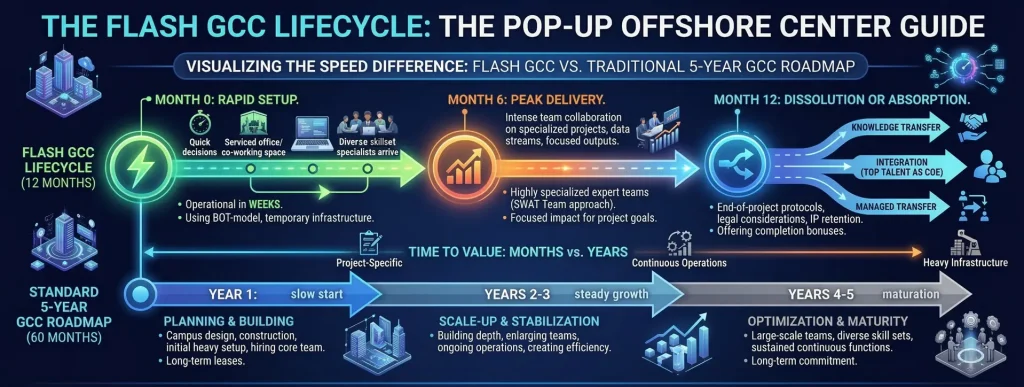
A Pop-Up Center stands apart from a conventional Global Capability Center (GCC) by providing a quick, adaptable, and short-term arrangement instead of an established, extensive operation. It includes temporary infrastructure and frequently employs a SWAT team hiring approach, emphasizing swift, specialized talent acquisition to address issues rapidly, instead of long-term, structural expansion.
Temporary vs. Permanent Infrastructure
- Pop-Up Centers: They are marked by quick setup, frequently using adaptable workspaces, co-working environments, or serviced offices to become operational in weeks instead of months. They are built to be flexible, enabling straightforward growth or closure according to project requirements.
Traditional GCCs: These consist of long-term capital in specialized, lasting, and frequently company-operated infrastructure. They are created for stability, scalability, and sustained, internal operations.
The “SWAT Team” Hiring Model
- Pop-Up Centers: Utilize a “SWAT Team” approach, which focuses on rapidly assembling highly specialized, expert teams for short-term, critical projects. This model prioritizes speed and specialized skill sets over broad, general hiring.
Traditional GCCs: Focus on long-term hiring strategies, building large-scale, sustainable teams with diverse skill sets to support ongoing business functions and continuous operations.
When should you deploy a Flash GCC?
The decision to go Flash should be driven by urgency and the nature of the task. It is not a replacement for a long-term global strategy, but rather a powerful tool for specific scenarios.
Y2K-Style Tech Sprints: We are currently in a Y2K-style era regarding AI and Data Privacy. If a company needs to audit 10 million data points to ensure compliance with new international regulations by a hard deadline, a Flash GCC provides the concentrated manpower to execute the sprint without bloating the permanent headcount.
Rapid Market Testing: If an enterprise wants to test a new product line in a specific region, a Flash GCC can act as a low-risk incubator. It allows the enterprise to build, test and iterate with local talent. If the product fails, the center closes with minimal friction. If it succeeds, the Flash GCC can be converted into a permanent fixture.
M&A Integration: When two multi-billion-dollar entities merge, the technical and operational plumbing is often a nightmare. A Flash GCC can be deployed specifically to harmonize data sets, merge legacy IT systems and standardize HR protocols across the continents. Once two companies become one successfully, the Flash GCC has fulfilled its purpose.
What is the Exit Strategy for a Temporary Center?
The exit strategy is just as important as the launch. Because these centers are designed to be temporary, a lack of clear sunsetting protocols can lead to legal complications and loss of Intellectual Property (IP). A successful exit typically follows one of these paths:
Knowledge Transfer: The most common exit. As the project nears completion, the Flash GCC team meticulously documents all processes and hands the keys back to the core team at the headquarters. The temporary staff is offboarded and the infrastructure is decommissioned.
Integration: If the Flash GCC uncovers incredible value, the enterprise may choose to absorb the top 10% of the talent into their permanent remote workforce, effectively turning a pop-up into a decentralized COE.
Managed Transfer: If the center was built using a BOT model, the enterprise may choose to let the partner take the operations to service other clients, while the enterprise retains the intellectual property created during the sprint.
To maintain a positive brand reputation, a Flash GCC must prioritize transparency. From Day 1, employees should understand the project-based nature of their roles. Offering completion bonuses or transition assistance ensures that the team stays motivated until the final day of the operation.
Summary
The Flash GCC represents a shift toward a more modular version of the modern enterprise. In an era where business needs may change in a single quarter, the ability to pop up a COE, execute a mission, and dissolve it gracefully is a massive competitive advantage. It is not just about saving costs but the speed of thought being matched by the speed of execution. By embracing the Flash GCC model, forward-thinking organizations can stay lean and tackle the world’s most complex challenges with the precision of a specialist and the speed of a start-up.