
Boomerang Strategy: Why Your Ex-Employees Are Your Best Hires
The race for skilled talent is growing each year. Yet many organizations overlook a powerful, familiar source – former employees. These employees already understand your culture, systems, and expectations. Re-engaging them can reduce hiring risks and speed up impact. It is no wonder that this aptly named boomerang hiring trend is becoming more popular.
Boomerang employees now account for 35% of all new hires, as per the latest market research. Boomerang hiring brings back professionals with new skills and a broader perspective. These employees return with confidence, clarity, and proven alignment with their roles and responsibilities.
This shortens onboarding time and strengthens team performance. It also lowers recruitment costs while improving long-term retention. Trusted talent can support global mandates and innovation goals. Reconnecting with alumni is not nostalgic – it is a smart, future-ready hiring advantage. For Global Capability Center (GCC) leaders, this strategy offers both stability and agility.
Why Boomerang Employees are Valuable for GCCs
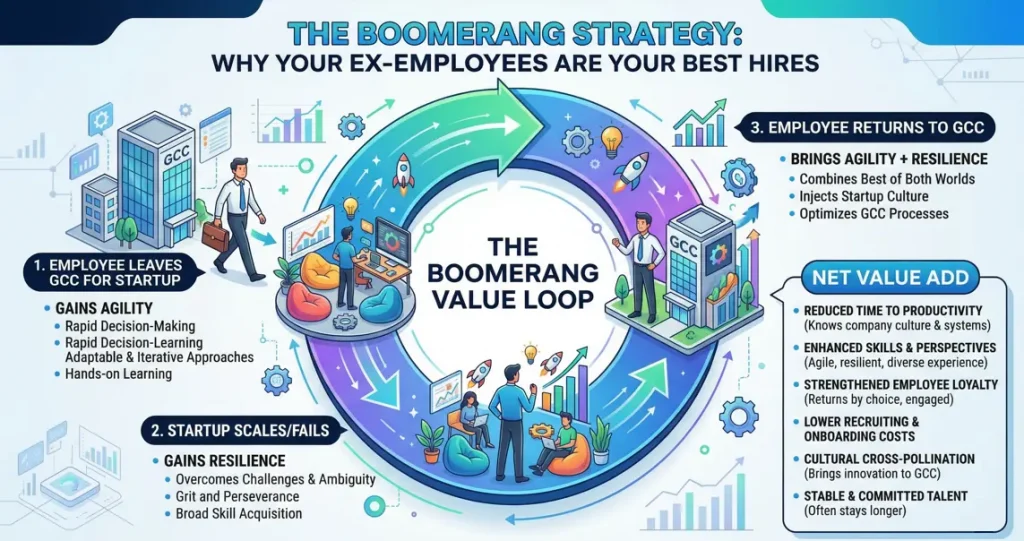
Boomerang employees bring familiarity and a fresh perspective to Global Capability Centers. On one hand, they understand existing processes and on the other, they return with new skills gained from external environments. This combination enables GCCs to scale capabilities faster while maintaining stability and performance.
The advantages of hiring with this approach include:
- Faster Onboarding and Early Productivity: Returning employees contribute quickly because they already understand core processes and workflows
- Lower Recruitment Costs and Reduced Hiring Risk: Rehiring proven talent lowers sourcing and training costs while reducing hiring uncertainty
- Strong Cultural Alignment and Continuity: Boomerang professionals strengthen team cohesion by bringing cultural familiarity and preserving institutional knowledge
- Fresh External Insights and Professional Networks: Time away equips them with new ideas, tools, and industry connections that add strategic value
- Higher Retention, Loyalty, and Leadership Potential: Returnees often show stronger commitment and grow into mentors or future leaders
- Seamless Support for Global Scale and Innovation: Their experience and trust enable GCCs to execute global strategies with speed and confidence
- Improved Employer Brand and Alumni Advocacy: Welcoming employees back enhances employer reputation and encourages alumni advocacy
- Greater Workforce Stability During Expansion: Boomerang hires provide dependable continuity that supports productivity during rapid growth
What Skills Do Alumni Bring Back from Startups?
Alumni returning from startup environments bring agility, innovation, and hands-on problem-solving skills. They combine entrepreneurial thinking with an understanding of your GCC culture and systems.
This helps boomerang hires accelerate transformation, productivity, and long-term value creation. Some standout advantages include:
- ‘Founder Mindset’ Injection: Startup experience builds resilience, accountability, and a bias for action. Returning alumni bring ownership and thinking that drive faster execution. It boosts smarter risk-taking and outcome-focused leadership within GCC teams.
- Zero Onboarding Time: Boomerang employees already understand internal systems, culture, and stakeholder expectations. This familiarity enables immediate productivity, smooth reintegration, and quicker contributions to critical global initiatives.
- Innovation and Fresh Problem-Solving: Alumni gain experience experimenting with new ideas, tools, and business models. They reintroduce this creative thinking to modernize processes and spark continuous improvement.
- Cross-Functional Collaboration: Startup roles often require working across multiple functions and priorities. This helps boomerang hires integrate teams, improve communication, and execute complex initiatives.
- Advanced Technical and Digital Capabilities: Many startups operate with cutting-edge technologies and lean systems. Alumni bring updated technical skills that strengthen digital transformation and operational efficiency.
- Stronger Networks and Industry Exposure: Time away expands professional connections and ecosystem understanding. These relationships can open partnerships, talent pipelines, and new growth opportunities.
- Higher Maturity, Confidence, and Leadership Readiness: External experience sharpens judgment and decision-making ability. Returning professionals step into mentoring or leadership roles that strengthen long-term capability.
How Do You Structure a ‘Returnship’ Program?
A structured program helps GCCs reconnect with employees through a clear pathway. It supports skill renewal, confident reintegration, and faster contributions to business goals. When aligned with boomerang hiring, returnships become a powerful tool. They are effective for long-term talent retention and growth. Here are some steps you can follow:
- Involve returnees in meaningful projects right away and encourage them to share what they’ve learned
- Show that former employees are genuinely welcome by scheduling meet-ups and introductions
- Set up a simple, time-bound program so expectations and goals are clear for everyone
- Understand each person’s strengths, gaps, and career aspirations before they rejoin
- Support them with updated onboarding, practical training, and steady mentoring
- Keep relationships warm by staying regularly connected with alumni
- Provide flexible work options and assess returnees fairly
- Track retention, performance, and overall experience to see what’s working
- Pair short-term contributions with clear long-term growth paths
- Approach reintegration with empathy and create a safe, supportive environment
Cultural Reintegration: Avoiding Friction
Cultural reintegration in rehiring can sometimes trigger subtle “I told you so” friction within teams. Resentment may arise if colleagues previously covered workloads or questioned the departure. They may perceive the returnee’s higher pay as unfair. Unresolved workplace issues during the employee’s absence can further intensify misalignment.
To avoid this, GCC HRs should communicate transparently about the rehiring decision. They must clarify the value the returnee brings and ensure fair, consistent treatment across the team from the outset. Preventing friction also requires structured and empathetic reintegration.
This demonstrates that growth outside the company is respected. It shows that returning talent is welcomed for the value they create now, not judged for past choices. This balanced approach reinforces culture and improves retention. It also turns boomerang hiring into a unifying rather than divisive force.
To make boomerang hiring truly work, GCCs need more than intent—they need the right structure and long-term vision. ANSR works closely with global enterprises to build and scale Global Capability Centers that are designed for sustainable growth.
By aligning talent strategy, workforce planning, and operating models, ANSR helps organizations create environments where returning alumni can thrive, and where hiring decisions translate into lasting impact, innovation, and cultural strength. Schedule a call with us to see how we can help you hire strategically.