
Rethinking GCCs: A CFO’s Lens on Value Beyond Cost
Summary
GCCs must prove “perfect ROI” by driving enterprise value – not just cost savings
CFOs now evaluate GCCs as strategic investments, focusing on timelines, payback, and ROI, ensuring each center delivers measurable, long-term value.
The GCC model has evolved from cost arbitrage to value arbitrage, operating as AI, R&D, and product innovation hubs that directly impact growth and competitiveness.
True value is transformational, not incremental – GCCs are expected to accelerate time-to-market, enable new capabilities, and drive innovation-led outcomes.
A value-centric governance model (covering financial returns, agility, innovation, and strategic impact) prevents GCCs from slipping into cost-center roles.
Recommendation: Design GCCs with a value-first mindset – anchor investments in innovation, measurable business impact, and long-term ROI to ensure they evolve into sustained enterprise value engines.
CFOs as co‑pilots in GCC strategy
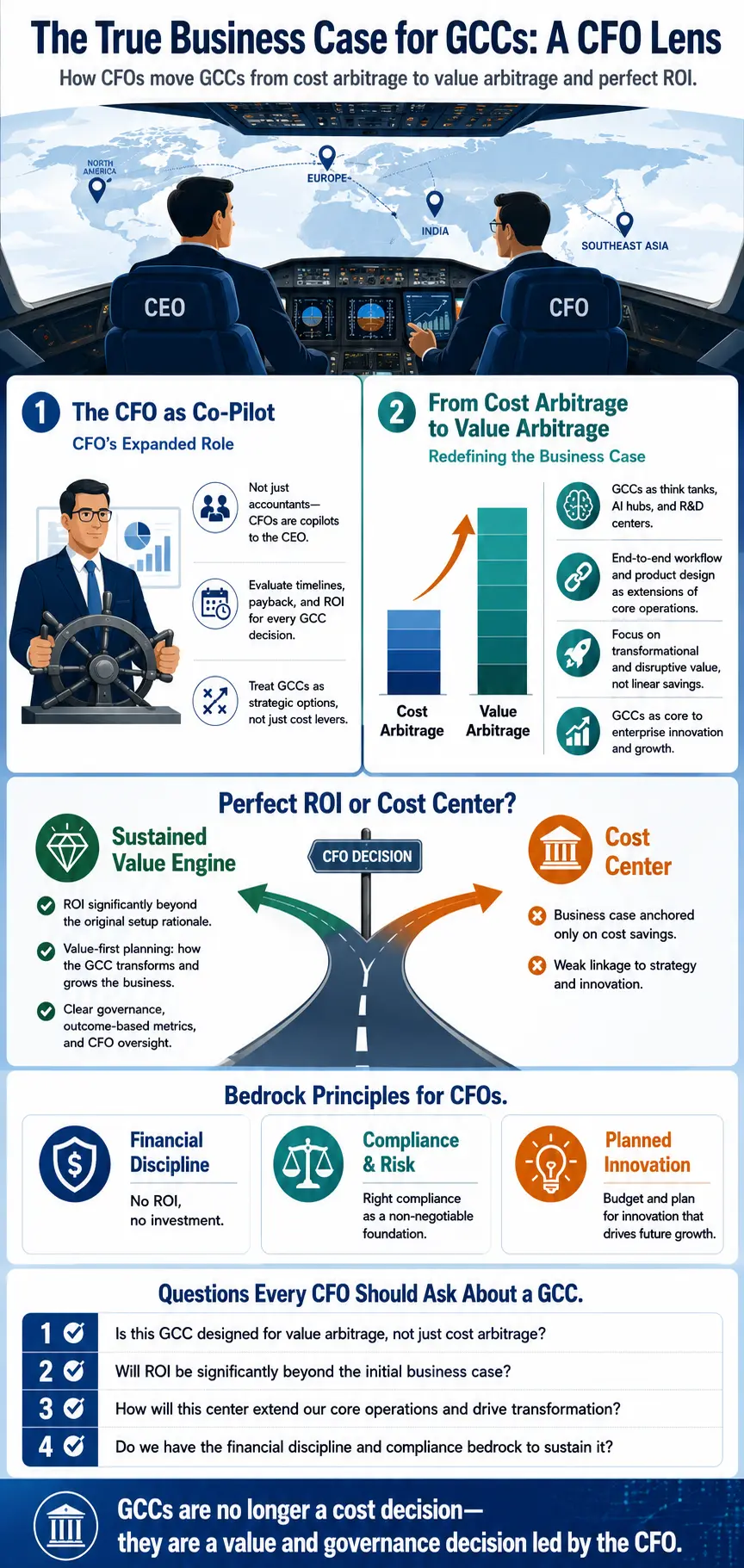
In modern leadership teams, the CFO operates as a co‑pilot to the CEO, not a back-office accountant. Every significant decision carries financial implications, so CFOs are embedded in choices around GCC location, scope, and evolution.
From this vantage point, GCCs are assessed against three core questions: expected timelines, payback period, and return on investment. A GCC is considered a viable option only when it can withstand this scrutiny and demonstrate a credible path to superior value creation.
GCCs beyond cost arbitrage
From back office to think tank
The original model of GCCs, built largely on labor and location arbitrage, is now insufficient. Contemporary GCCs function as think tanks, AI hubs, and R&D centers, with business engineering, end‑to‑end workflow design, and product design capabilities consolidated under one roof.
In this construct, the GCC behaves as an extension of core operations, not as a peripheral support unit. The financial logic shifts from cost arbitrage to value arbitrage, how the center elevates enterprise value in meaningful, measurable ways.
Transformational and disruptive impact
Value arbitrage assumes that GCC-driven improvements are not linear. Instead, they are expected to be transformational and disruptive. Examples include launching AI-powered products, compressing time‑to‑market, or creating new data and analytics capabilities that redefine decision-making.
Under this model, the GCC business case is anchored in growth, resilience, and innovation, with cost savings treated as a hygiene factor rather than the core story.
Perfect ROI and sustained value
ROI significantly beyond the setup rationale
A GCC or any function is deemed to create value only when there is a “perfect ROI.” This implies that returns must be significantly beyond the original rationale for setting it up, not merely in line with initial projections.
Planning therefore starts with value outcomes: how the GCC will transform the organization and support growth over time. This orientation is what determines whether a center matures into a value engine or slips into a cost-center label.
Governance and metrics that prevent the cost‑center trap
To avoid this trap, financial and governance decisions must align around a value-centric scorecard. Typical dimensions include:
- Multi-year financial returns versus the initial business case.
- Speed and agility improvements in delivery and time‑to‑market.
- Innovation and IP outputs (features, patents, AI use cases).
- Strategic impact on revenue, risk, and market access.
Such a governance frame keeps the GCC accountable for outcomes rather than activity.
Financial discipline, compliance, and innovation
Discipline and compliance as non‑negotiables
Financial discipline and ROI form the bedrock of every major GCC decision. If a proposed investment does not show a clear path to return, it should not proceed. In parallel, every initiative must sit on strong compliance and risk foundations, particularly given cross-border and regulatory complexity.
These principles ensure that growth and innovation are not pursued at the expense of control, governance, or long-term stability.
Planning innovation into the GCC lifecycle
Robust GCC planning always includes a forward-looking innovation agenda. Investments in talent, technology, and new capabilities are assessed for how they will help the organization grow in the future.
This requires budgeting beyond setup and BAU for continuous capability building – especially in AI, data, and product domains – while keeping ROI expectations explicit and trackable. In practice, this is how GCCs evolve from cost-focused constructs into enduring value engines.