
The ‘Middle Management’ Crisis: Saving the Layer That Matters
Summary
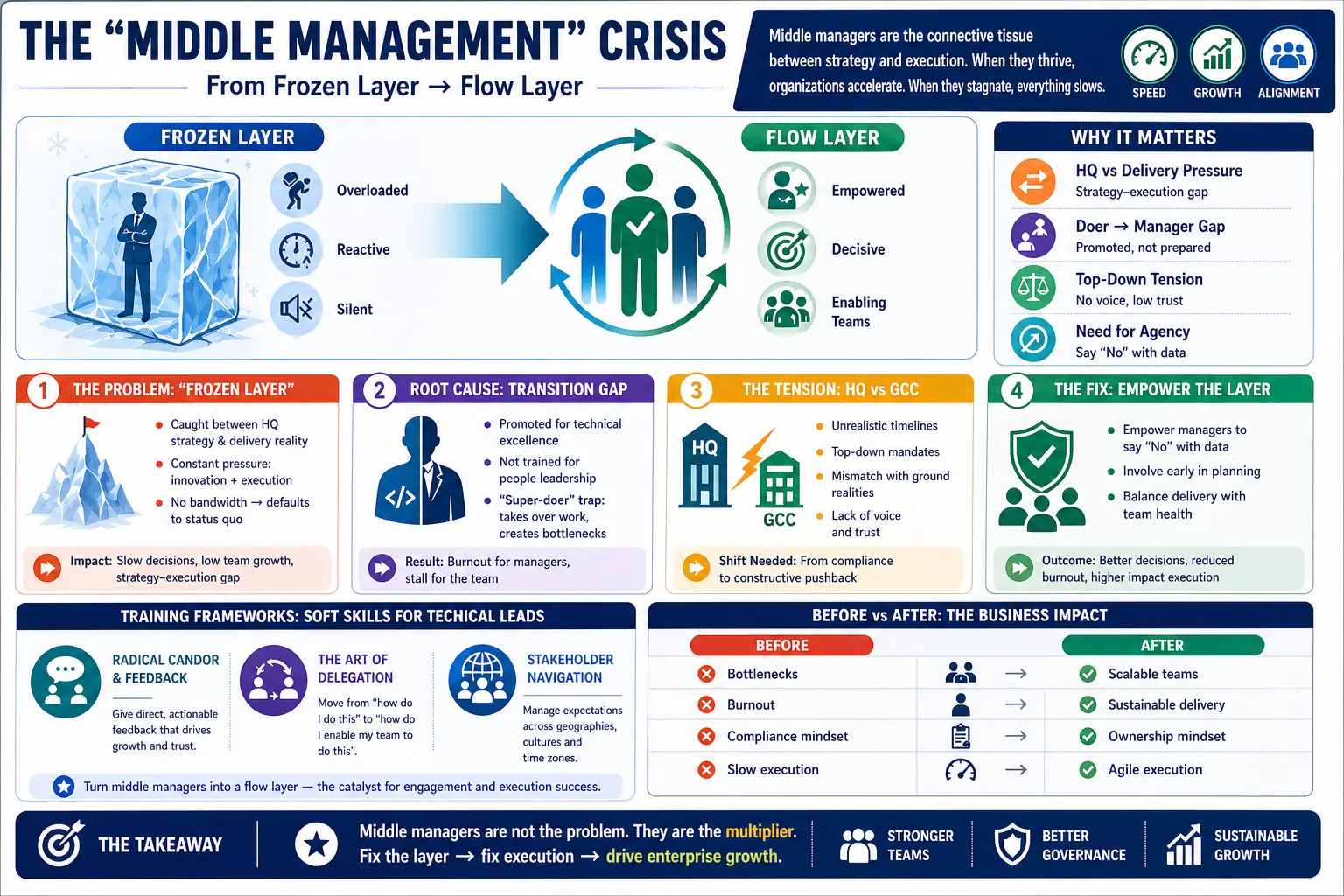
Middle management in GCCs is mislabelled as a “frozen layer,” when in reality it is an overstretched buffer between HQ’s push for transformation and the daily grind of talent, delivery, and attrition.
The biggest fault line is the unstructured leap from star individual contributor to people manager, which pushes technical experts into “super‑contributor” mode and creates burnout, bottlenecks, and disengaged teams.
Empowering managers to say “no” to misaligned asks from HQ—backed by data, realistic capacity views, and psychological safety—turns them from passive routers into active co‑owners of strategy and execution.
Targeted soft‑skills frameworks across radical candor, structured delegation, and multi‑stakeholder navigation are essential to “thaw” the middle, turning it into a flow layer that drives engagement, retention, and on‑ground success of global strategy.
Recommendation: Treat middle management as a strategic asset—redesign career paths, give them real decision rights with HQ, and invest in practical leadership training so this layer becomes your strongest engine for transformation instead of an accidental choke point.
The global corporate landscape is witnessing a quiet but profound shift within Global Capability Centers (GCCs). While executive leaders outline grand visions and frontline teams execute technical tasks, the connective tissue holding these worlds together is fraying. Often dismissed as the frozen layer, middle management is the high-pressure engine room of the modern enterprise. When this layer thrives, the organization accelerates. When it stagnates, the entire strategy grinds to a halt. Saving this vital demographic is not just a human resources initiative but a strategic necessity for long term growth.
Why is Middle Management the “Frozen Layer” in GCCs?
The term frozen layer has long been used to describe a level of management that seems resistant to change or slow to pass down communication. However, this perspective is often an unfair characterization of a group caught between two massive tectonic plates. On one side, there is the relentless push for innovation and agility from headquarters. On the other, there is the daily reality of managing talent, attrition, and operational delivery.
The layer becomes frozen not because of a lack of will but because of a lack of bandwidth. Middle managers in GCCs often find themselves acting as a human shock absorber. They translate complex global strategies into local action while simultaneously shielding their teams from corporate volatility. Without the right support, these managers default to a survivalist mindset where they focus purely on maintaining the status quo rather than driving the transformation that HQ expects. To unfreeze this layer, companies must invest in GCC leadership development and cultural innovation so that middle managers become the primary drivers of cultural and operational excellence.
The “Doer to Manager” Transition Gap in Technical Teams
The most common path to management in a technical GCC is through individual excellence. A brilliant coder or a stellar data scientist is promoted because they are the best doer on the team. Yet the skills that make someone a world class engineer are diametrically opposed to the skills required to lead people. This transition gap is where many GCCs lose their best talent and stifle their management pipeline.
When a technical expert becomes a manager without a bridge, they often fall into the trap of super-contributing. Instead of coaching their team, they take over difficult tasks because it is faster and more comfortable than delegating. This creates a bottleneck where the manager is overworked and the team feels micromanaged or underdeveloped. Addressing this gap requires a fundamental shift in identity. Organizations must provide clear pathways that celebrate management as a distinct craft, separate from technical execution. Success is no longer measured by the quality of the code the manager writes but by the collective output and growth of the people they lead.
How do you empower managers to say “No” to HQ?
One of the greatest tensions in a GCC is the power dynamic between the global headquarters and the local management layer. For a GCC to evolve from a cost center to a value center, its managers must have the agency to challenge unrealistic timelines or misaligned strategies. Empowering a manager to say no is about teaching them how to say yes to the right priorities.
True empowerment comes from data and trust. When middle managers have a seat at the table during the planning phases, they can provide the ground level reality that HQ might miss. If a global product launch ignores local talent constraints or time zone realities, the middle manager must feel safe enough to flag those risks. This psychological safety is cultivated when senior leadership rewards transparency over blind compliance. By encouraging managers to voice concerns, the organization prevents burnout and ensures that the projects that do move forward are feasible and high impact. It transforms the relationship from a top-down mandate to a collaborative partnership.
Training Frameworks: Soft Skills for Technical Leads
The solution to the middle management crisis lies in a deliberate and modern approach to training. For technical leads, soft skills are often the hardest skills to master. The focus must shift from theoretical leadership to practical, everyday frameworks that can be applied in a high-pressure environment. Effective training frameworks for GCC managers should focus on three core pillars:
- Radical Candor and Feedback: Technical teams thrive on precision. Managers need the tools to give direct, actionable feedback that helps individuals grow without damaging the relationship.
- The Art of Delegation: Moving from ‘how do I do this’ to ‘how do I enable my team to do this’ requires a structured approach to trust and verification.
- Stakeholder Navigation: GCC managers often report to multiple bosses across different geographies. Training must include the political intelligence needed to manage expectations across diverse cultures and time zones.
By investing in these areas, companies turn their middle management into a flow layer instead of a frozen layer. This group becomes the primary catalyst for employee engagement and the most reliable predictor of whether a global strategy will succeed on the ground. When the middle layer is empowered, the entire organization regains its agility and its heart.