
The Spin-Off: When Your GCC Becomes a Vendor
Summary
-
As GCCs mature, some reach a point where their processes, platforms, and domain expertise are strong enough to sell externally, shifting from a cost-center mindset to a profit-center, product-led culture.
-
Commercializing a captive unit brings powerful upsides—net-new revenue on existing infrastructure, faster recovery of GCC investments, objective market validation, and a stronger talent brand and ownership culture.
-
The risks are real: internal priorities can be diluted, top talent may be pulled toward paying clients, and the parent can suffer if governance, capacity ring‑fencing, and account‑tiering aren’t explicitly designed.
-
Before taking an “internal tool” or service to market, enterprises must strip out tribal knowledge, decouple from legacy systems, harden security and documentation, and solve complex IP and competition questions—especially when serving industry rivals.
Recommendation: Treat a spin‑off as a late‑stage evolution, not a quick win—only commercialize once your GCC has market-grade product, clear legal/IP guardrails, and a governance model that protects HQ’s priorities while unlocking a credible, scalable external revenue stream.
For years, Global Capability Centers were optimized for efficiency. They reduced costs, streamlined operations, and quietly strengthened the enterprise from within. But a fundamental shift is underway. Across industries, forward-looking CXOs are beginning to view their GCCs not merely as delivery arms, but as monetizable assets capable of creating independent market value.
When a Global Capability Center (GCC) matures enough to offer its specialized expertise to external clients, it crosses a strategic threshold. It moves from being a cost center to becoming a revenue contributor. It evolves from supporting the enterprise to competing in the marketplace. This transformation is not accidental. It reflects disciplined capability building, leadership maturity, intellectual property development, and operational excellence at global scale. For global leaders navigating margin pressure, innovation mandates, and shareholder expectations, this evolution presents a powerful question:
Is your GCC just optimizing costs, or is it ready to unlock new enterprise value?
The Ultimate Maturity Level: Becoming a Profit Center
The lifecycle of a GCC typically begins with a focus on arbitrage and operational efficiency. Over time, these centers build deep domain expertise, proprietary technology stacks, and highly refined processes. When a GCC reaches the ultimate maturity level as a modular, sellable GCC, it no longer simply consumes the parent company’s budget. Instead, it begins to generate its own income. Becoming a profit center is the crowning achievement for a leadership team within a captive unit. It signifies that the internal team has developed a product or service so superior that outside organizations are willing to pay for it. This shift changes the internal culture from a service-oriented mindset to a product-led growth mindset. It elevates the GCC from a line item on the expense sheet to a strategic asset that contributes directly to the enterprise’s bottom line. In this stage, the center is not just following a roadmap provided by headquarters but is actively creating a roadmap that influences the entire industry.
Pros and Cons of Commercializing your Captive Center
Turning an internal division into a market-facing vendor is a high-stakes move that requires a balanced view of the potential outcomes. While the allure of new revenue is strong, the organizational shifts required can be jarring.
Pro: Revenue generation and value validation
- New Revenue Stream Without New Infrastructure: Existing capabilities are monetized externally, accelerating return on the original GCC investment without significant additional capital expenditure.
- Faster Capital Recovery: Commercialization allows the parent organization to recoup setup and scale costs far more quickly than relying solely on internal utilization.
- Objective Market Validation: A signed third-party contract serves as an external stamp of approval. It proves that the GCC’s tools, processes, and expertise are competitive in the open market, not just internally acceptable.
- Shift from Cost Center to Value Creator: The GCC transitions from being measured on efficiency alone to being evaluated on market performance, innovation, and growth contribution.
- Stronger Employer Brand: External recognition enhances the GCC’s positioning as a market leader, making it more attractive to high calibre talent.
- Higher Employee Morale and Ownership: Teams gain confidence and pride when their work is validated by paying clients, fostering a stronger performance culture.
Con: Loss of focus on HQ needs
- Priority Dilution: As external clients come onboard, the parent organization risks becoming just another account instead of the primary stakeholder.
- Competing Deadlines and Expectations: External customers introduce new delivery timelines, custom requirements, and performance pressures that can strain internal capacity.
- Talent Reallocation Risk: High performing engineers and managers may be diverted to high revenue external engagements, leaving core internal initiatives under resourced.
- Impact on Headquarters Delivery: Slower turnaround times or reduced focus on strategic internal projects can erode trust between the GCC and corporate leadership.
- Mission Drift: Without strong governance, the GCC may gradually shift away from its founding purpose in pursuit of external growth.
- Need for Clear Governance and Guardrails: A successful dual service model requires explicit prioritization frameworks, ring fenced capacity, and executive oversight to protect the parent organization’s interests.
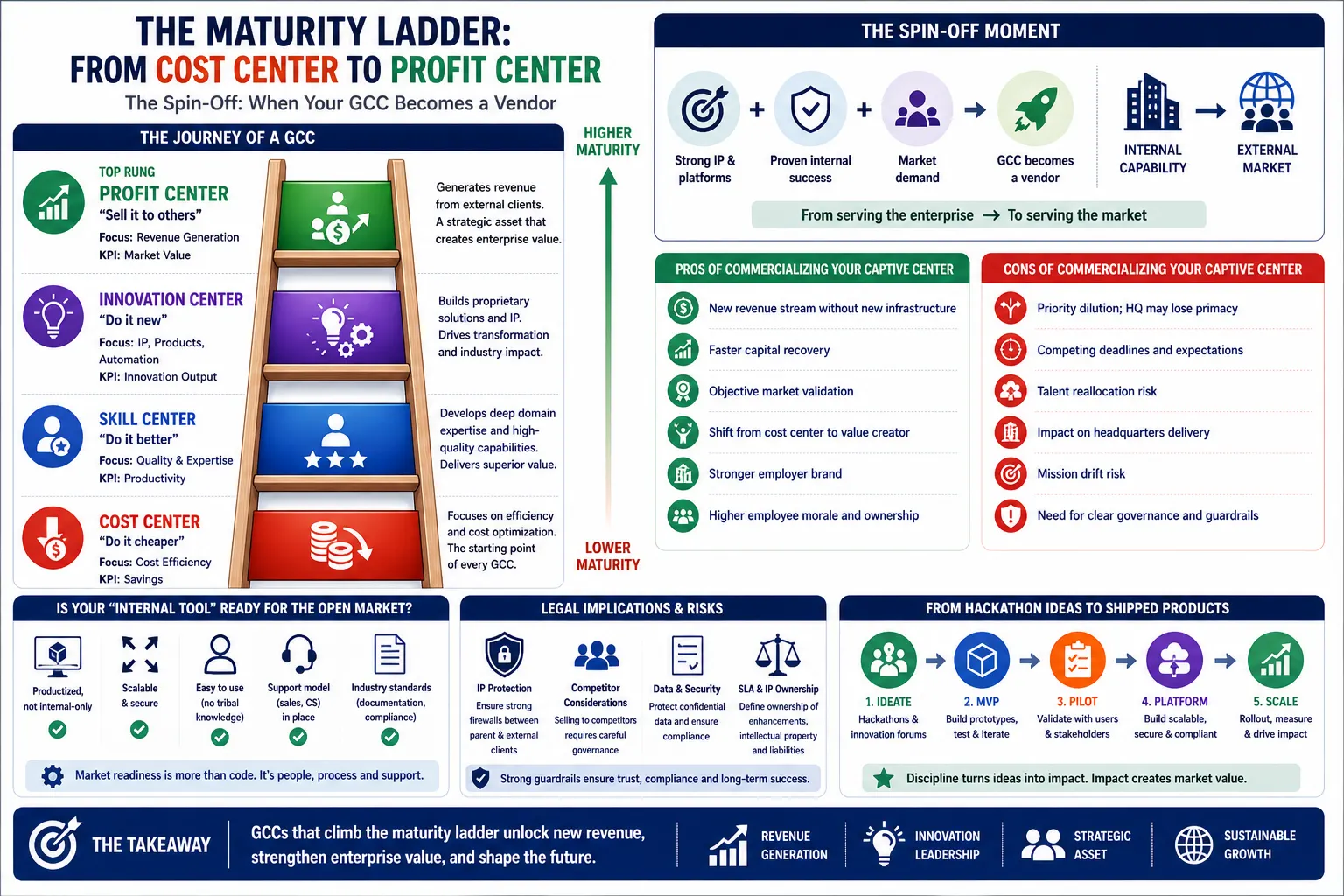
Is your “Internal Tool” ready for the open market?
Before a company decides to package its internal software or services for sale, it must perform a rigorous audit of the offering. An internal tool is often built with a series of tribal knowledge assumptions. It might work perfectly because everyone in the company knows the specific workarounds or because it integrates with a very specific, aging database that only the parent company uses.
To be market-ready, the tool must be decoupled from the parent company’s unique infrastructure. It needs a user interface that is intuitive for someone who has never stepped foot in your office. Furthermore, it must meet industry standards for security, documentation, and scalability. Many companies find that the last mile of turning an internal tool into a commercial product takes more effort than building the tool itself. The question of readiness is not just about whether the code works but whether the support structure, such as sales teams and customer success managers, is in place to handle a diverse client base.
Legal implications of selling services to competitors
Perhaps the most complex hurdle in the spin-off journey is the legal and competitive landscape. When a GCC goes to market, its most likely customers are often the parent company’s direct competitors. This creates a fascinating but perilous situation regarding Intellectual Property (IP). Companies must establish ironclad firewalls to ensure that proprietary data from the parent company does not leak into the services provided to a rival. There are also antitrust considerations and non-compete clauses to navigate. Legal teams must draft complex Service Level Agreements (SLAs) that define who owns the enhancements made to the software after it goes public. If a competitor requests a new feature that would benefit the parent company, who owns that specific piece of code? Additionally, the parent company must be comfortable with the idea that they are essentially arming their competition with the same tools they use to succeed. This requires a shift in perspective where the organization realizes that its true competitive advantage lies not just in the tool itself but in how they use it.
The journey from a captive center to a commercial vendor is a hallmark of the modern, agile enterprise. It turns cost centers into engines of innovation and ensures that the best ideas developed within a company have the chance to reach their full potential on the global stage. While the path is filled with operational and legal complexities, the rewards of building a self-sustaining, profitable entity are well worth the effort for a mature GCC.