
Building Future-Ready GCCs: Capability Clusters, Culture, and AI-First Workforce Design
Summary
Future-ready GCCs require three design shifts: capability clusters over fixed roles, global-local culture balance, and AI-driven workforce planning that treats skills as perishable assets
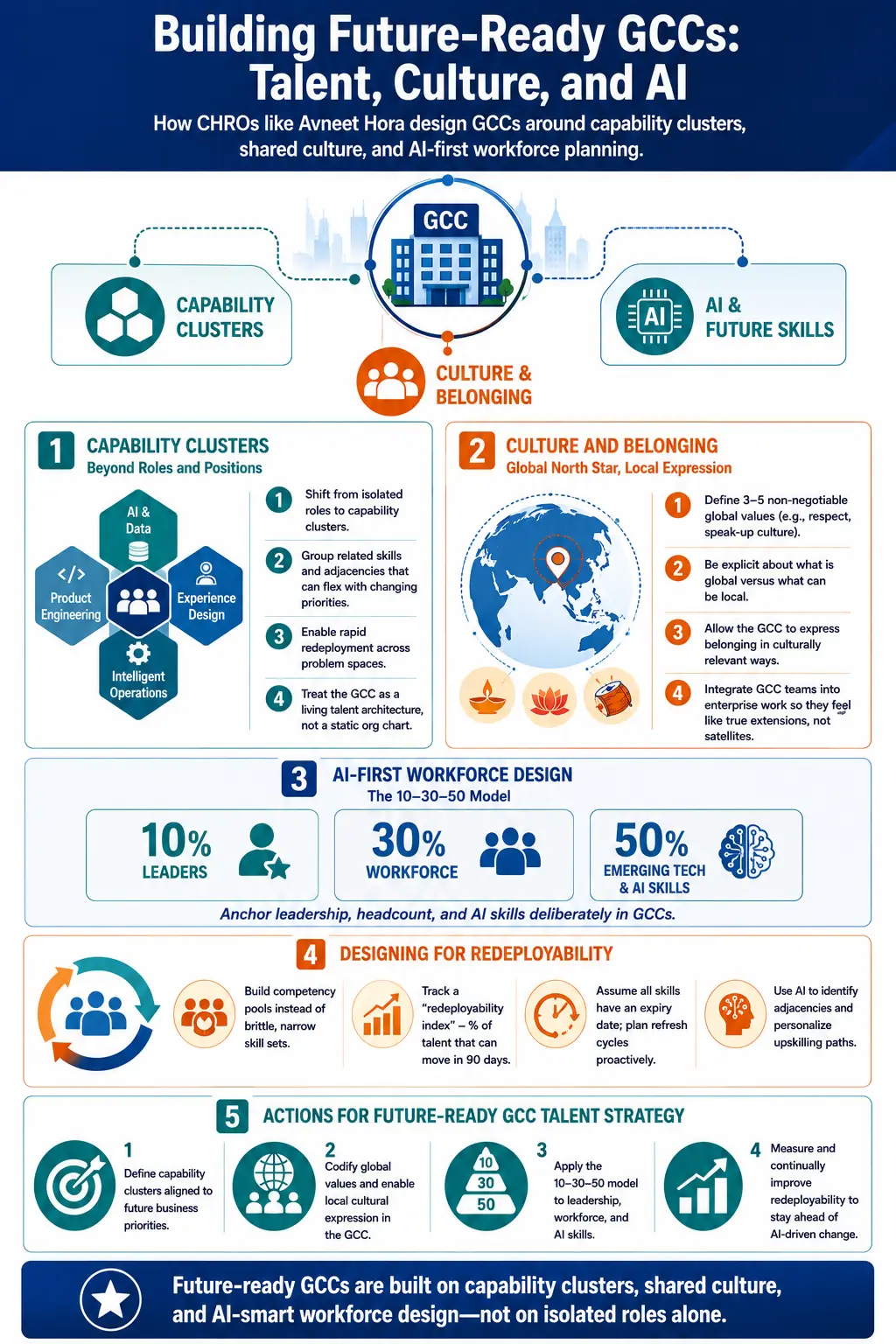
Build capability clusters, not isolated roles – coherent skill pools with learning agility that enable rapid redeployment across adjacent problem spaces, making the GCC resilient to strategic and technology shifts without constant rehiring.
Culture starts with a global North Star (3-5 non-negotiable values like respect, psychological safety, bias accountability) while empowering local expression through culturally relevant rituals and practices, positioning the GCC as a true enterprise extension, not a headquarters replica.
Apply the 10-30-50 rule: 10% of leadership roles, 30% of total workforce, and 50% of emerging AI/tech skills should sit in the GCC, ensuring centers shape strategy and own future capabilities, not just execute tasks.
Track redeployability index – the percentage of talent that can pivot to new priorities within 90 days – and use AI to identify emerging skills, map role adjacencies, and continuously refresh competencies as skill expiry accelerates.
Recommendation: Architect your GCC around adaptive competency pools tied to the 10-30-50 distribution, anchor culture globally while allowing local belonging, and embed AI-driven workforce vitality planning to stay ahead of skill obsolescence rather than reacting to it.
Avneet Hora, CHRO at ANSR, outlines a clear blueprint for making GCCs genuinely future-ready rather than just talent hubs in another time zone. Her perspective centers on designing for capability clusters, a global-local culture, and an AI-first workforce model that can continuously adapt as skills and roles evolve.
Building GCCs on capability clusters, not isolated roles
From a CHRO’s perspective, a future-ready GCC cannot be engineered by filling individual roles in isolation. The primary focus needs to shift from positions to capability clusters – coherent pools of skills and adjacencies that can flex as business needs change.
Capability clusters allow teams to pivot quickly into new mandates without rebuilding the talent base from scratch. When people share foundational competencies and learning agility, they can be redeployed across problem spaces, making the GCC resilient to shifts in strategy, technology, and demand.
Creating culture and belonging as an enterprise extension
Start with a global North Star
To build a strong culture in a GCC, the starting point is a clear global North Star. This means defining three to five non‑negotiable values and principles that must hold everywhere in the enterprise, regardless of geography. Common examples include respect, the ability to speak freely, and the expectation that people can raise concerns – especially around bias – without fear.
Being explicit about which cultural elements are global and which can be local prevents confusion and misalignment. Everyone knows what is non‑negotiable, and what can be adapted to fit local norms and practices.
Let the GCC express belonging locally
At the same time, the GCC needs permission and encouragement to express belonging in culturally relevant ways. That might include local rituals, celebrations, communication styles, or ways of recognizing people that align with local context while staying anchored to the global values.
This balance – global principles with local expression – helps the GCC feel like a true extension of the enterprise rather than a transplanted version of headquarters culture. It also strengthens identity and engagement within the center, which in turn improves retention and performance.
Rethinking workforce planning in an AI-shaped world
Applying the 10-30-50 rule
As AI reshapes roles and workflows, Hora advocates a simple but powerful 10-30-50 model for GCC workforce design:
Around 10% of leadership and strategic roles should be located in the GCC.
Roughly 30% of the organization’s overall workforce should sit in GCC locations.
Approximately 50% of emerging technology and AI skills should be built and operated from the GCC.
This distribution ensures GCCs play a central role in leadership, capacity, and future skills. The center is not just delivering work; it is shaping strategy, holding critical responsibilities, and becoming the natural home for AI and emerging technology capabilities.
Designing competency pools and measuring redeployability
In an AI-driven environment, static role descriptions age quickly. Hora emphasizes the need to act as an architect of competency pools rather than a manager of narrow skill lists. These pools are organized around broader capabilities and adjacencies, enabling people to move into new areas as technology and business needs change.
A key metric in this model is the “redeployability index”: the percentage of talent that can realistically be redeployed into a different priority area within the next 90 days. A high redeployability index signals a workforce designed for adaptability and resilience – one that can absorb AI-driven changes without constant large‑scale restructuring.
Planning for skill expiry and using AI to stay vital
Underlying this approach is the recognition that all skills have an expiry date. The half-life of many technical and functional skills is shrinking, especially in AI-intensive domains. Future-ready GCCs plan ahead for this reality rather than reacting when skills are already obsolete.
AI itself becomes part of the answer. It can help identify emerging skills, map adjacencies between roles, and support ongoing upskilling programs that keep the workforce “vital.” Used thoughtfully, AI doesn’t just automate work; it helps maintain the health and relevance of the talent base by continuously refreshing capabilities.