
FinOps for Australian Mid-Market GCCs: Running a 90-Day Cost Audit In-House
Summary
A 90-day cost audit helps Australian mid‑market GCCs turn AI and cloud cost pressure into board-ready savings and margin improvement
Standard reviews miss key leakages across seven categories: misallocated shared services, mis-tiered storage, oversized databases, inter‑region traffic and egress fees, software licences tied to cloud workloads, idle/orphaned resources, and fast-growing AI/ML GPU and inference spend.
Vendor-spend anomaly hunting-using live alerts against historical baselines-catches sudden spikes from AI workloads, API surges, or duplicate subscriptions early, adding a crucial layer of financial oversight and strengthening FinOps discipline.
Hybrid work has made underused offices a hidden cost centre; comparing actual occupancy (often only 40-60%) to long-term lease commitments exposes opportunities to rightsize space and lower per-workstation costs.
Shadow IT can represent 30-40% of total tech spend through unmanaged SaaS, duplicate tools, unused licences, and decentralised purchases, inflating costs and complicating security and compliance.
Recommendation: Run a focused 90-day cost audit across cloud, real estate, and shadow IT, and present quantified, owner-assigned, time-bound savings initiatives that survive board scrutiny – leveraging specialist partners like ANSR to turn insights into measurable margin uplift.
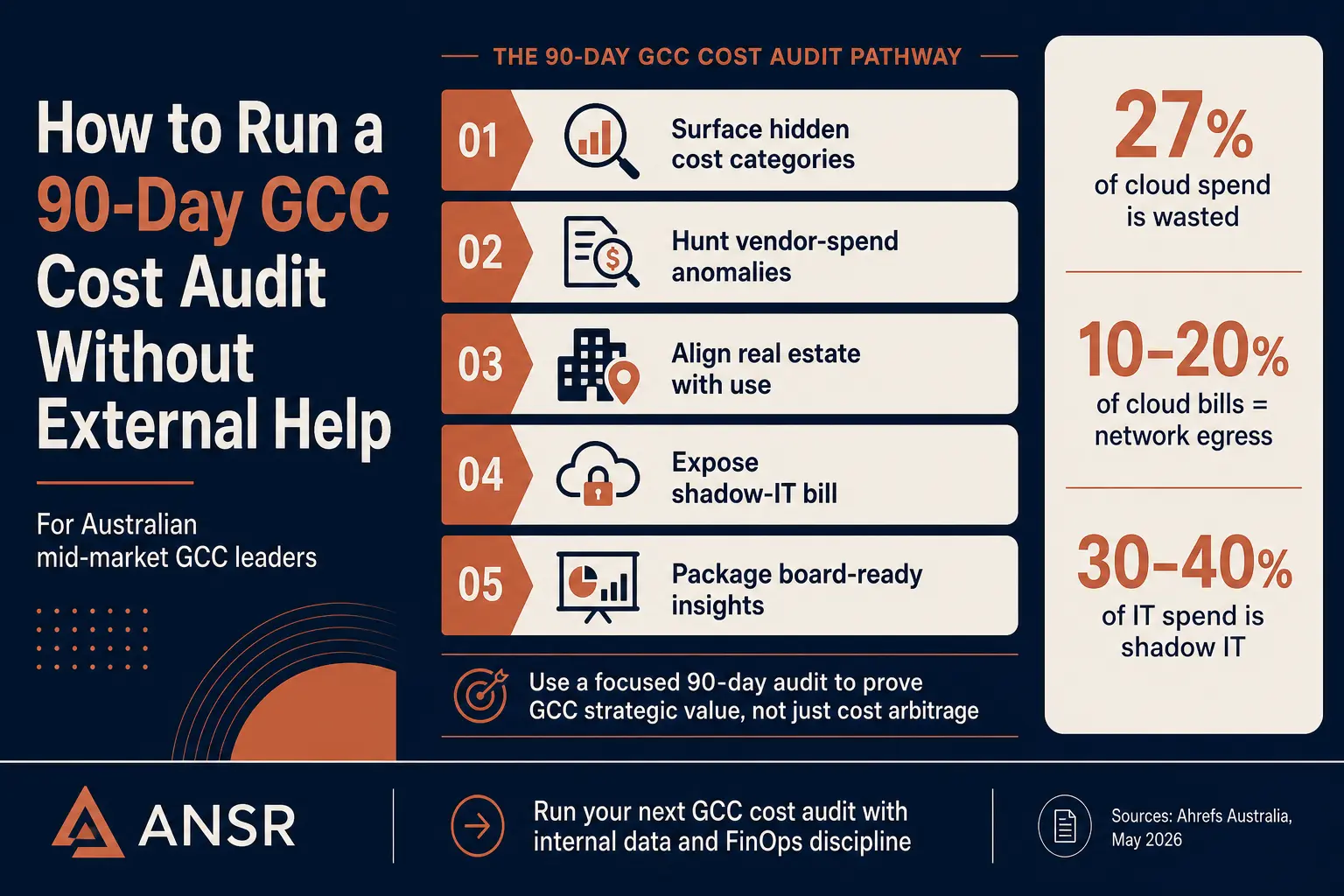
As Australian mid-market GCCs scale AI and cloud adoption in 2026, mounting operational expenses and margin pressure require precise cost tracking. Rising costs for AI, analytics, and cybersecurity talent can squeeze margins, and GCCs are now expected to deliver innovation, not just cost arbitrage. A 90-day cost audit can help determine if a GCC has strategic value by looking at five levers going from identifying hidden cost categories to actionable board-ready insights.
Seven Cost Categories Most Reviews Skip
The biggest cloud cost leaks rarely come from obvious overspend. They hide in categories that standard monthly reviews either aggregate, misallocate, or overlook. Network egress charges alone can account for 10–20% of cloud bills, yet many organizations review them only at a summary level.
The first blind spot is allocation drift from untagged or shared services, which obscures ownership and accountability. Storage tier mismanagement is another common issue, with inactive data left in premium tiers long after it is needed. Database costs often rise through oversized instances and inefficient queries, while inter-region traffic and data egress fees accumulate in the background.
Many reviews also miss software licensing costs attached to cloud workloads, along with idle snapshots, orphaned volumes, and other unused resources that continue generating charges. A newer category is AI and ML spending, where GPU consumption and inference workloads can scale rapidly without clear controls. Effective FinOps practices bring these costs into view before they become recurring issues.
Vendor-Spend Anomaly Hunting
Vendor spend spikes can erase months of optimization efforts. By the time they appear in a monthly review, the damage is often done. For instance, studies estimate that roughly 27% of cloud spending is wasted. Anomaly detection is thus an essential tool for identifying unusual cost patterns before they escalate.
Vendor-spend anomalies often originate from activities that routine reporting overlooks. A sudden increase in API usage, an expanded AI workload, or a duplicate subscription can drive costs higher within days. Buried within overall cloud consumption, these costs often go unnoticed until invoices arrive. Anomaly detection tools compare ongoing spending against historical baselines to flag deviations live. Rather than relying on manual reviews, teams receive alerts when spending deviates from expected patterns. This enables faster root-cause analysis.
For mid-market GCCs, vendor-spend anomaly hunting creates an additional layer of financial oversight. By identifying unusual spending early, teams can respond quickly, improve budget predictability, and strengthen FinOps governance. This helps prevent isolated incidents from turning into recurring cost overruns.
Real-Estate Utilization Vs. Lease Commitment
Many organizations are paying for twice the office space they use. In hybrid work environments, average daily office utilization often ranges from 40% to 60%. That leaves a significant gap between occupied space and leased capacity. This mismatch has become a hidden cost center for mid-market GCCs. Headcount may remain stable or grow, but office attendance often does not. As a result, many offices are larger than current usage requires.
Organizations continue to carry lease obligations based on pre-hybrid assumptions. Meanwhile, large portions of workspaces remain unused. The financial impact extends beyond rent. Occupancy costs typically include utilities, maintenance, security, cleaning, fit-outs, and other building-related expenses. These costs continue regardless of whether desks are occupied. This, in turn, increases the effective cost of each workstation when utilization remains low.
The key metric to consider here is not total square footage. It is the relationship between actual occupancy and long-term lease commitments. By comparing utilization data with leased capacity, GCC leaders can identify whether real-estate costs reflect current operating realities. With a clearer view of workplace efficiency, there is an opportunity to align space commitments with actual office usage.
Shadow-IT Bill (It’s Bigger Than You Think)
The technology spend one can see is often only part of the total bill. Studies suggest shadow IT can account for 30–40% of overall IT spending. This ends up creating a substantial layer of costs that sit outside formal budgets and procurement processes. Most of this spending accumulates gradually.
A department purchases a SaaS tool without involving IT. A team signs up for an AI platform using a corporate card. Employees adopt collaboration, analytics, or automation tools to solve immediate business problems. Individually, these purchases may appear insignificant, but they can add up to thousands of dollars in recurring monthly costs. The hidden bill extends beyond software subscriptions.
Organizations often pay for duplicate tools that serve similar functions. Many also maintain unused licenses. Fragmented technology stacks add integration and management costs. These expenses rarely appear in a single report. As technology purchasing becomes more decentralized, security, compliance, and data management costs continue to rise. This widens the gap between visible IT spending and actual technology expenditure. As a result, shadow IT becomes a larger financial issue than many GCC leaders assume.
Surface Findings That Survive Board Review
Recommendations without measurable business impact rarely survive board review. Mature cost optimization programs can achieve 15% or more in savings. But those results gain traction only when they are backed by clear evidence and financial outcomes.
Present FinOps findings using allocated spend data, before-and-after metrics, and forward-looking forecasts. The key is to avoid relying on standalone cost-cutting targets. For example, a rightsizing initiative should show current spend, projected savings, implementation timelines, and ownership. Likewise, FinOps team can quantify savings from anomaly detection or lease optimization. By linking them to budget performance or margin impact, evaluating outcome-based pricing models tied to measurable business results becomes easier.
The goal is to move beyond technical observations and present decision-ready insights. When savings opportunities are tied to business outcomes, assigned owners, and realistic delivery timelines, they are more likely to withstand executive scrutiny. They are also more likely to secure approval.
The biggest cost-saving opportunities are often hidden in areas that standard reviews miss. GCCs that continuously monitor spending, utilization, and technology investments can uncover hidden savings by conducting a 90-day cost audit to improve operational efficiency and support long-term growth. Having worked with over 200 GCCs in India, ANSR offers talent, workspace, business operations and research & advisory services. Whether to build the governance and visibility needed to identify these opportunities or turning insights into measurable business outcomes, experts at ANSR can help.