
Employer of Record in India: What UK Companies Need to Know in 2026
With the appropriate global recruitment partner, attracting exceptional people throughout the world is easier than ever before. By working with an Employer of Record (EOR), UK businesses can easily navigate the complexities of foreign hiring without incurring exorbitant fees. When a corporation hires an employee, it assumes a variety of responsibilities, costs, and legal obligations. This can be especially difficult for global corporations that need to manage a diverse foreign staff.
What is an Employer of Record, and Why do UK Companies Use One for India?
An employer of record in India is a third-party entity that legally hires employees on behalf of a foreign corporation. While the EOR India partner handles all legal aspects such as payroll, contracts, and statutory compliance, UK team maintains complete control over the employee’s daily work, performance management, and business objectives. UK businesses choose the EOR India model because it provides an entrance point into the market. Setting up a subsidiary can take three to six months, whereas an EOR can hire employees in as short as two to seven days. This agility will be important in 2026, as UK enterprises attempt to profit on CETA’s liberalized trade laws and India’s standing as a technological innovation powerhouse.
How Does an Employer of Record in India Work?
The partnership is a tripartite arrangement between the EOR supplier, the UK client, and the Indian employee. The Employer of Record India controls the full employee lifecycle, from issuing locally compliant contracts to managing offboarding.
- Legal Employer: The EOR partner is the entity indicated on the employee’s payslip and is responsible for all statutory filings with Indian authorities.
- Work Direction: The UK company remains the de facto employer for operational purposes, guiding the employee’s activities and integrating them into global teams.
- Compliance Shield: The EOR accepts the legal risks associated with changing Indian labour laws, such as the revised 2025/26 Labour Codes, shielding the UK parent from inadvertent infringement.
What does Payroll in India Involve for a UK Employer?
For a UK finance or HR leader, managing payroll in India involves several distinct statutory components that differ significantly from the UK’s PAYE system.
TDS (Tax Deducted at Source)
Employers are required to deduct income tax from employees’ pay, just like PAYE. However, the new Income Tax Act, 2025 will apply to salary payments as of April 1, 2026. One significant change for 2026 is that Form 130, which is the required yearly salary TDS certificate and must be downloaded straight from the government’s TRACES portal, has taken the place of the conventional Form 16.
Provident Fund (PF) and the 2026 New Rule
Both employers and employees must contribute to the Employees’ Provident Fund, a mandated retirement scheme. A new EPF Scheme that brought restrictions into compliance with the Social Security Code went into effect on June 29, 2026. The ₹1,800 contribution cap is a crucial change; companies are no longer having to compute PF on an employee’s entire base pay if it surpasses the ₹15,000 statutory wage maximum. It is now officially optional to contribute more than ₹1,800, which might raise Indian talent’s monthly take-home salary.
Professional Tax (PT)
India imposes an income tax at the state level, in contrast to the UK. The constitutional maximum is ₹2,500 annually, however rates and slabs fluctuate by state (Karnataka and Maharashtra, for instance, have different monthly caps).
Gratuity
Employees on fixed-term contracts are now only eligible for a gratuity (a lump-sum loyalty reward) for one year instead of five under the 2025–2026 regulatory revisions. After five years of continuous work, standard permanent employees usually maintain their entitlements.
How Much Does it Cost to Hire Employees in India Through an EOR?
When the HQ hire employees in India via an EOR, the cost structure consists of three main parts:
- The EOR Management Fee: Pricing varies by provider scale and expertise. Verified 2026 trackers show that India-specialist providers may start from around £75 per employee/month, while large global platforms can charge roughly £455 to £530 monthly.
- Loaded Statutory Costs: On top of the gross salary, UK employers must budget for:
- Provident Fund: 12% of basic salary (subject to the ₹1,800 mandatory cap or company policy).
- ESI (Employee State Insurance): 25% for employees earning up to ₹21,000 monthly.
- Gratuity Accrual: Typically, 4.81% of basic salary.
- Salary Projections: While cost-effective, India is seeing significant wage growth. India Inc. projects a 9.1% salary increase in 2026, with Global Capability Centers (GCCs) leading the charge at 10.4% due to high demand for AI and cybersecurity skills.
EOR vs. Setting up Your Own Entity: When should a UK Company Switch?
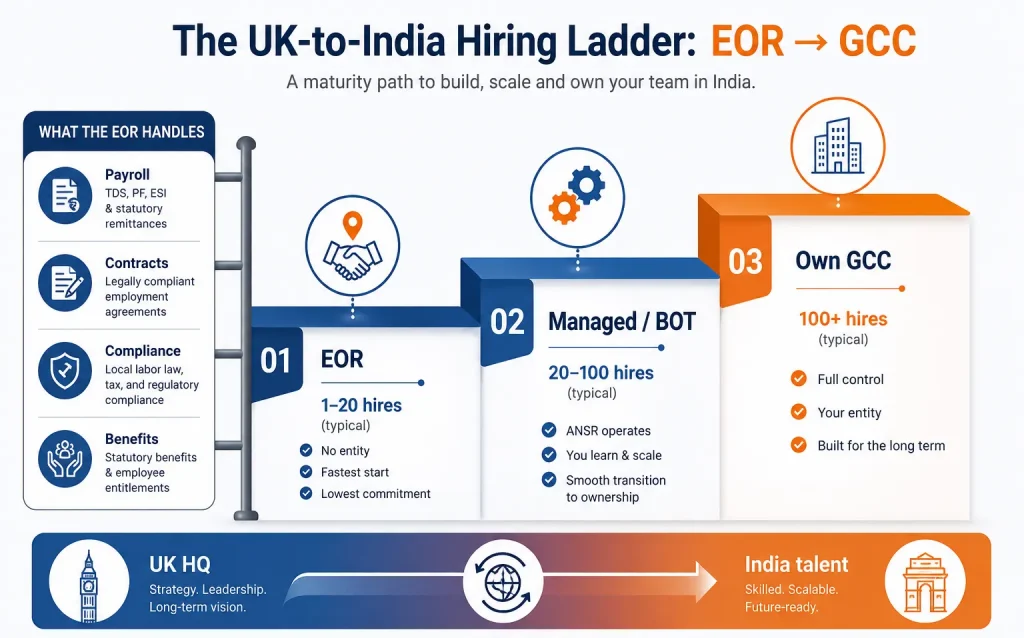
While an EOR is a powerful on ramp, it is often a temporary solution. A team of 5–10 members operating under an EOR lacks the strategic integration and direct organizational ownership required for a true Global Capability Center (GCC). A UK company should consider graduating from renting talent through an EOR to owning a GCC when:
- Headcount Scales: Most PE-backed firms transition to an owned entity once they reach 25 to 100 full-time employees.
- IP Ownership: If the Indian team is driving core product engineering or creating proprietary IP, direct ownership through a GCC ensures tighter integration with the global value chain.
- Long-Term EBITDA Impact: Owned GCCs in India typically deliver 50–60% cost efficiencies, directly enhancing EBITDA performance for the parent company.
Is an Employer of Record in India Right for your UK Business?
If UK firm needs to lock down premier tech talent before competitors do, or if testing the Indian market with a small sales team, an employer of record India is the ideal low-risk solution. It bypasses the months of legal incorporation and administrative burden while providing a compliant foundation under the new 2026 tax and labour rules. However, if the vision involves building a permanent center of excellence for AI, engineering, or global finance, the EOR should be viewed as the first step toward a wholly owned GCC.
Ready to start your journey in India? Talk to ANSR about how we can help scale from first EOR hire to a fully integrated Global Capability Center.