
Dedicated Development Team vs Staff Augmentation: Which Fits Your UK Business?
UK businesses scaling their technology function often face the same question: should they build a dedicated development team or use staff augmentation to cover immediate gaps? The answer depends on how much control and continuity the business needs, and how quickly it must add capacity.
A dedicated development team is a group of engineers who work exclusively on your product, embedded in your processes and accountable to your roadmap over the long term. Staff augmentation, by contrast, adds individual specialists to your existing team for a defined period, usually to close a skill gap or handle a short-term spike in workload. Both models solve talent challenges, but they solve different ones. In short, a dedicated development team is a long-term, integrated extension of your engineering organisation, while staff augmentation adds individual skills to your existing team for a shorter, more defined need.
What Is a Dedicated Software Development Team, and When Does It Fit?
A dedicated development team works as an extension of your in-house engineering organisation. It is assembled around your product, follows your development practices and stays with you across sprints, releases and roadmap changes. That continuity is what sets up a dedicated software development team apart from short-term arrangements.
This fits best when:
- The work is long-term product development, not a single project with a fixed end date.
- Deep integration with your existing engineering culture and tools matters.
- You need control over intellectual property, architecture decisions and delivery cadence.
The Dedicated Team Model
The dedicated team model is built around ownership rather than ticket-by-ticket delivery. Under the dedicated development team model, the provider assembles and retains a team against your requirements, and that team stays with your product instead of rotating between clients. For UK businesses building core platforms or proprietary IP, this reduces handover friction and preserves knowledge that might otherwise leave with a departing contractor.
How to Hire a Dedicated Development Team
UK businesses that hire a dedicated development team typically start by defining the roadmap, not the roles. The provider then builds a team around that roadmap, covering the skills the product needs across its life cycle rather than filling one vacancy at a time.
What Is Staff Augmentation, and When Does It Fit?
Staff augmentation adds skilled individuals to your existing team without changing how that team works. You retain management control, while the augmented staff extends your capacity. IT staff augmentation suits UK businesses that need a niche skill, such as a specific framework or compliance with specialism, without changing the wider delivery model.
This fits best when:
- You need to flex headcount up or down in response to demand.
- A specific skill gap needs filling for a defined stretch of work.
- The engagement is project-bound rather than open-ended.
Some providers describe this model as team augmentation, reflecting the same principle: add capacity, keep management in-house.
Resource Augmentation: Same Model, Different Name
Resource augmentation and team augmentation describe the same approach: adding people, not restructuring delivery. Whichever term a staff augmentation company uses, the model stays consistent. Staff augmentation services suit UK businesses managing seasonal demand, a one-off migration or a short sprint that needs specialist skills the in-house team does not have.
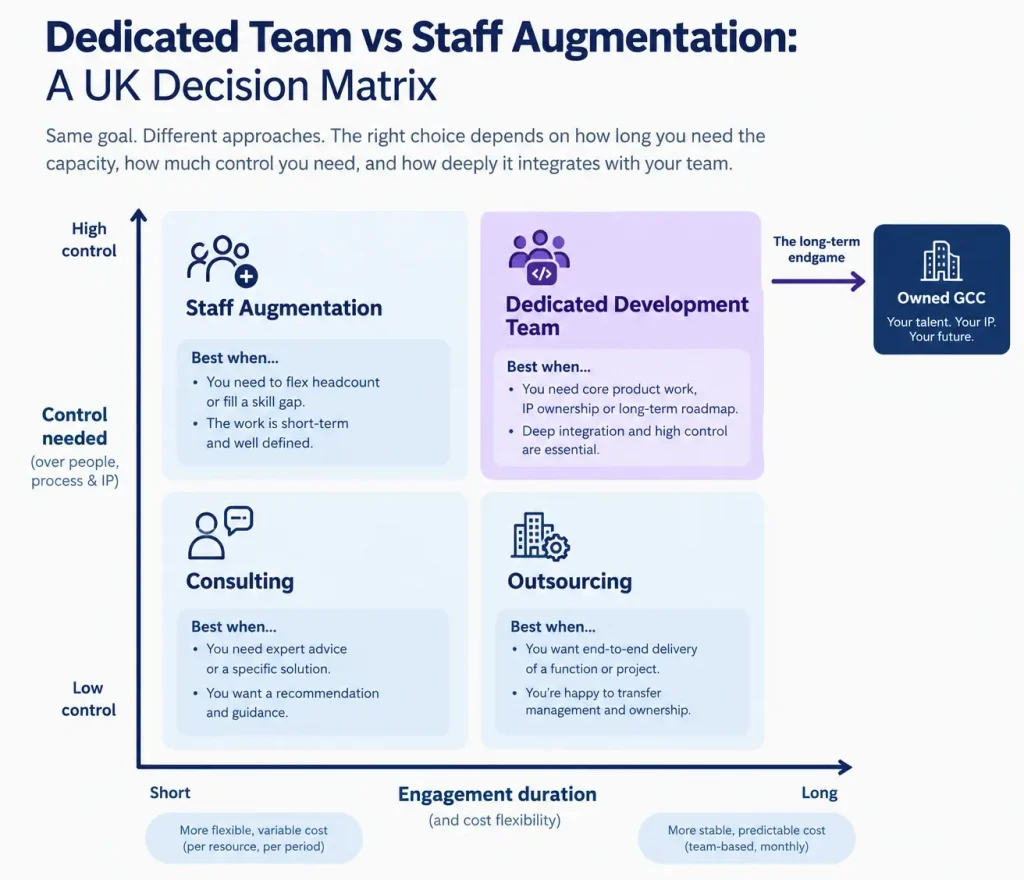
Staff Augmentation vs Consulting vs Outsourcing: How Do They Compare?
Staff augmentation, consulting and outsourcing all bring in external capability, but each solves a different problem. Augmentation gives you people who work in your direction. Consulting gives you expertise and recommendations, while you or your team own execution. Outsourcing gives you an outcome, with the provider owning delivery and management. On a spectrum of control, augmentation sits closest to your team; outsourcing sits furthest away, and consulting sits in between.
Staff Augmentation vs Consulting
Consultants advise and often deliver a defined outcome or strategy. Augmented staff, by contrast, execute day-to-day work under your direction. The comparison of staff augmentation vs consulting comes down to ownership of the outcome: consulting offers a recommendation; augmentation offers capacity.
Staff Augmentation vs Outsourcing
Outsourcing transfers an entire function or project to an external provider to manage end-to-end. In the comparison of outsourcing vs staff augmentation, augmentation keeps ownership and management inside your organization, while outsourcing transfers it. Staff augmentation sits closer to your team than either alternative, which is why it works well for short, well-defined gaps rather than open-ended ownership.
|
Aspect |
Staff Augmentation |
Consulting |
Outsourcing |
|
What it provides |
Additional skilled people |
Expertise and recommendations |
End-to-end delivery of a function or project |
|
Ownership |
Stays with your organisation |
Stays with your organisation |
Transfers to the provider |
|
Management |
You direct the work |
You direct the outcome; consultant advises |
Provider manages delivery |
|
Best fit |
Short, well-defined capacity gaps |
Solving a specific problem or filling an expertise gap |
Non-core functions or projects you want off your plate |
|
Engagement length |
Flexible, often short to mid-term |
Defined, project-based |
Often long-term or ongoing |
How Much Does Each Model Cost a UK Business?
Cost structures differ by design, not just by rate card. Staff augmentation is typically billed per resource, per period, keeping costs variable and tied to headcount added or removed. This makes budgeting straightforward for a defined engagement and easy to scale down once the work ends.
A dedicated development team usually has a different cost profile: a stable monthly investment that covers the team as a unit rather than individual billable hours. Over a long engagement, this can reduce the hidden costs of repeated recruitment and onboarding that often come with rotating augmented staff. The better question is not which model costs less in isolation, but which cost structure matches how long you need the capacity.
Which Model Should Your UK Business Choose?
The decision comes down to three variables: how long you need the capacity, how much control you need, and how deeply the work needs to integrate with your existing team.
|
|
Duration |
Control Needed |
Integration |
Best Fit |
|
Staff Augmentation |
Short-term |
Low to moderate |
Low |
Flexing headcount, filling a skill gap |
|
Dedicated Development Team |
Long-term |
High |
High |
Core product work, IP ownership, long-term roadmap |
If the need is short-term and well scoped, staff augmentation gives you flexibility without a long-term commitment. If the need is long-term, closely tied to your product and roadmap, and requires control over architecture and delivery, a dedicated development team is the stronger fit.
For UK businesses on a path towards sustained offshore or nearshore capability, a dedicated development team is often the natural first step towards a fully owned Global Capability Centre. Where staff augmentation solves a capacity problem, a dedicated team builds a foundation that can mature into an owned GCC, giving your business full control over talent, IP and delivery. Learn more about different GCC models and how they align to different stages of growth.
Ultimately, the choice comes down to aligning the model with your timeline, your need for control and the direction of your business specific.