
11 Crucial Steps For Building A Successful Center of Excellence
A business Center of Excellence (CoE) is a specialized team or entity. They are dedicated to fostering innovation, best practices, and strategic impact within an organization. Building a high-impact CoE requires distinct success factors, a clear vision, and robust support.
In this piece, we explore the concept, its strategic benefits, essential steps for implementation, and IT-specific considerations for long-term success.
What Is a Business Center of Excellence?
A CoE is a centralized team of experts focused on a specific area or subject matter. The mission is to consolidate expertise, develop best practices, and drive strategic advancements across the organization.
Unlike typical business units that handle daily operations, CoEs operate as hubs for thought leadership. They promote cross-functional collaboration, research, and continuous improvement – often influencing enterprise-wide change. CoEs are defined by their clarity of purpose, focus areas, strategic alignment, and autonomy. They are usually formed to accelerate organizational transformation, standardize methodologies, or introduce new competencies that are critical to business growth.
Benefits and Strategic Impact of a CoE
CoEs deliver numerous benefits that extend beyond simple process improvements. Some of them are described below:
- Streamlining workflows, eliminating redundancies, and maximizing productivity
- Leading to substantial cost savings and improved operational results
- Serving as the go-to source for specialized knowledge, best practices, and training
- Supporting high-quality decision-making across departments
- Unifying processes and ensuring consistent execution, and thus enhancing product and service quality
- Avoiding inconsistencies and error-prone approaches
- Providing a structure for experimentation to enable the adoption of new technologies
- Promoting a culture of improvement and boosting agility across the enterprise
- Deeply aligning with customer needs and market shifts
- Driving higher satisfaction and a competitive advantage
IT Centers of Excellence: Unique Considerations
IT-focused CoEs have unique challenges and opportunities. They require:
- Combining IT professionals with business strategists, analysts, and external experts to solve complex technical and organizational challenges
- Leading research, learning, and adoption of emerging tools, frameworks, and practices tailored to business needs
- Robust security practices, scalability of solutions, and high quality in both product delivery and end-user experiences
- The ability to quickly test new solutions and iterate for optimal results
- Engagement with external partners—including universities, open-source communities, and vendors—to leverage advances and scale solutions effectively
- Integration with new technologies into an enterprise like AI, machine learning, and blockchain
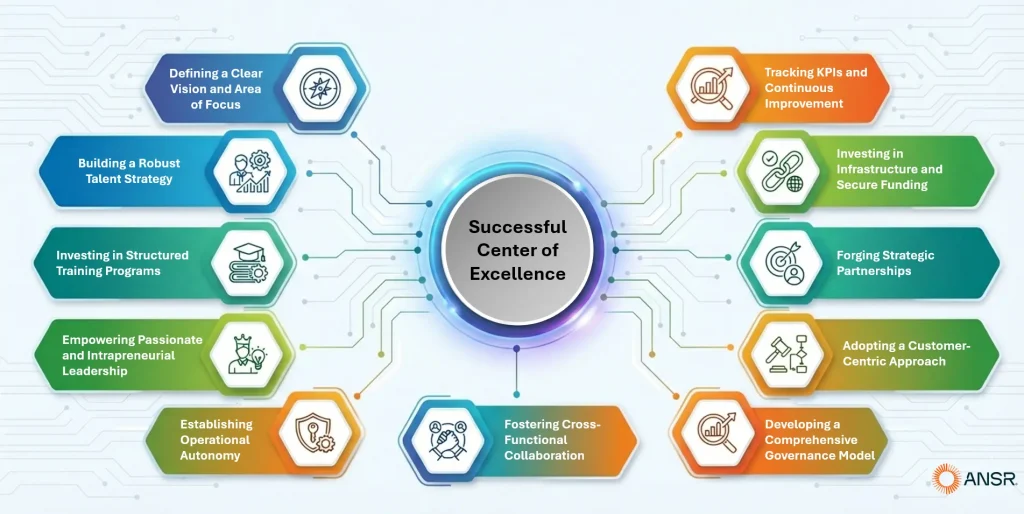
Steps for Building an Effective CoE
Building an effective CoE requires an array of strategic steps. Drawing on industry best practices, the following steps outline the essential levers for establishing a high-impact CoE.
- Defining a Clear Vision and Area of Focus
Building a CoE requires a clear vision that is consistent with the organization’s strategy. A CoE must have clear goals in order to maintain relevance. Having long-term goals impacts efficiency both now and in the future.
- Building a Robust Talent Strategy
Talent acquisition and competency development are critical. Adopt a three-pronged approach:
- Hire tenured experts to establish initial thought leadership and high performance
- Blend in experienced professionals with those who have domain, market, and technical expertise
- Implement a talent pyramid, recruiting high-potential individuals who can grow within the CoE
- Investing in Structured Training Programs
Design training leveraging industry experts, academia, and practical projects. This accelerates learning and equips talent with skills for real-world challenges. Academic partnerships and live projects broaden experience and mitigate risk.
- Empowering Passionate and Intrapreneurial Leadership
A visionary, empathetic, and flexible leader drives the CoE’s purpose. The right leader mobilizes resources, creates momentum, and ensures the center’s continued relevance, often by exemplifying intrapreneurial qualities and inspiring their team.
- Establishing Operational Autonomy
Enable CoEs to function with independence and direct control over roles, resources, and strategic execution by assembling diverse teams, from product managers and architects to technology researchers. Autonomy fosters innovation and accelerates development cycles.
- Fostering Cross-Functional Collaboration
CoEs must collaborate smoothly across business units and product teams. Structured engagement and governance frameworks are required for effective job prioritization, workload management, and innovation implementation.
- Developing a Comprehensive Governance Model
Implement clear standard operating procedures and governance mechanisms for accountability and efficiency. These frameworks enable prioritization and ensure resources are directed toward high-impact initiatives.
- Adopting a Customer-Centric Approach
The aim is to solve the issue based on customer feedback. This includes gathering deep industry insights, anticipating challenges, and proactively addressing market disruptions. It leads to making the CoE a trusted partner for internal and external customers alike.
- Forging Strategic Partnerships
Such alliances can expand access to knowledge, improve innovation, spread risk, and speed up advancement on groundbreaking projects. For this, entities form partnerships with universities, various allied organizations, user groups, and developer communities.
- Investing in Infrastructure and Secure Funding
Equip the CoE with advanced technology, robust infrastructure, and an adequate budget. Plan investments with an accurate ROI assessment that aligns with focused initiatives and strategy.
- Tracking KPIs and Continuous Improvement
Establish multifaceted success indicators (KPIs) like revenue growth, profitability effects, operational effectiveness, and customer results. Establish a strong evaluation system to track advancement, tackle obstacles proactively, and adjust strategies when necessary.
Case Study: Accelerating Innovation in India with Strategic Technical CoE Partnership
A leading global payment network sought to establish a Technology CoE in Bengaluru, India. The primary obstacle was attracting top-tier fintech talent. This was a major hurdle due to a highly competitive market. At the same time, navigating complex operational requirements was challenging.
The enterprise partnered with ANSR to leverage its extensive talent network and expertise in establishing and managing global capability centers. ANSR provided comprehensive support, encompassing:
- Rapid Talent Acquisition: Building a pipeline of highly skilled IT professionals, significantly accelerating the hiring process and reducing talent acquisition costs
- Operational Setup and Management: Providing end-to-end support for the TCoE’s operational infrastructure, including real estate, legal compliance, and HR management
In two years, this Bengaluru TCoE had over 1,000 highly trained employees. It became a critical innovation hub for global operations. This way, it contributes to:
- Enhancement of existing products
- Development of new solutions
- Creation of cutting-edge data platforms
This strategic partnership helped the enterprise overcome talent and operational barriers. Hence, it solidified its position in the digital payments landscape and demonstrates the power of a collaborative approach to innovation.
Want to expand your business with a Center of Excellence? Take advantage of ANSR’s vast Global Talent Network. Contact our team to schedule a strategy to boost the growth of your enterprise.