
What is a GSS Model? A Complete Guide
What is a GSS Model in Business?
A Global Shared Services (GSS) model serves as a strategic framework for integrating and streamlining various organizational operations, resulting in improved service quality and operational efficiency. At its core, GSS stresses openness, standardization, and consistent process execution to ensure fairness, consistency, and high regulatory compliance throughout the enterprise. GSS centralizes regular processes, allowing internal teams to focus on strategic goals like people development, organizational design, innovation, and long-term growth.
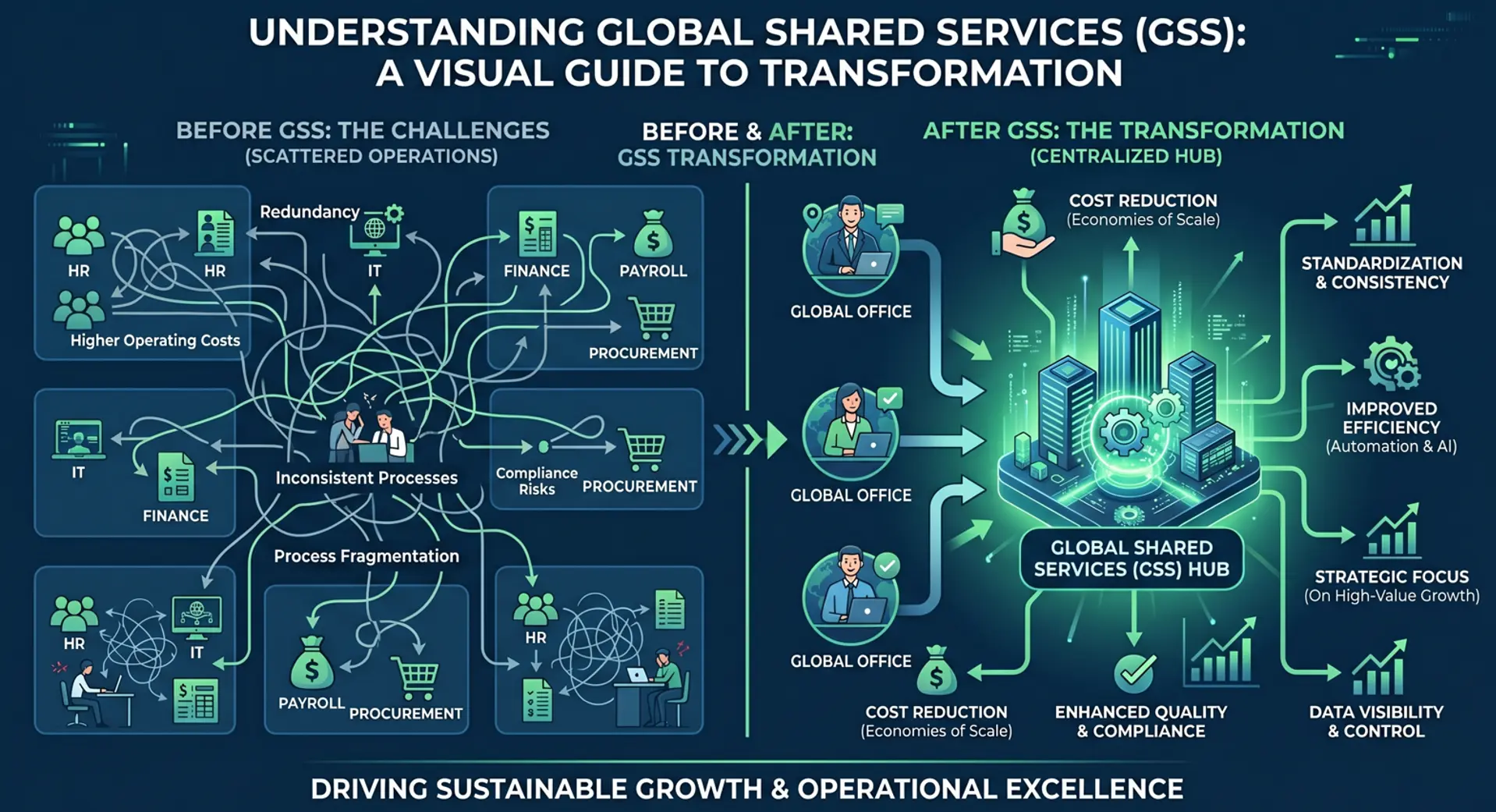
The GSS framework is composed of critical components that collectively improve operational performance. Payroll, IT support, and other back-office services are consolidated into a single organization, with uniform procedures used across geographies. With its global operating model, GSS uses cutting-edge technologies like automation, artificial intelligence, and integrated digital platforms to increase efficiency and accuracy while supporting a global customer base, frequently around the clock. As a result, businesses gain from economies of scale that result in considerable cost savings, increased efficiency due to the removal of redundancies, and higher quality due to stronger data governance, compliance, and consistency. GSS frees up the larger company to focus on strategic priorities, innovation, and sustainable growth by taking on operational duties.
How Do Global Shared Services Work?
Global Shared Services function by centralizing common, repeatable, and transactional processes, such as accounts payable, employee onboarding, helpdesk operations, or data management, into a single integrated service hub. These hubs may operate at a regional or global scale, depending on organizational needs, and often support teams across multiple time zones. The GSS model is grounded in several key operational principles:
Centralization of Processes: By consolidating functions like payroll and IT support into unified centers, organizations eliminate redundancy, reduce operating costs, and maintain consistent service levels. Centralization also improves workload distribution and boosts overall productivity.
Standardization and Uniformity: GSS applies uniform procedures across regions, minimizing performance variability and ensuring strong compliance with internal policies and regulatory standards. This consistency enhances data accuracy and operational quality worldwide.
Technology-Driven Operations: Modern GSS relies on automation, AI, analytics, and integrated digital platforms to streamline workflows, reduce manual errors, and provide real-time visibility. Automation accelerates tasks such as invoice processing and onboarding, while AI supports smarter, data-driven decision-making.
Global Reach and 24/7 Support: Many GSS centers operate around the clock, supporting global teams and customers across time zones. This ensures continuous service availability and strengthens business continuity.
Strategic Redeployment of Talent: By taking over routine transactional tasks, GSS enables business teams and leaders to focus on high-value strategic priorities such as organizational development, innovation, and market expansion.
In essence, GSS provides a central nervous system for organizational operations, integrating key business processes into a single, cohesive structure.
Key Benefits of Implementing GSS
Implementing Global Shared Services delivers a range of organizational benefits, from operational efficiencies to cost savings and improved quality control. Companies across industries increasingly turn to GSS models to strengthen scalability and drive long-term performance.
Cost Reduction and Economies of Scale: One of the most widely recognized advantages of GSS is significant cost savings. By consolidating repetitive tasks into a single operational hub, organizations gain economies of scale, reduce labor and infrastructure costs, and eliminate redundant processes. This streamlined structure leads to measurable reductions in overhead, administrative expenses, and process inefficiencies.
Improved Efficiency and Streamlined Workflows: GSS eliminates duplicate systems and fragmented workflows by centralizing processes into unified teams and implementing standardized procedures across regions. These consolidated operations accelerate service delivery, reduce processing times, and minimize bottlenecks across departments. Organizations with well-designed GSS frameworks typically report faster turnaround times and enhanced internal customer satisfaction.
Enhanced Quality, Compliance, and Data Control: Centralized service delivery ensures consistent adherence to regulatory frameworks and internal policies. With unified processes, companies improve data quality, enhance controls, and reduce compliance risks. Stronger governance structures support reliable auditing and performance tracking. Furthermore, the use of technology such as integrated platforms and automation enhances accuracy, reduces human errors, and ensures that data flows securely and efficiently across functions.
Greater Strategic Focus for Business Leaders: By offloading transactional work to GSS centers, business units can focus on strategic initiatives such as talent development, organizational restructuring, market growth, and innovation. This shift allows leaders to invest more time in value-adding activities instead of routine tasks.
Centralized Operations & Cost Efficiency
Centralized operations are at the heart of the GSS model. When functions such as IT, payroll, procurement, or HR administration operate through a single shared center, organizations reduce duplication and fully leverage shared resources. This consolidation not only cuts costs but also simplifies process oversight and improves accuracy. Moreover, centralized hubs help maintain consistent service levels across departments and regions, supporting scalable business growth.
Traditional Outsourcing vs. GSS Operations
While Global Shared Services and outsourcing may appear similar, their structures, purposes, and operational impact differ dramatically. Traditional outsourcing entails hiring external vendors to execute specific corporate operations, often to cut costs through labor arbitrage. These suppliers operate independently of the business and may manage processes using their own standards, tools, or service frameworks.
Global Shared Services, on the other hand, remain internal to the company, giving businesses complete control over technology, quality, and compliance. GSS strives to optimize internal processes through standardization, technology integration, and centralized administration, rather than relying on third-party providers. This internal ownership guarantees:
Higher transparency
Stronger alignment with corporate goals
Better oversight of data security and regulatory compliance
Ultimately, while outsourcing focuses on external cost advantages, GSS prioritizes internal efficiency, strategic control, and long-term operational excellence.