
Beyond Managed Services: How Best Sourcing and GCCs Redefine Global Delivery Models
Summary
GCCs are replacing managed services as the center of ownership, innovation, and competitive advantage
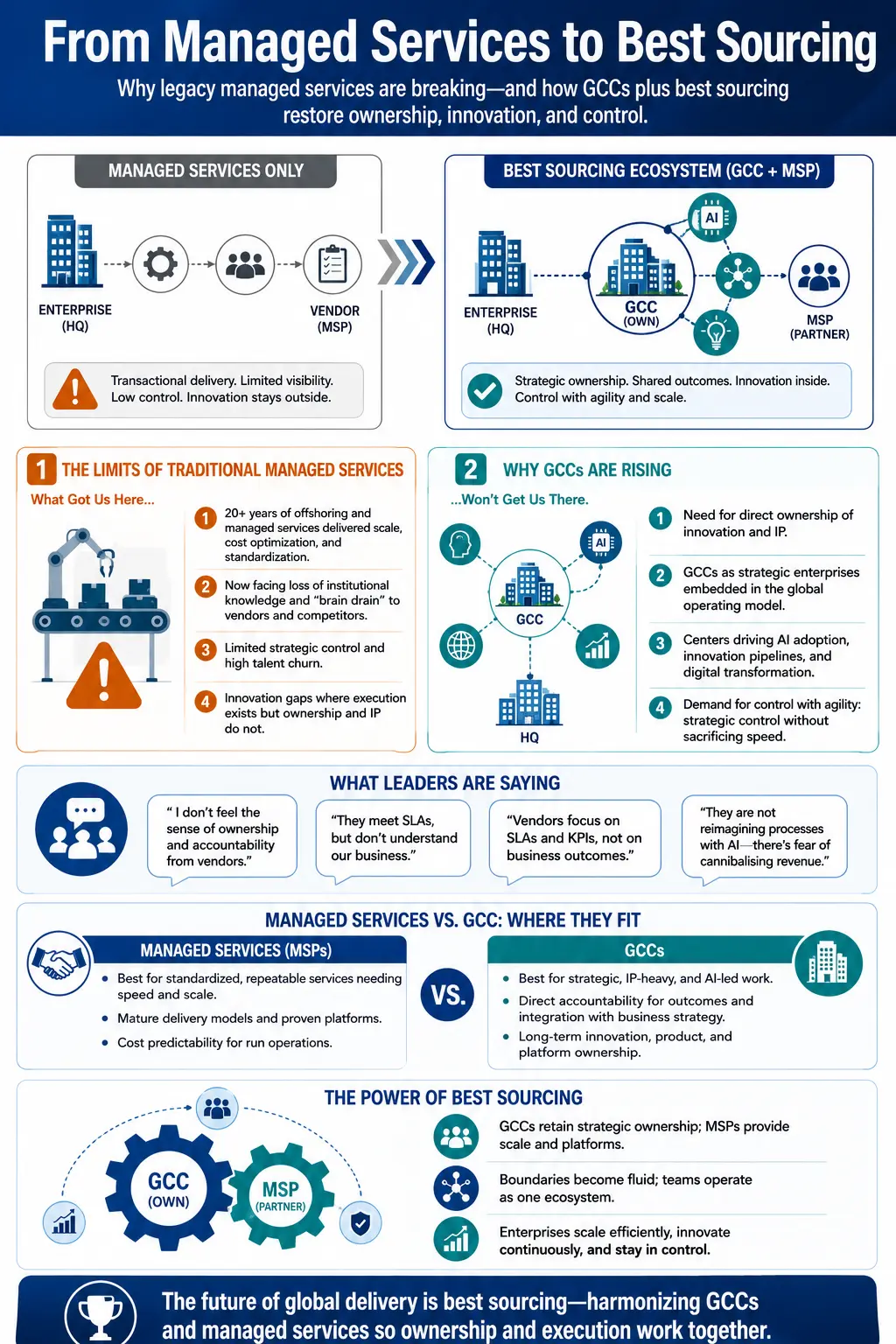
Traditional managed services are breaking under modern demands, creating innovation gaps, weak ownership, and loss of institutional knowledge in AI-first, fast-evolving environments.
Enterprises are shifting to GCCs to gain direct control over talent, IP, and strategy, enabling “control with agility” and embedding innovation within the business.
CXOs highlight misalignment in vendor models, where SLAs outweigh outcomes and providers lack deep business context, slowing transformation and AI adoption.
The future lies in “best sourcing” – a hybrid model where GCCs own strategy and innovation, while managed services handle scalable, standardized execution.
Recommendation: Build or evolve GCCs as strategic hubs for innovation and ownership, while integrating managed services selectively to create a balanced, outcome-driven global delivery model.
Why the classic managed services model is breaking
For over 20 years, offshoring, co‑shoring, outsourcing, and managed services helped organizations scale quickly, optimize costs, and standardize operations. That model was fit for a world where efficiency and labor arbitrage were the primary objectives.
Today, however, the same construct is revealing serious weaknesses. Organizations are experiencing loss of institutionalized business knowledge as critical know‑how sits with vendors and walks out the door – or even moves to competitors – creating structural disadvantage. Traditional managed services are struggling to keep pace with how businesses evolve, especially in digital and AI‑first contexts.
Most importantly, there are “innovation gaps where execution exists but ownership does not.” Enterprises inherit output, but not the underlying expertise, IP, or the ability to continuously reimagine processes. In a world where technology speed and differentiation define competitiveness, these gaps have become intolerable.
The forces pushing enterprises toward GCCs
Talent, ownership, and control with agility
The global shift toward GCCs is driven by a clear set of forces. Intense global talent competition is pushing enterprises to build direct access to high‑caliber skills rather than mediate everything through vendors. There is a growing need for direct ownership of innovation and IP – not just better unit costs or rate cards.
Equally important is the demand for “control with agility.” Organizations want strategic control over platforms, data, and roadmaps, while still retaining the ability to move fast and scale. GCCs, built as wholly owned entities, offer an operating construct that naturally supports this combination.
GCCs as strategic enterprises, not efficiency arms
Modern GCCs are no longer about operational efficiency alone. They have evolved into strategic enterprises deeply embedded in the global operating model. In many leading companies, the GCC is the entity driving AI adoption and innovation pipelines, owning digital transformation, accelerating go‑to‑market strategies, and shaping global business decisions.
The power of the model comes from combining global scale with localized agility: large, diverse talent pools; proximity to innovation ecosystems; and the ability to integrate tightly with enterprise strategy. Organizations that design GCCs this way build “strategic control without sacrificing speed and innovation without losing efficiency.”
What CXO trigger statements reveal about vendor models
Lack of ownership and business understanding
Client conversations across industries reveal a common set of trigger statements. Leaders express that they do not feel a sense of ownership, belonging, or accountability from traditional outsourced teams – certainly not at the level they expect from internal employees.
There is also frequent feedback that vendors “don’t understand our business” deeply enough. The relationship is often framed around contracts, SLAs, and ticket queues rather than shared goals, domain insight, and long‑term value creation.
SLAs over outcomes and fear of AI cannibalization
Another recurring theme is that outsourced and managed services providers focus “more on SLAs and KPIs and not on business outcomes.” Many are not reimagining business processes using new ways of working and AI, particularly when automation could cannibalize their own revenue streams.
This misalignment has a clear consequence: enterprises are bringing innovation and thought leadership back in‑house through their own GCCs. GCCs become the place where AI roadmaps are set, processes are redesigned, and new capabilities are built – while vendors increasingly play a supporting rather than leading role.
When managed services still make sense-and when GCCs are essential
The enduring role of managed services
Despite the shift, managed services models are not disappearing. They continue to make strong sense where organizations need speed, scale, and efficiencies. Managed Service Providers (MSPs) bring mature delivery models, proven platforms, and the ability to scale quickly with cost predictability for standardized, repeatable services.
For infrastructure operations, routine support, and highly industrialized processes, this model can remain both effective and economical – provided expectations are correctly set around execution rather than strategic innovation.
The GCC answer for strategic, IP-heavy work
The model changes when the work becomes strategic. Enterprises increasingly turn to GCCs when they need ownership of IP, accountability for outcomes, and deeper integration with product and business strategy.
GCCs are the natural home for long‑term innovation, especially with the advent of AI capabilities. They house cross‑functional teams that design, build, and scale new products, platforms, and data assets – then export these capabilities back to the broader enterprise. In these domains, outsourcing the core is no longer acceptable.
Best sourcing – harmonizing GCCs and MSPs
One ecosystem, not competing models
The future of global delivery is not a binary choice between managed services and GCCs. The reality is “managed services and GCCs working together through a best sourcing model.” In this construct, GCCs retain strategic ownership, and MSPs are leveraged as powerful execution and platform partners.
Boundaries become fluid, with teams operating as one large ecosystem. Enterprises tap into MSP investments in advanced technologies and tools while keeping decision rights, architecture, and outcome accountability inside GCC structures.
The power of best sourcing
Best sourcing is about finding the right mix to scale efficiently, innovate continuously, and stay in control. It assigns the right work to the right construct:
- GCCs for strategic, IP‑heavy, AI‑driven, and business‑critical capabilities.
- MSPs for standardized services, run operations, and areas where scale and proven delivery patterns dominate.
This blended model preserves the benefits of managed services while addressing their structural gaps through GCC-led ownership. It reflects a new global mandate: enterprises must design delivery architectures where execution and ownership reinforce each other, rather than pull in opposite directions.