
Captive vs Vendor vs BOT Models
The need to scale operations, manage costs, and access specialized talent across international boundaries is not feasible. However, the process of achieving these objectives is complicated, requiring a rigorous evaluation of various engagement models.
The decision to utilise a Captive Center, a Vendor, or a Build-Operate-Transfer (BOT) structure is not merely a tactical choice but a profound decision that impacts the organisation’s long-term capability, risk profile, and talent brand.
Enterprises must move beyond a simple cost-saving perspective and adopt a holistic framework to determine the optimal model for their unique operational needs.
Ownership and Control
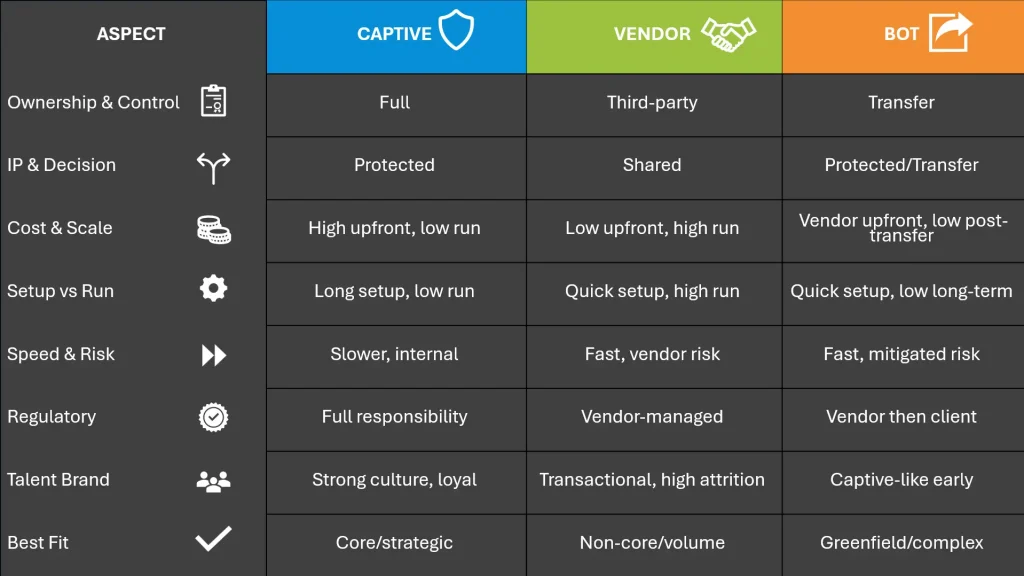
The core difference between these models is that ownership and operational control of the parent organization is essential for proprietary processes, sensitive data, or core functions.
- A Captive Center is fully owned and operated by the parent company, giving complete control over strategy, technology, culture, and operations, ideal for R&D, advanced analytics, or critical IT.
- A Vendor model has a third-party manage specific processes or IT services under client-defined SLAs, with the client overseeing execution and expertise.
- The Build-Operate-Transfer (BOT) model is a hybrid: the vendor sets up and runs the center initially, then transfers ownership, assets, and talent to the client, creating a captive without starting from scratch.
IP and Decision Rights
The implications for Intellectual Property (IP) and decision rights are substantial.
- In a Captive model, all IP stays within the organization, and decisions align with corporate strategy, safeguarding critical assets.
- In a vendor model, proprietary data is shared with the provider, increasing exposure risk, and decision rights are contract-driven, often resulting in a transactional relationship.
- The BOT model mitigates these risks by operating under the client’s strategic direction with IP protections, ensuring secure transfer of ownership, assets, and decision rights.
Cost and Scale
Financial structure and scalability differ sharply across the three models, shaping their long-term business case. Leaders often misjudge by focusing on unit cost instead of total cost of ownership (TCO) over time.
- A Captive model demands high upfront CapEx but delivers the lowest long-term operating costs, ideal for sustained scale.
- Vendor models require minimal CapEx and offer predictable OpEx, but long-term TCO can exceed a mature captive due to vendor margins.
- The BOT model is initially OpEx-heavy, with the vendor covering setup costs; after transfer, it follows a captive-like low-cost trajectory, balancing short-term ease with long-term savings.
Setup vs Run Curves
The trade-off between the Captive and Vendor models is best visualised through the setup versus run curves.
- Captives have a long, resource-intensive setup curve but a low, flat run curve.
- Vendor has a very quick, low-friction setup curve but a higher, potentially inflationary run curve as vendor costs and scope creep accumulate.
- The BOT model compresses the client’s setup curve by outsourcing the Build and Operate phases, providing the benefit of a quick launch and the potential for long-term Captive cost efficiency.
Speed and Risk
Time-to-market and risk management are key executive concerns.
- Vendor allows the fastest launch with existing infrastructure and talent but carries risks of quality issues, dependence, and knowledge loss.
- Captive takes longer to set up due to legal, real estate, and recruitment requirements, but risks are managed internally.
- BOT speeds time-to-market by having the vendor handle setup, compliance, and regulations, while the client focuses on strategic transition and knowledge transfer.
Launch and Regulatory Factors
For complex or highly regulated industries, the handling of regulatory factors is crucial.
- In a Captive, the parent company must bear full responsibility for all local compliance, labour laws, and taxation. While more demanding, this provides complete transparency and control.
- Vendor shifts much of the compliance burden to the vendor but introduces counterparty risk and the challenge of auditing a vendor’s adherence to your regulatory standards.
- The BOT model transfers the risk and complexity of the initial regulatory launch to an expert, providing a clear path to compliant ownership.
Talent Brand
Attracting skilled global talent requires more than competitive pay, it depends on a strong talent brand and employee value proposition (EVP).
- Captive Centers hire employees directly, fostering loyalty, deep expertise, and low attrition.
- In the Vendor model, talent is employed by the service provider, which enables flexibility and scalability, though it may sometimes result in a more transactional engagement and relatively lower cultural alignment.
- BOT develops a captive-like talent brand early, with the vendor overseeing the team under the client’s culture to ensure a smooth transfer.
Fit by Scenario
The selection of the appropriate model is based on the nature of the function, the organization’s strategic objectives, and its risk appetite.
Strategic Priority | Recommended Model | Rationale |
Maximum Control & IP Protection | Captive | Full ownership ensures complete control over data, processes, and corporate culture. |
Quick Launch & Flexibility | Vendor | It has minimal setup time and high scalability for non-core or cyclical tasks. |
High Control, Lower Initial Risk | BOT | Leverage vendor expertise for setup, resulting in long-term ownership and control. |
When to Choose Each
- Captive Centers are suitable for core, strategic functions, including strong cultural alignment and full IP protection, such as product development or data science.
- The Vendor model utilizes non-core, high-volume, or temporary tasks, enabling rapid scaling and rapid cost reduction.
- BOT bridges to a future Captive, mitigating greenfield risks and providing complex configurations or specialized centers with vendor expertise.
Conclusion
Choosing between Captive, Vendor, or BOT models is a critical decision for executive leadership. It requires careful evaluation of control, long-term costs, speed-to-market, and the strength of the talent brand. Vendor Outsourcing offers speed and flexibility, while Captive Centers provide strategic control and long-term value. The BOT model bridges the two, enabling high control while reducing initial setup risks. Selecting the right model ensures the operational strategy directly supports the organization’s global objectives.