
Designing a Dual-shore Model for Offshore and Nearshore Centers
Traditionally, enterprises have often approached global delivery as a binary decision: offshore for cost efficiency or onshore for control and proximity. Today, shrinking business cycles and the need for continuous collaboration have rendered this either–or mindset obsolete. Modern enterprises now view global delivery as a distributed ecosystem rather than a single-location strategy. The rise of the dual-shore model, a deliberate integration of offshore and nearshore capabilities, marks the next phase of operational maturity. By combining the scale of offshore talent with the time-zone and cultural alignment of nearshore teams, organizations are moving beyond cost arbitrage toward building resilient, always-on delivery engines that balance speed, scale, and strategic closeness.
Why Enterprises Choose Dual-shore Delivery
The shift toward a dual-shore strategy is rarely sparked by a single factor. Instead, it is a response to the inherent limitations of relying solely on one delivery archetype. While offshore centers provide the muscle for high-volume execution, nearshore centers provide the connective tissue required for high-touch collaboration.
Balancing Cost, Time Zone, and Regulatory Needs
Financial efficiency remains a cornerstone of global delivery, but it is no longer the sole metric of success. While offshore locations offer an unmatched cost-to-quality ratio for large-scale operations, they often present challenges in real-time synchronization with western headquarters. A dual-shore model introduces a nearshore component to bridge this gap. Nearshore centers operate within the same or adjacent time zones, allowing for synchronous communication during the core business day. Furthermore, nearshore locations often share regulatory frameworks such as GDPR compliance within the EU, which simplifies data privacy management and reduces the legal friction associated with complex cross-border workflows.
Using Nearshore for Proximity and Offshore for Scale
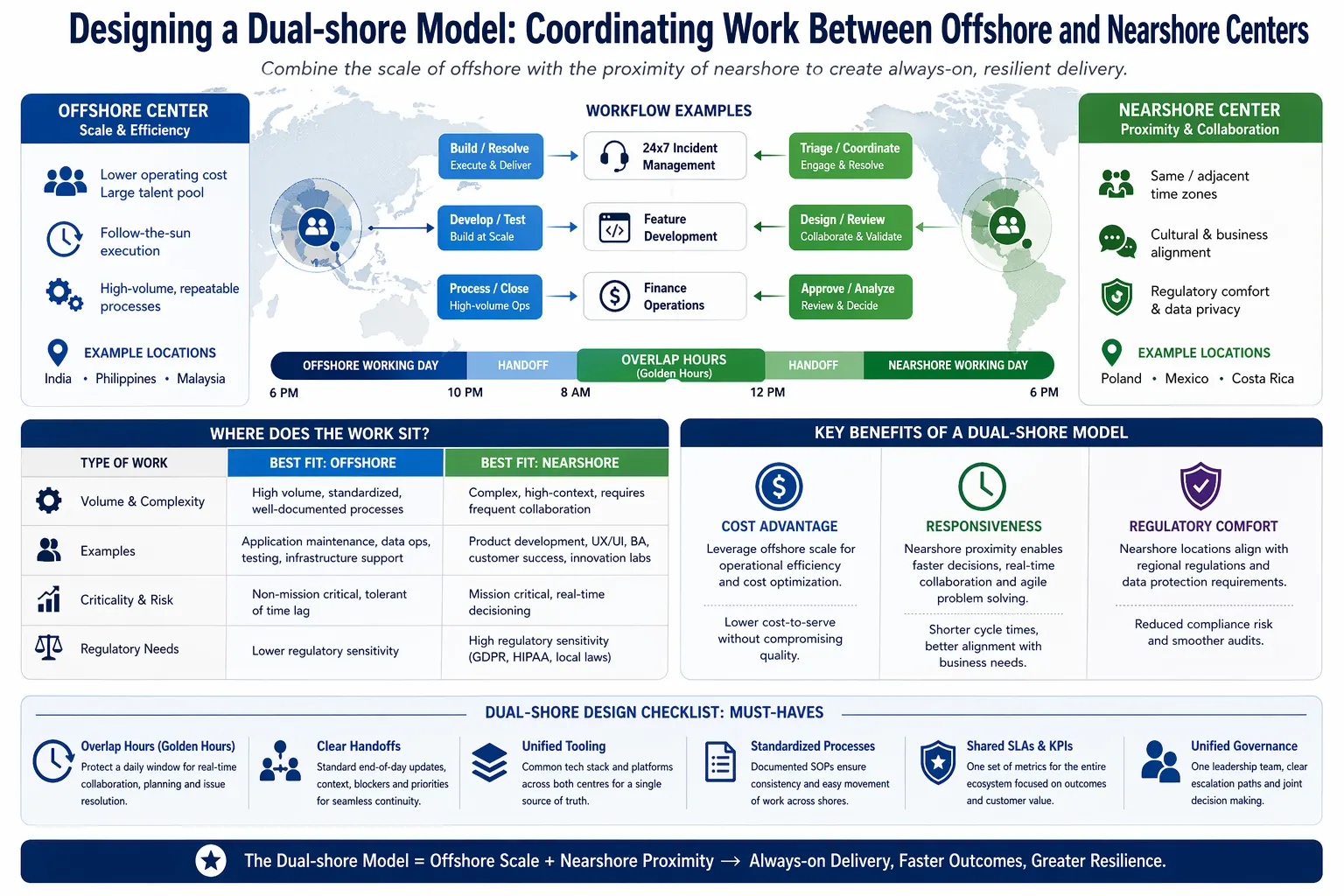
The most successful enterprises use these two models as complementary forces. Offshore centers act as the engine of scale. They house most of the workforce, handling standardized, repeatable, and high-volume processes that benefit from 24/7 follow-the-sun cycles. Nearshore centers, conversely, are utilized for proximity. These hubs are ideal for agile pods, product development, and customer-facing roles where cultural nuances and real-time problem-solving are paramount. By combining the two, a company can maintain a massive operational footprint offshore while keeping its most volatile and collaborative projects within a short flight or a shared afternoon of its primary market.
Designing the Dual-shore Operating Model
A dual-shore strategy is only as effective as the architecture supporting it. Without clear rules of the road, a multi-location setup risks becoming a fragmented collection of silos that compete rather than cooperate.
Work Allocation Rules Across Locations
The first step in design is defining a clear taxonomy of work. Organizations must move away from arbitrary task assignments and toward a logic-based allocation model. Common criteria for work placement include:
- Complexity and Interdependence: High-context tasks requiring constant stakeholder feedback are routed nearshore, while high-volume, well-documented processes are routed offshore.
- Criticality and Risk: Mission-critical functions may be split across both locations to ensure business continuity (BPC), should one region face geopolitical or environmental disruption.
- Talent Availability: Niche skills such as specialized AI research or localized legal expertise are placed wherever the talent density is highest, regardless of geography.
Governance, Ownership, and Escalation Paths
In dual-shore models, lines of accountability and leadership ownership are frequently blurred. Organizations must establish a unified governance framework that transcends geography. This typically involves a global service owner who oversees the entire functional tower across all shores. Crucially, escalation paths must be standardized. If a delay occurs in an offshore center, the nearshore team shouldn’t just wait, they should have a pre-defined protocol for intervention or overflow support. This requires a shared management layer that views the offshore and nearshore teams as a single integrated unit rather than two separate vendors.
Orchestrating Collaboration Across Centers
The true test of a dual-shore model lies in the white space between the centers, the handoffs, the communication, and the shared culture.
Handoffs, Overlap Hours, and Communication Rituals
Effective orchestration requires leveraging golden hours, the window of time when the working days of the offshore, nearshore, and onshore teams overlap. These hours are precious and should be reserved for high-value activities: sprint planning, complex troubleshooting, and strategic alignment. Outside of these hours, the model relies on seamless handoffs. A clean handoff involves more than just sending an email, it requires standardized end-of-day reporting where the departing team provides context, pending blockers, and clear instructions for the incoming team. This ensures that work progresses continuously, effectively gaining 16 to 24 hours of productivity in a single calendar day.
Tooling, Documentation, and Process Standardization
A dual-shore model cannot survive on tribal knowledge. It requires a documentation-first culture. Because teams are rarely in the same room, every process must be codified in a centralized, cloud-based repository.
- Shared Tech Stack: Both centers must use identical project management tools and communication platforms to maintain a single source of truth.
- Standard Operating Procedures (SOPs): A process performed in Manila must be identical to the one performed in Warsaw. This consistency ensures that work can be moved between shores during peak volumes without a drop in quality or a need for retraining.
Measuring and Optimizing Dual-shore Performance
To ensure the model is delivering on its promise, leadership must look beyond traditional productivity metrics and focus on the health of the entire ecosystem.
KPIs for Customer Experience and Delivery Resilience
Traditional KPIs like average handling time or cost per full-time employee (FTE) are necessary, but insufficient. A dual-shore model requires ecosystem metrics:
- Cycle Time Compression: Is the follow-the-sun model resulting in faster project completions compared to a single-shore approach?
- Resiliency Score: How quickly can the nearshore center absorb the offshore workload during a localized outage?
- Stakeholder Satisfaction (NPS): Is the proximity of the nearshore team improving the internal or external customer experience through better communication and alignment?
By monitoring these metrics, enterprises can fine-tune their shore-mix, perhaps moving more work nearshore if time to market becomes the priority, or shifting more to offshore as processes become more mature and standardized.
The dual-shore model is not merely a geographic arrangement, it is a strategic capability. When executed with precision, it offers the best of both worlds: the unrivalled efficiency of offshore scale and the high-velocity collaboration of nearshore proximity. In the race to digital maturity, the organizations that win will be those that can orchestrate talent seamlessly across any border, in any time zone, at any scale.