
5 Great Reasons to Choose Hyderabad for Your Next GCC
Hyderabad has quickly become a major destination for Global Capability Centers (GCCs) in India, putting it on par with Bengaluru as a top hub for multinational companies. In the first half of 2023, Hyderabad and Bengaluru each opened 11 new GCCs.
Hyderabad has led the way in expanding existing centers. Strong infrastructure, a highly skilled workforce, and a business-friendly environment have played a big role in driving this growth. The Telangana government’s proactive policies have only strengthened Hyderabad’s appeal as a destination for GCC setup.
In FY25 alone, the city attracted 70 new GCCs, directly contributing to the state’s $1 trillion economy vision. With its emphasis on R&D and innovation, Hyderabad has firmly positioned itself as a key player in India’s digital economy.
Here are 5 reasons that make it stand out:
1. Talent Pool and Universities
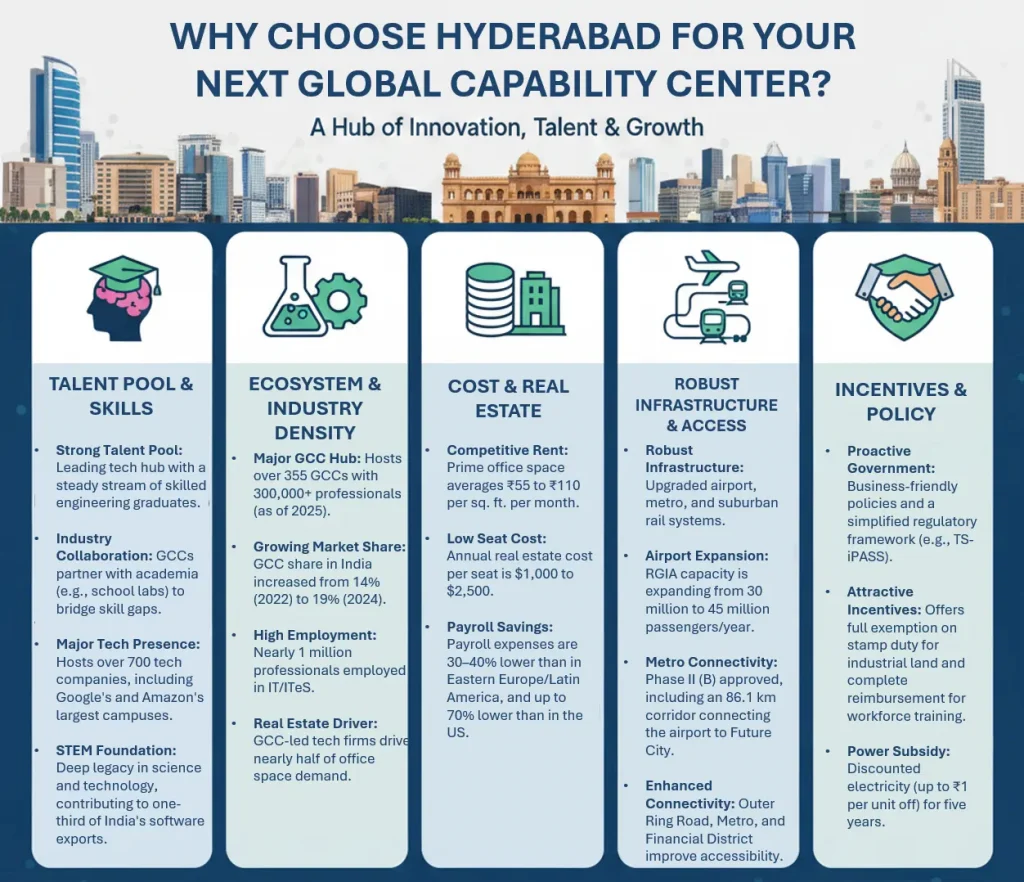
Hyderabad has established itself as a leading technology hub, supported by a strong education system that produces a steady stream of skilled graduates. This makes the city one of India’s most attractive locations for hiring engineering talent.
Global Capability Centers (GCCs) are collaborating with schools to bridge skill gaps and align academic training with industry needs. Initiatives such as Hexagon R&D India’s school labs strengthen the connection between classroom learning and business requirements, cultivating the next generation of technology leaders.
The city is also a major hub for innovation and digital growth, hosting more than 700 technology companies, including Google’s second-largest campus and Amazon’s largest global campus.
STEM Output and Skills
Hyderabad has a strong legacy in science and technology, with institutions that laid the foundation for its STEM ecosystem. The Regional Research Laboratory (now the Indian Institute of Chemical Technology) and the Hyderabad Science Society were among the earliest research centres, driving scientific progress after 1948.
Hyderabad’s pharmaceutical industry progressed with milestones such as the 1972 reverse engineering of diazepam. Organizations like ECIL and CMC trained talent in hardware, software, and design, driving growth in the IT sector.
Graduates from these institutions joined major technology companies, reinforcing Hyderabad’s role as a tech talent hub. The city’s contributions, ranging from affordable medicines and vaccines to digital solutions and e-governance tools, demonstrate its strength in research and practical innovation.
2. Cost and Real Estate in Hyderabad
Hyderabad’s commercial real estate market offers highly competitive pricing for GCCs. The average rental rates for office spaces in prime areas, like Gachibowli and HITEC City, range from ₹55 to ₹110 per square foot per month. For instance, a 2,200 sq. ft. fully furnished office space in HITEC City is available for ₹1.3 Lakh per month.
Seat Costs and Flexibility
Operating a GCC in Hyderabad offers substantial cost advantages. Real estate costs per seat annually fall within the $1,000 to $2,500 range, which is considerably lower than in Western countries. Additionally, payroll expenses are typically 30–40% lower than in Eastern Europe or Latin America, and up to 70% lower compared to the US, depending on the roles.
Furthermore, Hyderabad’s infrastructure development, including the Outer Ring Road, Metro Rail, and Financial District, enhances connectivity and accessibility, making it easier for GCCs to operate efficiently.
3. Infrastructure and Access
Hyderabad has strengthened its infrastructure to match rapid growth, upgrading its airport, metro, and suburban rail. At the same time, the city is improving public spaces, parks, walkways, and green areas, making it more accessible, walkable, and livable for residents and visitors.
Airports
Hyderabad’s Rajiv Gandhi International Airport (RGIA) is growing quickly to keep up with the growing number of passengers. GMR Airports Limited has announced plans to construct a new runway and a second terminal to accommodate the increased traffic.
The airport currently serves almost 30 million passengers each year. The proposed expansion aims to raise the capacity to 45 million passengers per year.
Metro
The state government has approved Phase II (B) for the Hyderabad Metro Rail project, which covers 86.1 km across three corridors.
The Hyderabad Unified Metropolitan Transport Authority (HUMTA) is also building skywalks in busy areas like Ameerpet, Dilsukhnagar, LB Nagar, and Hitec City to make it easier for people to walk around the metros.
The Telangana government has also approved the building of an 86.1 km metro corridor that will connect RGIA to Future City. The project is estimated to cost ₹19,579 crores. The MMTS station at Umdanagar, a major stop for people travelling to and from the airport, is also undergoing a ₹12.37 Crore renovation as part of the Amrit Bharat Station Scheme.
4. Ecosystem and Clusters
Hyderabad has rapidly grown into one of India’s strongest GCC hubs, supported by robust infrastructure, a policy push, and a depth of talent. As of 2025, it hosts over 355 GCCs with more than 300,000 professionals.
Additionally, Hyderabad’s share of India’s GCCs rose from 14% in 2022 to 19% in 2024, highlighting its acceleration as a preferred location for global firms.
- Industry Density
Hyderabad’s IT and GCC ecosystem demonstrates both workforce depth and industry concentration. Nearly one million professionals are employed in IT and ITeS, enabling the city to generate about one-third of India’s software exports.
This concentration extends to real estate, where GCC-led tech firms drive nearly half of office space demand, underscoring the sector’s central role in the city’s growth.
5. Incentives and Risk
Telangana provides a robust incentive framework for GCCs and large-scale investments, designed to reduce setup risks. Key benefits and challenges include:
- Attractive Incentives: Life sciences projects can receive 50–75% State GST reimbursement for seven years
- Land and Duties: Full exemption on stamp and transfer duty for industrial land purchases
- Training Costs: Complete reimbursement of workforce training expenses
- Power Subsidy: Discounted electricity of up to ₹1 per unit for five years
- Delayed Disbursements: As of early 2025, over ₹3,000 Crores in dues under T-IDEA and T-PRIDE remain unpaid, affecting investor trust and financial planning
- Policy and Compliance: Telangana has simplified its regulatory framework to support business operations. Key initiatives include TS-iPASS (Telangana State Industrial Project Approval & Self-Certification System), which streamlines approvals, along with legal frameworks aligned with central laws and GCC requirements.
Sector-specific policies, such as those in electronics, feature compliance-friendly measures like support for quality certification, patent registration, and cleaner production, enabling global companies to meet standards without bearing the full upfront cost.
Hyderabad is an ideal location for a GCC, offering a skilled workforce, competitive costs, and robust infrastructure, along with world-class universities, strong STEM expertise, and a thriving innovation ecosystem that supports efficient scaling.
If you’re considering Hyderabad for your next GCC, ANSR can help you navigate the city’s ecosystem, align with talent strategies, and accelerate setup with minimal risk. Expert teams at ANSR ensure your center is not just operational but also future-ready. Get in touch with our team today to explore how we can help you establish and scale your GCC in Hyderabad.