
From Gatekeepers to Governance Accelerators: The GCC Legal Function of the Future
Summary
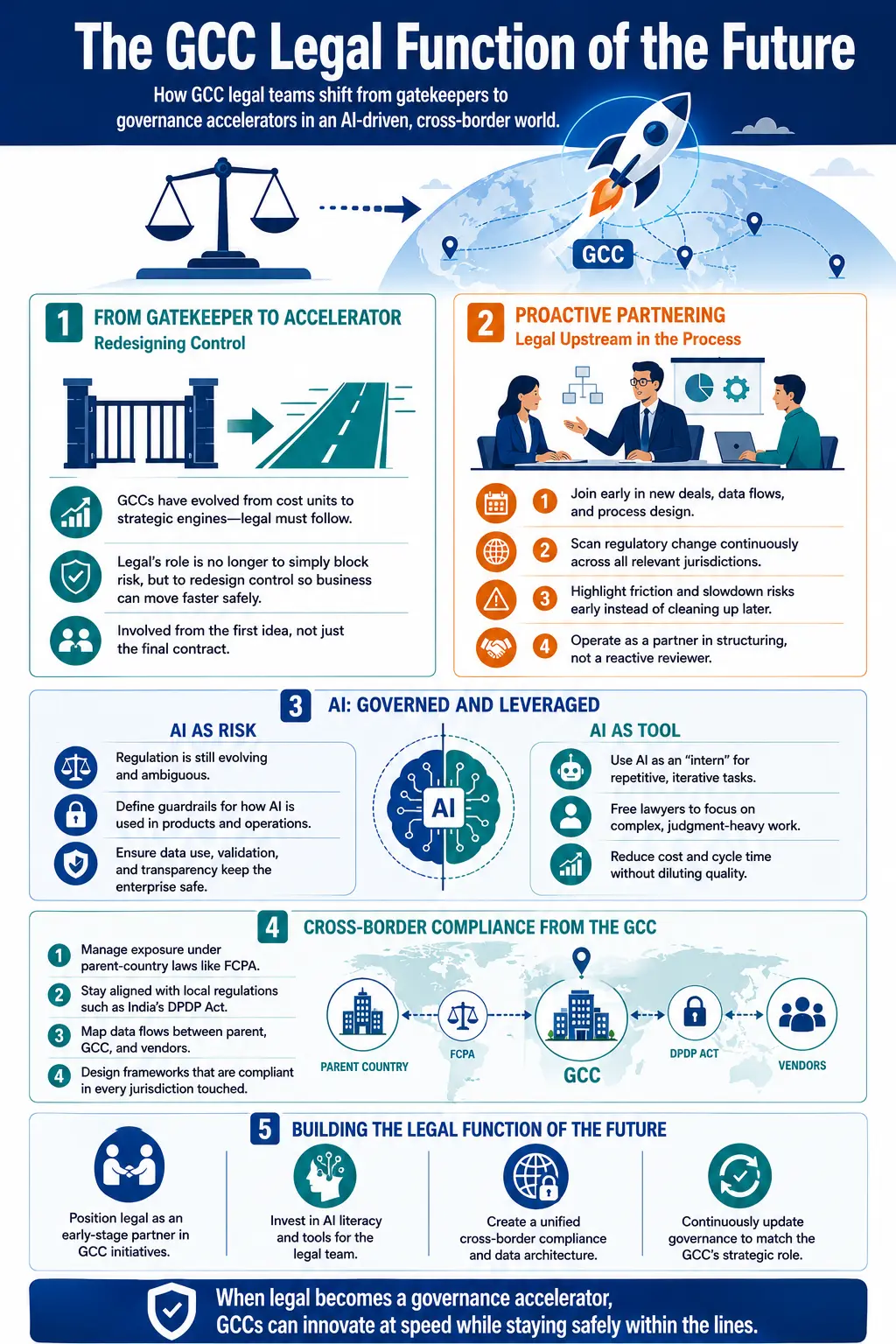
GCC legal teams are shifting from compliance gatekeepers to strategic governance accelerators – enabling speed without sacrificing control
Legal now participates upstream in deal conception, process design, and workflow architecture, embedding compliance early to reduce friction and shorten time-to-execution.
AI presents dual demands: legal must govern ambiguous, evolving AI regulations while simultaneously using AI to automate repetitive tasks like document review and drafting, freeing lawyers for high-stakes judgment work.
GCC lawyers operate as global citizens of regulation, managing cross-border exposures (FCPA, DPDP) and designing data/process architectures that satisfy multiple jurisdictions simultaneously.
Continuous regulatory scanning translates fluid rules into practical guardrails, allowing innovation to proceed with clarity rather than stalling at compliance checkpoints.
Recommendation: Reposition legal as a front-end strategic partner – integrate them into business planning from day one, invest in AI-augmented workflows, and build cross-border compliance into system design to turn governance into a competitive advantage.
Legal in GCCs is no longer a back-office control tower
As GCCs have matured over the last decade, they have steadily moved from cost arbitrage units to strategic engines tightly embedded in the parent company’s global operating model. Legal functions inside these centers mirror that shift. The role is no longer limited to policing risk at the end of a process; it is about redesigning control so that business can move faster without breaking rules.
This evolution demands a mindset change. Legal is expected to operate as an accelerator of governance: enabling deals, data flows, and new business models to proceed with clarity and confidence, rather than slowing them down through late-stage interventions. It is not about reducing control, but about structuring it intelligently and early.
Moving upstream – legal as a proactive business partner
In the room from the first slide, not the last
In the emerging GCC model, legal teams are expected to show up at the front of the process, not just at the contract redlining stage. They participate when new deals are conceived, when data processes are designed, and when new workflows are architected, so that regulatory and risk considerations are built in from the start.
This early involvement turns legal into a partner in execution and structuring, rather than a reactive advisor. By identifying friction points and potential slow-downs upfront, legal reduces the amount of “clean-up” required later in the lifecycle, shortening time‑to‑yes for business initiatives.
Continuous scanning of regulatory change
The regulatory environment around data, AI, and cross‑border operations is increasingly fluid. GCC legal teams must maintain an active watch on changing rules and enforcement trends in both the offshore location and the parent jurisdiction. Ambiguity is the default, particularly around AI: laws are emerging, interpretations are evolving, and enforcement patterns are still being defined.
Legal’s role is to translate this moving picture into practical guardrails and frameworks that keep the business out of trouble while still allowing it to innovate. That means regularly updating templates, policies, and technology controls in step with regulatory developments.
AI as both regulatory challenge and productivity lever
Governing AI use amid regulatory ambiguity
AI has become a central concern for GCCs across industries. Enterprise use of AI to transform business is accelerating, but the regulatory aspects remain ambiguous and fragmented. Legal teams must partner closely with the parent entity to understand how AI is being used – across products, operations, and internal tooling – and what exposures that creates.
They then help define the guardrails: where AI can be used, what data can be processed, how outputs are validated, and what disclosures or controls are required. The goal is to ensure that AI-driven transformation does not inadvertently create compliance, privacy, or ethical risks that will surface later as regulatory or reputational issues.
Using AI as an “intern” to amplify legal work
AI is not just an object of regulation; it is also a tool. Forward-looking legal teams treat AI as a digital intern that can handle iterative, lower‑complexity work while human lawyers focus on genuinely complex analysis and judgment.
This requires being able to distinguish between complex and repetitive tasks. Document review, basic research, and standard drafting patterns can be heavily augmented by AI with minimal human intervention, driving down cost and cycle time. High-stakes negotiations, nuanced regulatory interpretation, and strategic risk assessment remain firmly in human hands. In this model, lawyers who know how to “get work done out of AI” stay ahead; AI does not replace them so much as extend their capacity.
The GCC lawyer as a global citizen of regulation
Managing cross‑border exposure (FCPA, DPDP, and beyond)
GCC legal roles are inherently cross‑border. A lawyer in an Indian GCC supporting a U.S. parent, for example, must manage exposures under both Indian law and extraterritorial regimes like the U.S. Foreign Corrupt Practices Act (FCPA). FCPA applies to Indian companies and citizens when they are part of an American company’s operations, making it essential to maintain a robust anti‑corruption compliance framework within the GCC.
Similarly, data privacy and security laws such as India’s Digital Personal Data Protection (DPDP) Act add another layer of complexity. Legal needs to understand how data flows between the GCC, the parent entity, vendors, and other business units; then design frameworks that simultaneously satisfy Indian requirements, parent‑country laws, and any other jurisdiction touched by the data.
Designing compliant data and process architectures
The legal function plays a central role in defining how information and responsibilities move through the GCC. This includes mapping data flows between locations, clarifying which entities are controllers and processors, and working with technology teams to embed compliance into system design.
When done well, this results in a technological and process framework that is compliant across all relevant regimes, not just the local one. The GCC lawyer, in effect, becomes a global citizen of regulation – watching how exposures in one jurisdiction may be triggered by actions in another, and ensuring the center remains safe while still fulfilling its strategic mandate.