
Vietnam, Poland, or Mexico? Choosing Your Second GCC Location
Global enterprises are expanding beyond single hub dependency to reduce operational risks. A second Global Capability Center strengthens resilience, continuity, and access to diverse talent.
Vietnam, Poland, and Mexico have emerged as compelling contenders for the second GCC expansion. Leaders explore these emerging regions for a combination of factors – cost efficiency, innovation potential, and stability.
Each provides strong talent pools, improving infrastructure, and growing digital capabilities. Their geographic spread across Asia, Europe, and the Americas enables time-zone coverage and flexibility.
Choosing the right GCC location, however, requires aligning business priorities with sustainable workforce strategy. Here, regulatory ease, scalability, cultural compatibility, and ecosystem maturity influence outcomes. If chosen right, your right second GCC can speed up innovation while safeguarding global business continuity and future growth.
How Does Poland Compare for Engineering Talent?
Poland is emerging as a strong engineering talent destination for the second GCC expansion. It is supported by a growing economy, skilled workforce, and strong European connectivity. Companies increasingly view the country as a resilient hub for technological development.
The country offers deep STEM education capacity with consistent graduate output each year. Major cities like Warsaw and Kraków host dense clusters of engineering professionals. Strong startup momentum and R&D centers strengthen Poland’s expanding innovation ecosystem.
Engineering talent spans software, embedded systems, analytics, and mechanical domains. Most professionals concentrate on software and internet-focused technology verticals. This enables faster scaling of digital platforms, engineering teams, and next generation technology capabilities.
Here are some way in which Poland compares to other countries for engineering talent with perspective to a second GCC:
- A large installed engineering workforce supports immediate hiring and scalable team growth.
- Strong universities ensure a continuous supply of technically trained graduates annually.
- A mature startup and R&D ecosystem drives innovation, experimentation, and applied engineering skills.
- The presence of global enterprises validates Poland’s capability for complex engineering delivery.
- Competitive operating costs remain attractive compared to Western European locations.
- Business friendly regulations and EU compliance improve long term operational stability.
Is Vietnam the New Hub for Cost-effective IT Support?
Vietnam is rapidly emerging as a cost-effective destination for GCC expansion, expecially for global enterprises seeking affordable talent, scalable delivery, and resilient diversification. Vietnam offers strong value through lower salaries, improved infrastructure, and supportive technology policies.
Compensation of developers here remains significantly below mature global technology hubs across experience levels. This creates a strong pricing advantage for enterprises. This advantage enables sustainable scaling without compromising quality. It also supports productivity and long-term delivery outcomes, while low attrition supports operational stability.
Vietnam produces thousands of STEM and IT graduates annually, strengthening the digital workforce pipeline. Young professionals from here show adaptability, strong learning ability, and improved English proficiency. Continued government investment also enhances the national technology ecosystem.
Here is why Vietnam stands out for cost-effective IT support when planning a second GCC:
- Significantly lower salary benchmarks enable sustained cost savings for long-term IT support operations.
- Stable workforce retention ensures predictable costs and uninterrupted enterprise support delivery.
- A growing pipeline of technical graduates supports scalable helpdesk and infrastructure services.
- Strong government digital and AI policies enhance long-term confidence in offshore IT support.
- APAC time-zone alignment improves continuous service coverage and operational resilience.
Mexico: The Nearshore Advantage for US Time Zones
Mexico is becoming a strategic nearshore destination for GCC expansion across North America. Its geographic proximity enables faster collaboration, lower travel friction, and stronger operational alignment. Enterprises benefit from real time coordination that supports agile delivery and responsive customer operations.
Mexico operates within Central and Mountain time zones, overlapping major US business hours. Teams in New York, Chicago, Dallas, and Los Angeles achieve near full day collaboration. This alignment reduces delays, improves communication, and accelerates decision making across distributed teams.
Short flight durations enable frequent in person meetings and stronger executive oversight when required. Compared with Asia based hubs, Mexico minimizes overnight coordination and operational handoff complexity. It creates a more integrated environment for IT services, customer support, and digital operations.
Here are some of Mexico’s nearshore advantages for US time zones when planning a second GCC:
- Real-time collaboration enables faster project execution and continuous stakeholder communication.
- Minimal travel time supports frequent site visits and stronger leadership engagement.
- Shared working hours improve service delivery for customer support and IT operations.
- Reduced coordination delays enhance productivity across cross-border distributed teams.
- Geographic proximity strengthens resilience, oversight, and long-term operational efficiency.
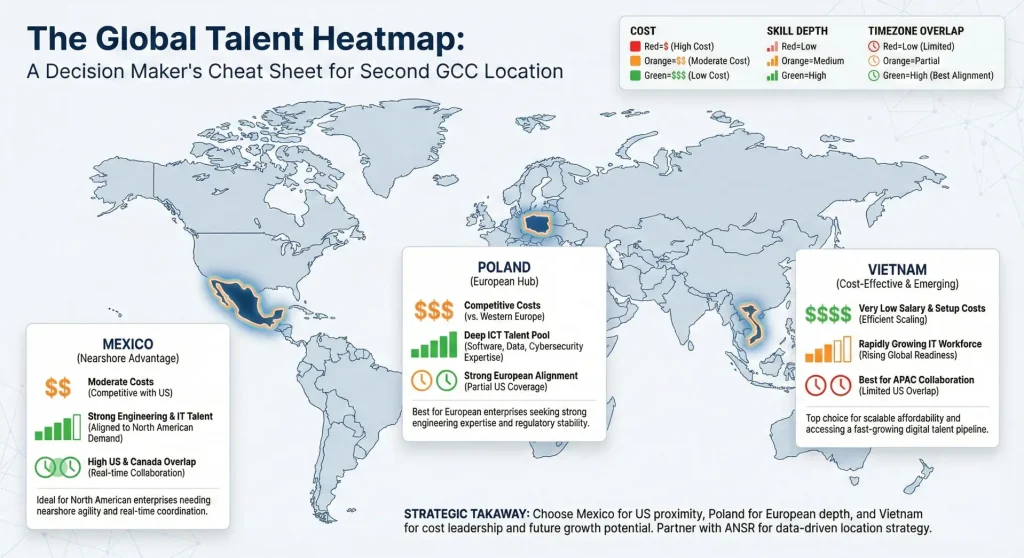
Comparative Table: Cost vs. Skill Availability
Selecting the right location for a second GCC requires balancing cost, talent depth, and time-zone fit. Vietnam, Mexico, and Poland each offer distinct strengths shaped by workforce maturity, regional access, and ecosystem scale. The comparison below highlights how these locations differ in GCC readiness and long-term capability growth.
|
Factors |
Vietnam |
Mexico |
Poland |
|
Operating Cost |
Very low salary and setup costs enable efficient GCC scaling |
Moderate costs remain competitive with US delivery centers |
Competitive costs versus Western Europe with strong quality delivery |
|
Digital and Engineering Talent |
Rapidly growing IT and engineering workforce with rising global readiness |
Strong engineering and IT talent aligned to North American demand |
Large ICT talent pool with deep software, data, and cybersecurity expertise |
|
Talent Scalability |
Expanding graduate pipeline supports long-term hiring growth |
Stable workforce suited for operations and support roles |
A mature talent ecosystem enables steady scaling of engineering teams |
|
Time-Zone Alignment |
Best for APAC collaboration with limited US overlap |
High real-time overlap with the US and Canada |
Strong alignment with Europe and partial US collaboration coverage |
|
Geopolitical and Supply-Chain Resilience |
Diversified Southeast Asian operating stability |
Nearshore resilience for US-centric business models |
EU regulatory stability with strong data-privacy compliance |
Conclusion
Choosing between Vietnam, Poland, and Mexico depends on cost efficiency, talent depth, and real-time collaboration needs. Vietnam offers scalable affordability and fast-growing digital talent. Poland delivers strong engineering expertise within the European ecosystem, while Mexico provides seamless North American alignment with nearshore agility.
A well-planned second GCC strategy can help enterprises leverage these regional strengths to build a diversified global footprint that enhances resilience, innovation, and long-term stability. Considering India as a location for your next GCC?
Partner with ANSR, which supports organizations in designing, setting up, and scaling Global Capability Centers in India through data-driven location strategy, talent access, and operational expertise. With the right strategic guidance, businesses can accelerate GCC expansion while ensuring sustainable growth and global competitiveness.