
How to Manage an Offshore Team Across the UK–India Time Gap
Most UK leaders picture a communication black hole the moment they consider an offshore team in India. A five-hour difference sounds like a void where nothing gets decided, and nothing gets escalated in real time. That fear is exactly what stalls the decision to build offshore capability in the first place.
The picture does not reflect how offshore teams actually operate. Companies that understand how to manage an offshore team across this time gap treat it as a scheduling problem, not a structural one. The UK and India share a genuine overlap window each afternoon, wide enough to run daily standups, live reviews and real-time problem solving. The hours outside that window are not dead time either. They function as extended coverage, since work started in London continues in India after the UK day ends, and work started in India is often ready for review by the time London logs on. Handled with intent, the time gap stops being a limitation and becomes a structural advantage.
Why Does the UK–India Time Gap Feel Harder Than It Is?
The UK sits roughly four and a half to five and a half hours behind India, since India does not observe daylight saving and the UK does. On paper, that reads like a barrier, something to route around or absorb as a cost of doing business offshore. In practice, it leaves a substantial overlap window each afternoon, UK time, when both teams are online together and available for real-time work.
The perception of difficulty rarely comes from the hours themselves. It comes from three things that have nothing to do with geography: standups scheduled without regard for who is actually awake, decisions that are left unassigned, so both sides wait on each other, and a communication style built for same-room teams rather than a distributed one. A UK-based team with unclear ownership will struggle just as much within its own building as it will with an office in Bengaluru. The time gap simply makes the underlying problem visible faster.
Once you plan around the overlap instead of around the gap, remote team management across these two geographies starts to look routine rather than risky. The overlap window is not a workaround. It is the anchor the rest of the operating rhythm gets built on, and everything outside it becomes deliberate handoff time rather than a source of anxiety.
How Much Working-Hours Overlap Do UK and India Teams Actually Get?
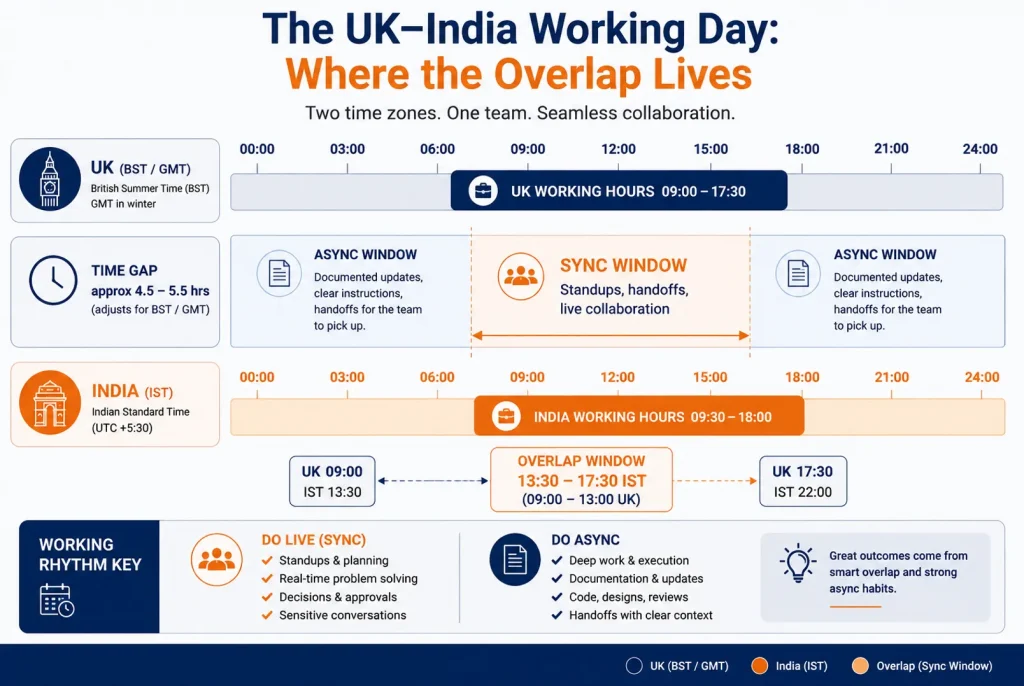
A typical UK working day of 9 am to 5.30 pm overlaps with an Indian working day of roughly 1.30 pm to 10 pm IST for about three to four hours, usually between 1 pm and 5.30 pm UK time. That window narrows or widens slightly depending on the time of year, since the UK moves its clocks and India does not, so it is worth confirming the exact hours each spring and autumn rather than assuming a fixed schedule.
Structure the day around that window rather than fighting it. The UK morning, before India comes online, works well for independent tasks that need focus rather than input: planning, writing, review of work handed off the previous evening. The Indian evening, after the UK has logged off, works the same way in reverse, giving the India team a stretch of uninterrupted time to build on whatever was agreed during the overlap. Neither block should be treated as waiting time. Each is a full working period.
Reserve the overlap hours themselves for anything that genuinely needs two people in the room at once: design reviews, escalations, sprint planning, client calls, or any decision where back-and-forth over chat would take longer than a fifteen-minute conversation. Filling the overlap with status updates that could have been written down asynchronously wastes the one part of the day where both teams are available together.
Organizations focused on managing distributed teams block out this overlap explicitly on a shared calendar, rather than assuming everyone will simply find their way into it, and then protect that window from being absorbed by internal meetings on either side. Handled this way, three to four well-used shared hours consistently outperform a full eight-hour overlap with no structure behind it.
When Should You Hold Standups and Handoffs?
The daily standup works best anchored inside the overlap window, ideally early in the shared afternoon rather than at the tail end of it. A standup held early gives both teams enough remaining overlap time to resolve anything that comes up in the meeting itself, rather than surfacing a blocker with no shared hours left to address it. A standup held late in the window, by contrast, tends to produce decisions that sit unactioned until the following day, since there is no time left to act on them together.
Handovers work best as short written summaries at the close of each side’s working day, covering three things: what moved, what is blocked, and what the other team needs to pick up next. This should not be treated as a formality. A handover written in five minutes at the end of the UK day can save the India team an hour of guesswork the next morning, and the reverse holds true as well. Teams that skip this step tend to rediscover the same context twice: once when the previous shift wrote the code or drafted the document, and again when the next shift has to reconstruct what was intended.
Together, a well-placed standup and a disciplined handover turn the time gap into a relay rather than a delay. Work does not stop when one side logs off. It passes cleanly to the other, with enough context attached that nothing needs to wait for the next overlap window to move forward.
What Communication Rhythm Works for Managing Offshore Teams?
Managing offshore teams depends less on tools and more on rhythm. Build a cadence around three layers: a daily async update to flag progress and blockers, a live sync inside the overlap window for anything that needs a quick decision, and a weekly structured review to step back and course-correct. Write decisions down as they happen rather than after the fact, so nobody waits twelve hours just to find out what was agreed. This async-first approach is a core principle of managing remote teams generally, but it matters more across a time gap, where waiting for a same-moment reply is not always realistic. Set clear response-time expectations for each channel, so urgent issues get flagged as urgent and everything else moves through documentation instead of chat noise.
How Do You Build Culture and Trust Across a Distributed Team?
Distributed team management succeeds or fails on trust, and trust needs more than shared tools. For UK-India teams specifically, that means designing onboarding around the handoff points your new hire will work in, not a generic induction. Schedule in-person visits with intent: a UK manager’s first India trip should map to the team’s real working hours, not a token week disconnected from the daily overlap rhythm. Build shared rituals that survive the time gap rather than fight it, such as monthly all-hands scheduled inside the overlap window and a recognition channel that does not favor whichever team happens to be awake when good news lands. Teams that feel like one team, rather than a UK team plus a vendor in another time zone, consistently outperform those that do not.
What Are the Common Offshore-Management Mistakes, and How Do You Avoid Them?
The most frequent mistake is time zone dumping, pushing unstructured work to the offshore team at the end of the UK day with no context, then expecting finished output by morning. This erodes trust fast. A close second is micromanagement disguised as oversight, where every task needs sign-off from the UK side, which defeats the purpose of building offshore capability at all. The third is treating the offshore team as second-class: excluding them from strategic conversations, giving them only execution work, or scheduling every important meeting at a time convenient for the UK alone. Avoid these by setting clear decision rights, giving the offshore team ownership of outcomes rather than tasks, and rotating meeting times so the inconvenience is shared, not one-sided.
Setting Your Offshore Team Up to Run Smoothly
Working with offshore teams across the UK–India gap is a solvable operational problem, not a structural one. Managing global teams at this distance comes down to three things: a scheduling model built around real overlap hours, a documented communication rhythm, and a deliberate investment in trust and culture. Get those right, and offshore team management stops feeling like a workaround and starts functioning like a genuine extension of your business.
For UK leaders who want the benefits of an India-based team without owning every layer of this operational detail, a managed Global Capability Center model removes much of the day-to-day management burden. The infrastructure, compliance, talent management and operational rhythm are handled for you, so your leadership time goes into strategy and outcomes rather than scheduling logistics.
Talk to ANSR about building a GCC in India that runs on your terms, not your time zone.