
GCC Framework for AI and Data Governance: All You Need to Know
Artificial Intelligence (AI) is increasingly shaping global business operations and decision-making, but it also introduces growing data risks, from algorithmic bias to regulatory non-compliance. Industry research shows that the average global cost of a data breach has surged to USD 4.88 million, marking the sharpest annual increase since the pandemic.
In the financial sector, this figure is even higher. Data breach expenses now average around USD 6.08 million, approximately 22% more than the global average. These rising costs underscore the urgent need for stronger AI oversight and improved data governance across industries.
Understanding AI and Data Risks in Global Operations
The use of artificial intelligence is seriously altering the way businesses work at a global scale. While it is creating many incredible opportunities, it also gives rise to many potential risks. These include ethical dilemmas, new kinds of cybersecurity threats, major privacy concerns, and shifts in the job market.
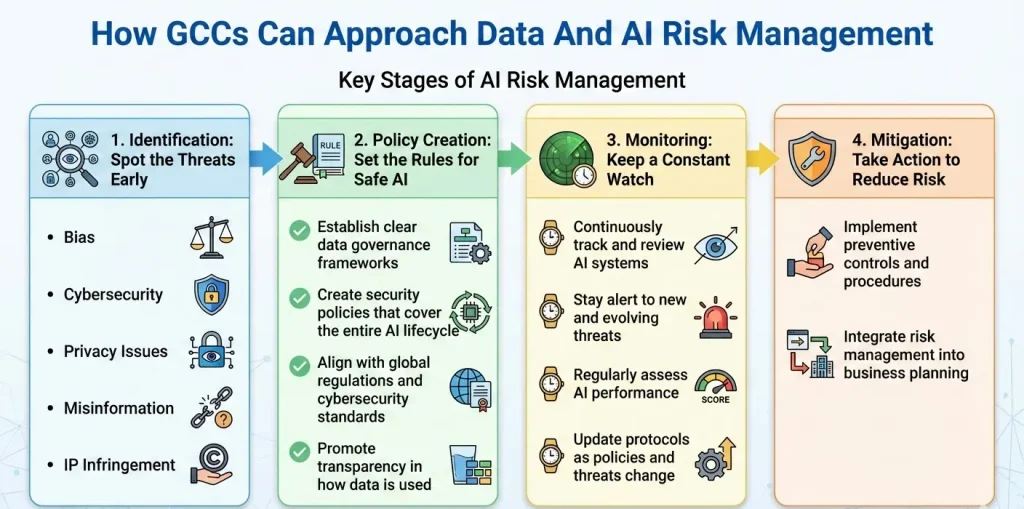
ReHere are 10 common risks linked to AI:
- Bias: AI systems may unintentionally perpetuate human or data-based biases which they have learnt from the data they have trained on
- Cybersecurity Threats: Attackers and criminals alike are using AI to fashion new and smarter, more targeted cyber threats
- Data Privacy Issues: AI frequently works on big data sets that may include personal or sensitive information
- Environmental Harms: Running massive AI-based models consumes a huge quantity of energy and water
- Existential Risks: Some experts fear AI becoming too advanced or hard to control
- Intellectual Property Infringement: Generative AI tools might inadvertently reuse copyrighted material, creating legal issues for users and developers
- Job Losses: Increased automation resulting from AI could adversely affect jobs in areas such as customer support and administration
- Lack of Accountability: When AI makes a poor or harmful decision, it is not always clear who is accountable for the outcome
- Lack of Explainability and Transparency: Some of the AI-system architectures are highly complex and difficult to understand
- Misinformation and Manipulation: AI-generated content like deep fakes may be fake or misleading content that looks real
Also Read: Reskilling for AI-first GCCs
Building an AI Risk Management Framework
As AI deployment expands globally, understanding and managing associated risks is becoming increasingly critical. Recent surveys indicate that while over 90% of firms use AI, only 18% have formally established internal policies to govern its safe and ethical use.
Key Policies for AI Security
AI systems are becoming more integrated into critical business infrastructure. Organizations can, thus, consider implementing robust AI security policies to address risks across their life cycle. Some of these policies include:
- Leverage existing cybersecurity standards where applicable to current AI needs
- Design security policies that cover the full AI life cycle and value chain
- Coordinate globally with allies to align AI security strategies
- Engage in public-private partnerships to develop and deploy security solutions
- Expand support for AI-specific cybersecurity R&D and workforce training
Regulatory Compliance and Data Governance
Regulatory compliance begins with strong data governance and alignment with cross-border regulations. Organizations can consider the following measures to ensure AI systems meet legal and ethical standards:
- Align AI usage with existing data protection and industry-specific laws
- Build governance frameworks to monitor and control AI data practices
- Promote transparency in how data is collected, processed, and used by AI
- Support international regulatory cooperation to enable data interoperability
- Regularly update compliance protocols as threats and policies evolve
Proactive Risk Mitigation Strategies
Proactive risk mitigation begins with early detection and continues through structured, ongoing improvement. The components below help organizations build a stable and adaptable risk management approach:
- Continuous Monitoring and Assessment
Regularly tracking and reviewing risk factors to detect changes early and respond quickly. This helps organizations stay alert to evolving threats and make timely adjustments.
- Early Risk Identification
Identifying potential issues before they escalate into major disruptions. Early detection allows for faster, more cost-effective interventions.
- Prioritized Risk Assessment
Assessing the likelihood and impact of each risk to focus on the most critical threats. This enables smarter resource allocation and more informed planning.
- Preventive Control Measures
Implementing policies, procedures, and technologies to minimize or eliminate risk effects. These controls serve as buffers, reducing exposure and enhancing stability.
- Strategic Integration
Incorporating risk thinking into business planning to improve decision-making and organizational readiness. This ensures risk awareness is embedded in daily operations.
- Culture of Improvement
Continuously refining processes based on feedback, new data, and emerging threats. A consistent cycle of learning strengthens adaptability and resilience.
Conclusion
The growth of AI in global centers presents both huge opportunities and serious challenges. To navigate the new landscape, adopting cutting-edge technologies isn’t enough. Enterprises need to strengthen AI governance to stay relevant. This requires putting practical policies in place while staying on top of the regulatory requirements.
Robust AI risk management practices, including bias monitoring, transparency in screening logic, and regulatory alignment are critical components for scaling ethical AI across global operations.
By adopting proactive risk mitigation strategies with ethical and transparent oversight, businesses can enhance decision-making and operational efficiency. Expert teams at ANSR help organizations build AI-enabled global hubs that operate securely, ethically, and in full regulatory alignment. Contact ANSR today to start your AI-backed GCC journey.