
How to Build A Multi-Hub Global Delivery Network as a Resilient Global Strategy
The era of the single-source offshore model is giving way to a more sophisticated architecture: the multi-hub global delivery network. By strategically integrating Global Capability Centers (GCCs) with nearshore hubs, forward-thinking enterprises are no longer just chasing cost savings they are building a resilient ecosystem designed for speed and continuous innovation. By spreading work across low-cost emerging markets, aligned nearshore locations, and R&D hubs, companies reduce geopolitical risk. This structure also helps teams stay aligned across time zones.
As per recent research, the GCC market alone hit $128.5 billion in 2023 and is eyeing $300 billion by 2032, fueled by talent hunts and resilience needs. Nearshore setups supercharge this by slashing time-to-market 28% and burn rates 41% via shared time zones and regulations. Indian hubs housed in cities like Bangalore further fuel AI-driven breakthroughs. In 2026’s volatile economy, nailing talent orchestration, governance, and hybrid tech will separate globally resilient enterprises from those with local influence.
Why Single-Country Offshoring Can Limit Global Hub Growth
Single-country offshoring offers quick cost wins but limits long-term hub expansion and weakens a company’s global sourcing strategy. Silos that are created in this way end up stifling innovation and amplifying disruptions.
In the turbulent environment of 2026, multi-hub delivery networks integrating GCCs, nearshore locations, and tech hubs will unlock diverse talent pools and provide the adaptability required for sustainable growth.
Risk of Concentrated Delivery Models
Centralizing operations in a single offshore location, such as India or the Philippines, raises risks from geopolitical unrest, regulatory changes, and supply chain disruptions. These issues can quickly bring projects to a standstill.
At the same time, communication hurdles, cultural differences, and time zone challenges gradually undermine efficiency. Talent poaching and lapses in IP security add to the strain, driving up hidden costs and leading to inconsistent quality.
Finally, this model curbs scalability. Firms miss opportunities in diverse markets and specialized skills, resulting in a fragile structure vulnerable to currency shifts and wage hikes.
How a Distributed Global Tech Hub Network Drives Resilience
A multi-hub approach distributes GCCs across regions such as Latin America and Eastern Europe. This setup creates redundancy against disruptions, allowing seamless workload shifts and diversified revenue streams to maintain uninterrupted operations.
It also improves collaboration with lower latency and better cultural alignment. Simultaneously, it taps into global expertise to speed up innovation and counter risks from regional instability.
This distributed resilience optimizes costs, improving service levels, and supporting agile scaling, turning potential threats into competitive advantages.
Role of GCCs, Nearshore Centers, and Vendors in a Global Delivery Network
GCCs serve as strategic hubs for core operations, nearshore centers enable agile collaboration via proximity, and vendors offer specialized scaling. Global delivery networks (GDN) integrate GCCs, nearshore centers, and vendor partnerships to drive efficiency, innovation, scalability, and coordinate multi-hub delivery for multinational enterprises.
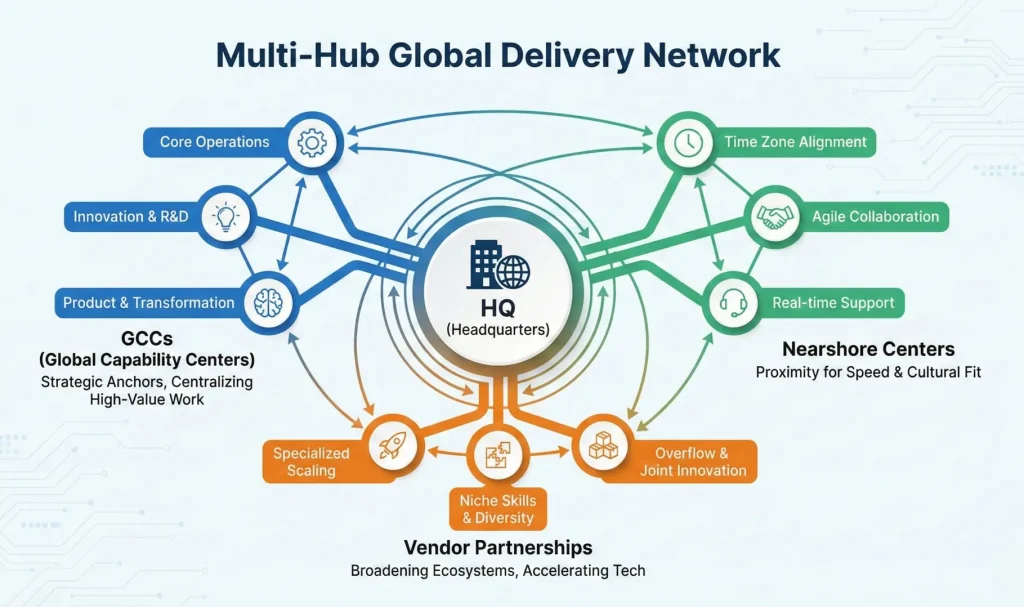
This model tackles talent shortages, time zone issues, and technological evolution, yielding cost savings, and quicker market entry.
GCCs as Strategic Anchors in the Global Hub Model
GCCs have evolved from back-office roles into strategic anchors in the global hub model, centralizing innovation, R&D, and high-value work to drive transformation. Across regions like India, North America, and Europe, GCCs embed leadership, dedicate innovation resources, and apply AI to streamline operations and spark growth.
Top performers leverage enablers like AI architectures and business-aligned strategies to boost:
- Efficiency
- Digital progress
Nearshore Centers for Agility and Time Zone Alignment
Nearshore centers enhance GDN agility through geographic proximity and time zone overlap, promoting real-time teamwork that surpasses offshore models. Cultural alignment reduces misunderstandings, while costs drop substantially versus onshore without sacrificing quality.
Vendor Partnerships to Scale the Global Tech Hub Ecosystem
Vendor partnerships amplify GDNs by broadening tech hub ecosystems with niche skills, talent diversity, and joint innovation beyond internal limits. Alliances with hyper-scalers, startups, and providers speed AI, cloud, and SaaS advances, crafting integrated solutions. Effective governance transforms vendor relationships from transactional partnerships into strategic alliances. By establishing clear oversight, companies ensure alignment, transparency, and long-term value creation.
Key governance benefits include:
- Shared value creation
- Seamless data flow
- Expanded market reach
- Strategic collaboration
Governance, Metrics, and Operating Models for Multi-Hub Success
Effective governance, metrics, and operating models form the foundation of multi-hub GDNs. These elements ensure predictable and seamless multi-hub delivery across distributed teams.
They foster smooth collaboration, careful risk oversight, and consistent value delivery across distributed teams. Governance bridges high-level strategy with on-the-ground execution, even amid diverse regulations. Metrics provide clear insights into efficiency and innovation, supporting smarter, data-guided choices. Meanwhile, adaptive models emphasize modularity to better navigate disruptions and changes.
Integrating Governance Across Global Hubs
Governance integration in GDNs balances centralized oversight with hub autonomy, ensuring policy consistency in data security and AI ethics across various regions.
Hybrid models use steering committees, digital monitoring, and risk-embedded charters to streamline decisions and build trust. This approach scales operations while minimizing compliance risks and fueling innovation.
Measuring Performance Across the Global Delivery Network
GDN performance measurement relies on KPIs spanning financials, innovation, and operations, like business impact scores, throughput rates, and retention indices. AI-powered dashboards aggregate data for benchmarking and predictive tweaks, shifting from silos to holistic views. Interconnected metrics boost resilience and value in dynamic settings.
Building a Unified Culture Across Distributed Tech Hubs
Unified culture in distributed hubs bridges gaps via virtual programs, mentorship, and shared rituals, embedding values and learning. Leaders model hybrid norms and inclusivity, using tools for sentiment tracking to combat silos.
Strong cultures enhance innovation and retention, creating high-trust ecosystems for adaptability.
Conclusion
A multi-hub global delivery network gives companies the resilience, talent access, and speed needed in today’s volatile environment. By combining GCCs, nearshore centers, and vendor-led tech hubs, organizations spread risk, accelerate innovation, and keep teams aligned across time zones.
Strong governance, shared culture, and data-led performance systems tie these hubs together. They turn distributed operations into a unified, future-ready engine that outperforms single-location models.
ANSR helps enterprises design, build, and scale these multi-hub networks with high-performing GCCs, nearshore centers, and global tech hubs. Connect with ANSR to power your next stage of growth.