
Nearshore Development Centers for Agile, Product Led Teams
Modern software engineering calls for deeper collaboration than the traditional requirement hand-off outsourcing model was designed to support. In its place, a new paradigm has emerged as the nearshore development center (NDC). As enterprises pivot from project-based mindsets to product-led strategies, the geographic and cultural distance of offshoring has become a friction point that many can no longer afford. As software moves from being a support function to the core of the customer experience, rapid feedback loops define competitive advantage. Nearshoring for North American and European enterprises is therefore less about cost optimization and more about restoring agility that was diluted across twelve-hour time differences. With closer time-zone and cultural alignment, distributed teams evolve from task executors into embedded product collaborators and innovators.
Why Nearshore Is Ideal for Agile and DevOps
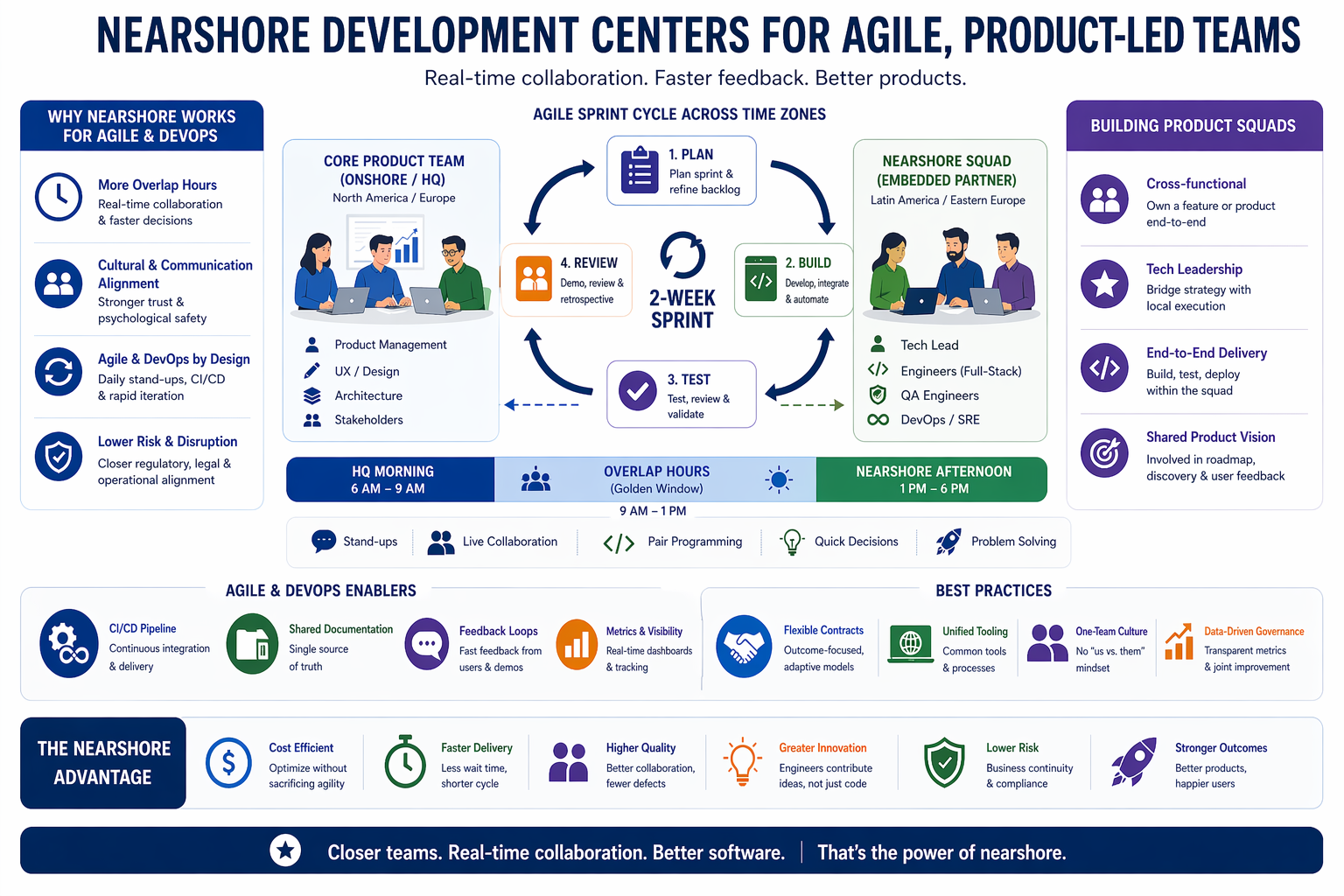
At its core, Agile is a philosophy built on proximity of time, communication, and decision-making. It relies on continuous dialogue, rapid course correction, and real-time rituals such as daily stand-ups and sprint reviews. DevOps reinforces this need for closeness, with its ‘you build it, you run it’ ethos requiring tight integration across development, testing, and operations. Nearshoring naturally aligns with these principles by enabling teams to collaborate in real time rather than through delayed handoffs.
The greatest enemy of Agile is the wait state, the idle time created when teams cannot get immediate answers or decisions. In traditional offshore models, a developer encountering a blocker may wait half a day for a response from a product owner in another time zone, effectively losing an entire workday of productivity. Nearshore models, by contrast, offer substantial time-zone overlap, enabling synchronous stand-ups, live pair programming between senior architects and engineers, and rapid iteration where feedback from a morning sprint demo can be implemented the same day.
Agile also depends on psychological safety—the ability for team members to challenge assumptions, raise concerns, and propose alternatives. Nearshore teams often share closer cultural norms, educational frameworks, and business communication styles with the home office, reducing friction and misunderstanding. This cultural proximity minimizes the risk of the yes-man syndrome, where teams agree to unrealistic timelines or flawed requirements to avoid confrontation, and instead encourages constructive debate that strengthens product decisions and software quality.
Building Product Squads in Nearshore Software Companies
Leading Nearshore Delivery Centers (NDCs) are moving beyond staff augmentation models toward integrated product squads. A product squad is a cross-functional, autonomous team that owns a feature, product area, or customer journey end-to-end shifting the nearshore center from execution support to product co-creation. This transition marks a fundamental shift from staff augmentation to outcome ownership. In a staff augmentation model, the client manages individuals and delivery risk. In a product-led nearshore model, the NDC owns delivery outcomes, quality, and velocity. Effective squads typically include a well-balanced mix of roles:
- Tech Lead: Acts as the bridge between the client’s global architecture strategy and local execution, ensuring alignment on standards, scalability, and design principles.
- Full-Stack Engineers: Capable of working across backend, frontend, and integration layers to deliver features end-to-end without dependency bottlenecks.
- Embedded QA and DevOps: Integrated directly into the squad so that testing, automation, and deployment are core sprint deliverables, not downstream activities.
For nearshore squads to function as true product teams, shared product vision is essential. Enterprises that treat nearshore teams as strategic partners involve them in roadmap discussions, user research, and product discovery. When engineers understand the end-user’s pain points and business context, they move beyond ticket execution to proactive problem-solving and innovation. This shift transforms the nearshore center from a delivery extension into a capability center, one that contributes to product intellectual property, accelerates innovation, and strengthens the enterprise’s digital core.
Governance, Contracting, and Collaboration Best Practices
Transitioning to a nearshore model requires a fundamentally different governance and contracting framework than traditional outsourcing. As delivery becomes more collaborative and product-centric, contracts and operating models must enable flexibility, shared accountability, and continuous improvement rather than rigid, transactional control.
- Flexible Contracting Models Enable True Agility: Flexible contracting is essential. Fixed-price models are inherently misaligned with agile, as they lock requirements in time and discourage experimentation and innovation. For nearshore product teams, enterprises are increasingly adopting models that support adaptability and outcome ownership. Managed services arrangements, for example, focus on funding dedicated squads for their capacity and capabilities rather than a static feature list. Outcome-based incentives are also gaining traction, with a portion of contract value tied to performance metrics such as system reliability, user adoption, or delivery velocity aligning vendor success with business outcomes.
- Unified Tooling and One-Team Governance: Unified tooling and one-team governance are critical enablers of collaboration. In a nearshore model, the digital environment becomes the shared workplace, and governance must enforce a common technology and collaboration stack. This includes shared communication platforms such as slack or Microsoft teams where nearshore engineers have the same visibility and access as internal teams, as well as a unified CI/CD pipeline to ensure consistent testing, security, and deployment standards. Beyond tools, leadership behavior matters if high-performing organizations avoid us vs. them language and include nearshore leaders in strategic offsites, town halls, and planning cycles to reinforce a single, integrated engineering organization.
- Data-Driven Escalation and Collaborative Performance Management: Escalation and performance management should be data-driven and collaborative. Agile nearshore governance prioritizes transparency over static reporting. Real-time dashboards tracking metrics such as cycle time and change failure rate provide an objective view of squad health and delivery performance. When issues arise, escalation should trigger joint retrospectives and root-cause analysis not contractual penalties. The goal is continuous improvement, not blame, enabling nearshore squads to operate as long-term product partners rather than transactional vendors.
The rise of nearshore development centers signals a shift in how enterprises think about innovation velocity. In a world where feedback loops define competitive advantage, reducing temporal and cultural distance is critical. By embedding development closer to the business, enterprises move from shipping features to shaping experiences. The NDC is no longer a contingency model for back-office delivery it is the engine driving product strategy and digital differentiation.