
Offshore Software Development for Australian Companies: What It Really Costs
The cost of offshore software development for Australian firms generally ranges from AUD $30 to $80 per hour, or AUD $4,500 to $9,000 monthly per developer, resulting in cost savings of 55-70% compared to local recruitment. However, the actual expense requires careful consideration of hourly rates alongside concealed factors such as management, infrastructure, and compliance costs.
Why do Australian Companies Choose Offshore Software Development?
Enterprises in Australia choose offshore software development to overcome local tech talent shortages and wage arbitrage Partnering with an offshore software development company in regions like India provides a favourable time zone overlap, enabling real-time daily communication and faster project delivery. Key drivers for offshoring are:
- Skills Shortage: Australia’s local pool of experienced tech talent is small and constrained by high demand.
- Cost Efficiency: Labor and operational expenses drop significantly, cutting total budget requirements without losing quality.
- Time Zone Alignment: India’s time zone (UTC+5:30) sits close to Australian time zones. This allows a 4-to-5-hour same-day working overlap for meetings, unlike the severe gaps faced by US firms.
- Fast Scaling: Businesses can onboard vetted engineers in weeks instead of enduring months of local recruitment.
What does Offshore Software Development Cost?
The total offshore software development cost depends on more than developer salaries. Geography, experience, technology requirements, operational overhead, and setup needs all influence the final budget. Understanding these cost drivers helps businesses build a more realistic offshore development budget.
Developer Rates
Developer rates typically account for the largest share of an offshore development budget. Costs vary based on location, experience, technical specialization, and project complexity.
- Junior Developers: Suitable for routine development, QA, maintenance, and support tasks.
- Mid-Level Developers: Best suited for independent feature development, integrations, and application enhancements.
- Senior Developers and Architects: Typically required for system architecture, security, complex infrastructure, and technical leadership.
Rather than comparing hourly rates alone, businesses should evaluate the overall capability and value delivered by each talent market.
The Hidden Costs of Offshore Development
Base developer rates are only one part of the equation. Businesses may also need to account for management, communication, compliance, quality assurance, and technology infrastructure. Key operational costs can include:
- Management and Coordination: Product managers, scrum masters, engineering leads, and local delivery teams.
- Communication and Collaboration: Project management platforms, secure communication tools, and virtual collaboration infrastructure.
- Legal and Compliance: Contracts, intellectual property protection, data privacy requirements, and regulatory compliance.
- Quality Assurance: Testing environments, automation tools, and dedicated QA resources.
These additional expenses can materially affect the total cost of an offshore development team and should be included during the planning stage.
One-Time Setup Costs vs. Ongoing Expenses
A realistic offshore development budget should separate initial setup costs from recurring operational expenses. This distinction gives businesses greater visibility into both the investment required to launch a team and the cost of maintaining it over time.
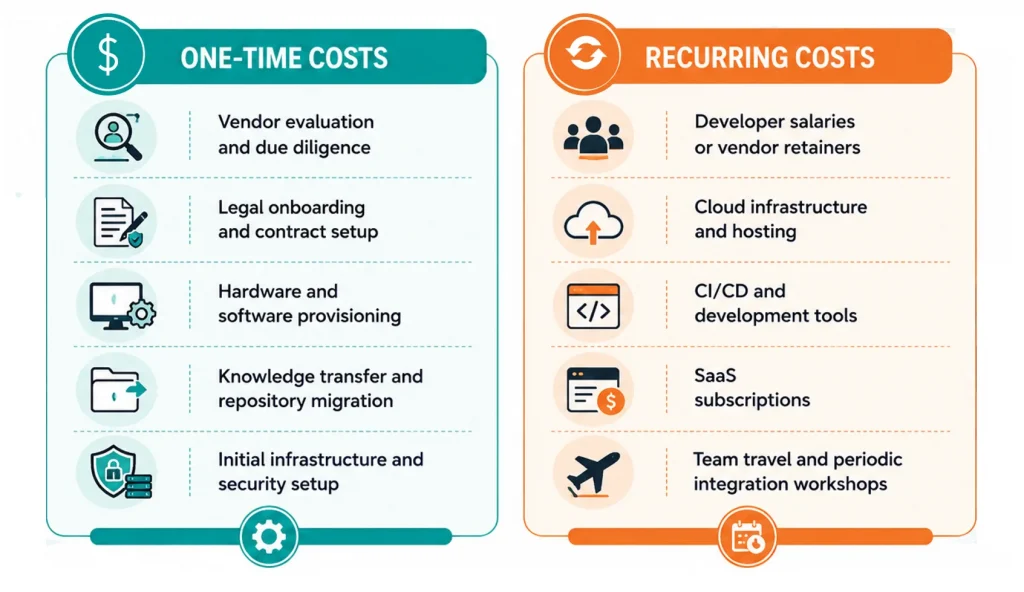
This breaks down the key costs involved in offshore software development into two categories: one-time setup costs and recurring operational costs. It highlights expenses such as vendor evaluation, legal onboarding, hardware and software provisioning, knowledge transfer, developer salaries, cloud infrastructure, development tools, SaaS subscriptions, and team travel. This reinforces the importance of considering both upfront and ongoing expenses when planning an offshore development budget. Separating these costs helps businesses avoid underestimating the initial investment or overlooking recurring expenses when comparing offshore delivery models.
What are the main offshore engagement models and how do they price?
Factor | Project Outsourcing | Dedicated Team | Offshore Development Center (ODC) |
Core model | Vendor delivers a defined project end to end | Dedicated developers work as an extension of your team | Long-term offshore setup built around your organisation |
Best suited for | One-time builds, MVPs, defined projects | Continuous development and product scaling | Large-scale, strategic engineering operations |
Scope | Fixed or clearly defined | Flexible and evolving | Long-term roadmap driven |
Control | Low to moderate | Moderate to high | High |
Team ownership | Vendor-managed | Dedicated to your business | Built around your organisation |
Engagement duration | Short to medium term | Medium to long term | Long term / permanent |
Pricing model | Fixed price or T&M | Monthly retainer / T&M | Cost-plus / operational cost + management fee |
Infrastructure | Typically vendor-provided | Vendor-managed | Dedicated infrastructure and facilities |
Management | Vendor manages delivery | Vendor handles HR and operations; client manages product work | Greater client involvement in operations and governance |
Scalability | Limited to project scope | Easy to scale team size | Designed for significant, sustained scale |
Strategic integration | Low | Medium | High |
Typical outcome | Completed project | Extended engineering capacity | Strategic offshore capability / potential BOT transition |
How Do You Hire Offshore Developers Without Quality Risk?
For successfully hiring offshore developers, Australian companies must avoid the cheap rate pitfall and concentrate on the long-term value of developers, their technical skills and dependability. First, they should evaluate developers according to Australian standards and requirements. For instance, during the technical interview, one could check how developers would design the solution to ensure the personal identification information is kept inside Australian clouds.
Next, it is necessary to give preference to the developer tenure by demanding from the vendors the documentation proving the average developer tenure. The vendor that has the average developer tenure of eight years would often provide more value to the customer over 24 months than the cheap vendor with the average employee turnover. Lastly, it is necessary to conduct a paid trial before signing a contract. Ideally, it should be a two-week paid trial with the actual developers working on the client’s account.
When does an Offshore Development Center Beat project outsourcing?
In the case of companies that have repetitive technology needs and high demands for intellectual property control, the offshore development center (ODC) model or, even more advanced, the global capability center (GCC) model may suit them better. Even though project outsourcing is very efficient for one-time projects, the ODC would save up to 40-60% of costs and bring higher operational flexibility.
The GCC model will make it possible for mature Australian companies to turn the offshore center into a strategic pillar in terms of innovations and AI. This kind of model has already been efficiently used by such large corporations as NAB in Australia that created the team of 1,400 people in India in cybersecurity and AI areas.
Is Offshore Software Development Worth it for Your Australian Business?
From a financial point of view, an eight-person team of engineers working offshore will allow an Australian business to save up to $750,000 – $900,000 each year on local recruiting and operations. However, it is only in case if the Australian business chooses its partners according to their business maturity, experience, and reliability, rather than by their lowest per-hour prices.
When there is a necessity for scaling fast, with top-notch software and good IP rights protection, the priority should be made on creating a reliable offshore presence. Offshoring is no longer merely an option to save money for Australian companies.