
Offshore Staff Augmentation vs Nearshore Product Teams: Choosing the Right Tech Delivery Model
As organizations scale digital initiatives, choosing the right tech delivery model becomes essential. The right delivery approach can help companies balance cost efficiency, access to global talent, and operational flexibility.
It is now widely accepted that distributed teams enable faster scaling, while also helping manage budget constraints and skill shortages. Industry research shows that global outsourcing, including offshore and nearshore delivery, can reduce development costs by 30% to 70%, depending on the model.
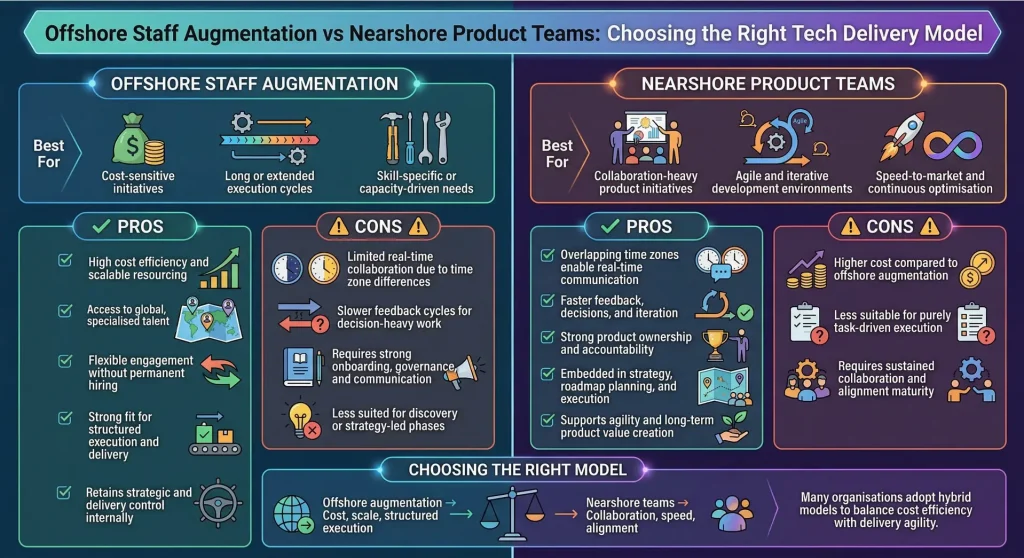
Offshore staff augmentation offers strong cost efficiency, scalability, and access to global talent, helping organizations expand capabilities without increasing permanent headcount. Nearshore product teams provide closer collaboration through cultural alignment and overlapping time zones, enabling real-time communication and faster decisions.
The choice between nearshore and offshore development models depends on priorities such as collaboration needs, project complexity, and delivery agility. Selecting the right model supports sustainable growth, innovation, and consistent business value.
How Offshore Staff Augmentation Works
Offshore staff augmentation brings in external experts who work alongside existing teams from remote locations. Companies fill specific skill gaps by partnering with offshore providers that supply trained professionals.
These individuals follow the company’s processes, tools, and communication routines, functioning much like internal team members. The approach keeps strategic control in-house while adding capacity and managing costs more effectively, with delivery speed improving when onboarding and governance are well managed.
Here are the various types of offshore staff augmentation models:
- Dedicated Team Model: This model assigns offshore development center professionals exclusively to a single client. These teams align closely with internal goals, processes, and long-term delivery roadmaps. Clients retain full control over priorities, workflows, and performance management. It is ideal for ongoing development and evolving product requirements.
- Project-Based Model: The project-based model engages offshore talent for defined scopes and fixed timelines. Teams focus on specific deliverables until project completion and ramp-down. It works well for specialized needs requiring short-term expertise. Clear requirements and milestones ensure predictable execution and controlled costs.
- Hybrid Model: The hybrid model combines dedicated teams with project-based resource flexibility. Organizations can scale resources across multiple priorities, balancing long-term continuity with short-term specialization needs. Strong coordination is essential to manage shared responsibilities and overlapping resources.
A structured onboarding and execution process ensures offshore staff integrate effectively with in-house teams. Clear planning, communication, and governance help maximize productivity and minimize delivery risks.
Here are the core steps involved:
- Review current skill gaps, project scope, timelines, and expectations
- Choose an offshore partner with strong capability and cultural fit
- Outline the engagement model along with roles and communication routines
- Agree on contracts, IP protection, service levels, and compliance terms
- Get internal teams ready with the right tools, workflows, and alignment
- Onboard offshore talent with aligned tools and security standards
- Set daily and weekly rhythms for standups and reviews
- Monitor progress through reviews and feedback loops
- Track performance using clear KPIs
- Run retrospectives to refine collaboration and remove blockers
What Makes Nearshore Product Teams Different
Nearshore product teams operate as integrated extensions of internal product organizations. They cover the full product lifecycle, including strategy, discovery, development, and execution. They collaborate closely with business, design, and engineering stakeholders daily.
Time zone overlap enables real-time feedback and faster decisions, strengthening continuous alignment across teams. Product ownership, discovery, delivery, and iteration happen within a shared operating rhythm. It supports agility, accountability, and long-term product value creation.
Nearshore product teams enable real-time collaboration, faster feedback cycles, and stronger product ownership. Unlike traditional offshore outsourcing models, they are embedded in strategy, roadmap planning, and daily decisions.
Here are the steps decoded on how these teams work:
- Teams collaborate daily through overlapping hours for real-time communication and quick decisions
- Agile sprints drive flexible, transparent, and continuous delivery
- Project management tools give clear visibility into tasks, progress, and timelines
- Real-time issue resolution enables quick bug identification and fixes
- Security and compliance frameworks protect data through controls and encryption
- Ongoing support and maintenance ensure performance and product stability
- Cross-functional alignment keeps product, design, and engineering focused on shared goals
- Backlog refinement keeps priorities updated and business-aligned
- Sprint reviews provide frequent feedback to guide product direction
- Documentation and knowledge sharing maintain alignment and support onboarding
When to Use Each Model Across the Lifecycle
Nearshore product teams are ideal when products demand collaboration across delivery and optimization. They support agile cycles through communication, faster feedback, and shared ownership across stages.
This model fits dynamic environments where speed, flexibility, and alignment remain critical. Here are the lifecycle phases you can use this model across:
- Use nearshore development teams during discovery phases requiring frequent workshops, validation, and stakeholder alignment
- Adopt it for iterative development cycles needing rapid feedback, sprint reviews, and decisions
- Scale the teams during launch phases to accelerate delivery without long-term hiring commitments
- Rely on nearshore support post-launch for continuous improvements, optimizations, and evolving user requirements
Offshore staff augmentation works best when organizations need scalable expertise across extended execution cycles. It enables global talent, cost efficiency, and flexible resourcing without permanent hiring commitments. It supports structured execution, long-term scaling, and efficient delivery for cost-sensitive initiatives.
Here are the lifecycle phases you can use this model across:
- Use offshore staff augmentation when internal teams lack specialized skills required for well-defined execution phases
- Adopt it to scale teams while avoiding lengthy recruitment and permanent hiring overheads
- Choose offshore development centre support for budget-driven projects needing quality delivery at optimised operational costs
- Rely on offshore teams for short-term initiatives that do not justify full-time internal hires
- Apply offshore augmentation when in-house teams are overloaded and require sustained execution support
Choosing between offshore staff augmentation and nearshore product teams depends on delivery priorities. Offshore models suit cost efficiency, scalability, and structured execution across extended delivery cycles. Nearshore teams fit collaboration-heavy initiatives needing speed, alignment, and continuous feedback. The right choice balances budget constraints, project complexity, governance maturity, and collaboration intensity.
Organizations increasingly adopt hybrid strategies to optimize cost, quality, and delivery agility. Aligning the model with business goals ensures predictable outcomes and long-term technology value.
ANSR helps enterprises design, scale, and optimize global delivery models precisely. Partner with ANSR to build high-impact offshore and nearshore development teams aligned to your growth strategy.