
Building an Offshore Team in India: An Australian Mid-Market Playbook
For Australian mid-market companies planning to scale in 2026, offshore growth is no longer a question of whether to look overseas, it is a question of how to do it with control, speed, and strategic intent. As local tech talent gaps persist and fully loaded employment costs rise through superannuation increases, payroll taxes, and competition for specialised skills, India has become a compelling base for building high-performing offshore teams.
What does it mean to build an offshore team in India?
To build an offshore team in India means establishing a dedicated, integrated extension of your domestic workforce rather than simply delegating tasks. Unlike traditional vendor arrangements where projects are thrown over the wall, an offshore team operates under your direct daily management, using your internal tools, and aligning with your corporate roadmap.
For Australian companies, India is the best destination. Its primary technology hubs Bengaluru (the SaaS capital), Pune (the fintech and banking center), and Hyderabad (the data and cloud infrastructure powerhouse) offer an unparalleled concentration of talent fluent in cloud-native software engineering, DevOps, and advanced analytics. Offshoring allows mid-market firms to capture this expertise, turning geographical expansion into a core corporate capability.
Offshoring vs outsourcing: what’s the difference for your team?
Understanding the difference between offshoring and outsourcing is critical to choosing the right operating model. Although the terms are often used interchangeably, they address two different strategic decisions: who performs the work and where the work is performed.
Outsourcing changes who do the work. A company transfers specific tasks, projects, or functions to an external third-party provider, typically under a defined scope, service agreement, or deliverables-based contract, while Offshoring changes where the work is done. A company moves operations or builds a team in another country, such as India, to access specialised talent, expand capacity, and operate more efficiently across global markets.
For Australian mid-market companies, the distinction becomes particularly important when long-term ownership and control matter. Traditional outsourcing can sometimes create challenges around team continuity, product context, communication, and knowledge retention, particularly when teams work across multiple clients or projects.
A dedicated offshore team, by contrast, can provide a different model. Team members are selected around the company’s requirements, work exclusively on its priorities, and build knowledge of its products, processes, technology, and business goals over time. The company retains greater control over how the team operates while accessing a broader global talent pool.
How do you hire and structure offshore staff in India?
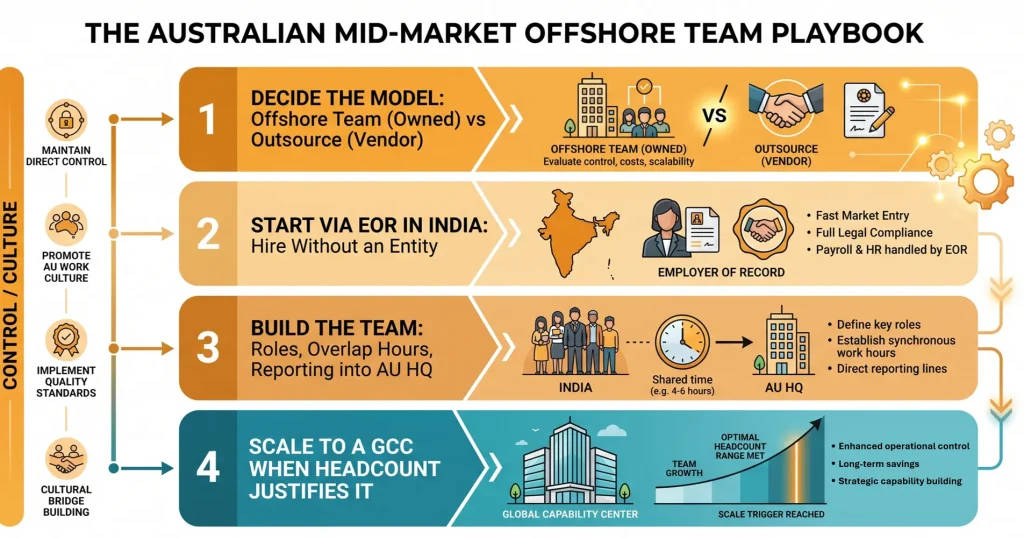
The coordination of offshore employees in India by Australian companies becomes easier because of the time zone similarity between the two countries. The time difference between India and AEST is about 4.5 hours, hence there is an effective period for collaborative effort in the afternoons. In the mornings, Australian teams engage in meetings with the clients and develop strategies, whereas Indian teams are invited to take part in stand-ups, discussions, and issue solving in the afternoons in Australia. With the end of the day in Australia, the Indian team takes over the execution of plans that have been made, ensuring continuity of delivery process.
What’s the Fastest Way for an Australian Company to Get Started?
Most mid-sized Australian companies find that setting up a subsidiary in India is not the quickest route towards setting up a team in the offshore market. An Employer of Record could offer a quicker route by handling employment, taxation, and local statutory issues while still maintaining control over the offshore team.
The Employer of Record could handle issues such as TDS, Provident Fund, and other employment needs, helping the business concentrate on recruiting and integrating the new employees into the team without having to understand India’s employment framework right away. It also could provide a more systematic approach towards the classification of workers, employment documentation, and intellectual property issues. Nevertheless, mid-sized Australian companies would do well to seek legal and tax guidance in relation to their organizational structure.
How Do You Keep Control and Culture Across an Offshore Team?
The success of offshore teams is best achieved if they are considered an extension of the main organization rather than a discrete delivery unit. Begin with proper reporting relationships, communications, and processes. Standup meetings between Australia and India, with the help of collaboration tools such as Teams, Slack, Jira, or Linear, can make sure that priorities and decisions are transparently tracked by all parties involved.
Recruitment process should pay attention not only to the technical skills but to the working style of candidates. Find engineers with good communication skills, critical thinking, and a sense of responsibility for results. There is even a dedicated interview for finding working style fit in an Australian low-hierarchy culture.
By combining the correct legal arrangements, governance framework, and cultural alignment, offshore teams of Australian companies can give both access to global talent pool and control over it.