
From Cost Arbitrage to Innovation Engines: Rethinking the GCC Mandate
Summary
GCCs must shift from executing narrow mandates to defining strategy – becoming the enterprise itself, not just an offshore extension
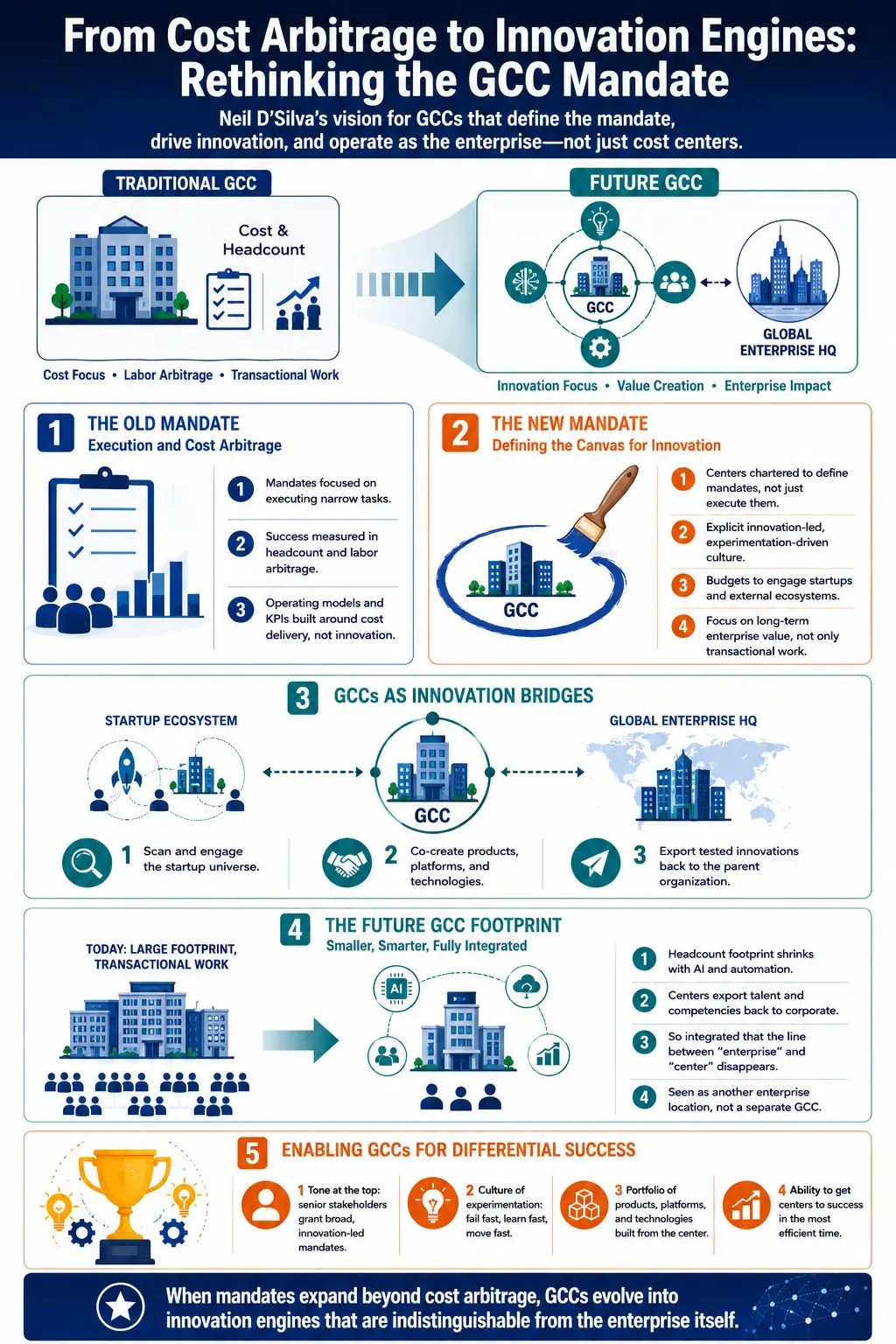
Traditional GCC mandates focus on cost arbitrage and headcount delivery, confining centers to execution roles; redefining the mandate to include problem-solving, strategy-shaping, and proposition-building unlocks innovation and transforms operating models.
Innovation-led GCCs are backed by senior stakeholders, funded for experimentation, and empowered to bridge the startup ecosystem with the enterprise, creating differentiated products and platforms rather than transactional output.
The future footprint will be smaller but smarter: AI and automation reduce transaction-heavy headcount while increasing talent density, turning GCCs into export engines for competencies, leaders, and technologies that drive global enterprise value.
Culture separates winners from followers – organizations that enable fast experimentation, learning from failure, and rapid iteration build GCCs that accelerate success in the shortest time.
Recommendation: Rewrite GCC charters from the top down – shift measurement from headcount to innovation impact, fund centers as strategic investments, and embed them so deeply that “GCC” becomes obsolete as a label.
Neil D’Silva, Managing Partner & Chief Client Success Officer at ANSR, sets out a bold vision for the next generation of GCCs: centers that define the mandate, not just execute it, and operate as the enterprise itself rather than a distant extension. He argues that only by changing the mandate, operating model, and culture can GCCs become true innovation engines that shape the future of global enterprises.
Changing the mandate changes everything
Most GCCs today are still chartered to execute narrow mandates tied to cost and headcount. Their success is measured in terms of labor arbitrage and the number of roles moved, not in terms of innovation or enterprise transformation. The mandate is about “delivering numbers,” with headcount as the primary currency.
D’Silva argues that this core assumption has to change. When GCCs are asked only to execute, they never get the canvas to redefine what is possible. A broader mandate -one that includes defining the problem, shaping strategy, and building new propositions-naturally forces a different operating model, different measurement systems, and a different culture. In his words, it all starts with the tone at the top and the strategy that follows.
What innovation-led GCCs look like
Designed and funded for experimentation
GCCs that are set up for “differential success” look and feel very different from cost-first centers. They are typically backed by very senior stakeholders at corporate, given explicit mandates around innovation, and funded to act accordingly.
These centers are experimentation-driven and innovation-led. They are not confined to transactional work, but are expected to shape long-term success for the enterprise. They have budgets to reach into the startup ecosystem, partner with emerging players, and bring new ideas, products, and platforms into the enterprise. This bridging role – between the startup universe and the GCC – is where true innovation-led GCCs emerge, becoming genuine investments in differentiated propositions in India or other talent hubs.
Beyond “GCC” as a label
Looking ahead, D’Silva suggests that these centers may not even be called GCCs. The nomenclature itself becomes outdated once the center stops being seen as a separate entity. In the future vision, these locations are simply “the enterprise,” another place in the world where the company operates, indistinguishable from headquarters in terms of importance and integration.
The future footprint: smaller, smarter, more integrated
AI-driven scale with a tighter footprint
D’Silva expects that the physical and headcount footprint of these centers will be smaller than it is today, driven by AI, machine learning, and broader technology leverage. As automation takes on more repeatable work, the need for large-scale, transaction-heavy headcount diminishes.
Instead, GCCs will be characterized by high-density talent and capability: fewer people, but with deeper skills, broader mandates, and stronger links to value creation. The focus shifts from how many people sit in the center to what those people can create, export, and influence across the enterprise.
Export engines for talent and competencies
Future GCCs will also function as export engines. Rather than being primarily importers of work, they will export talent, competencies, products, and platforms back into the corporate. The integration will be so strong that it becomes hard to distinguish between “enterprise” and “center” anywhere in the world.
This vision sees GCCs as sources of global leaders, centers of excellence for key capabilities, and origins of platforms and technologies that drive the broader organization forward.
What differentiates the best enablers of GCCs
D’Silva points to a culture of innovation and experimentation as a key differentiator for organizations that successfully enable such centers. Winning models encourage teams to try new things, fail fast, learn quickly, and move on, rather than being constrained by rigid delivery contracts or risk-averse mindsets.
Over time, this culture has produced tangible outcomes: a proposition of products, platforms, and technologies that accelerate the success of the centers themselves. The ability to move GCCs to success “in the most efficient pool of time” is what differentiates strong enablers in the market – and underpins the belief that there is “just one answer” when it comes to how these centers should be conceived and built.