
From Shared Services to a GCC: A Guide for Australian Enterprises
Published on
Many Australian enterprises built their shared services operations 10 to 20 years ago, when the goal was simple: centralize transactional work and cut costs. That model served its purpose. But the business environment it was built for has changed. Boards now expect more than cost containment. They want strategic capability, faster innovation and access to specialized talent. For a growing number of Australian companies, the answer is not to abandon shared services but to evolve it. This guide explains why legacy shared services centers are reaching their limits, and how Australian enterprises are transforming them into global capability centers in India.
What Is the Shared Services Model, and Why Is It Changing?
The shared services model consolidates repetitive, transactional functions, such as finance, human resources administration and IT support, into a single centralized unit that serves multiple business units. The goal is efficiency: one team handles a process once, instead of every division handling it separately.
Many Australian enterprises adopted this model 10 to 20 years ago, often through offshore or nearshore centers built for cost arbitrage. At the time, that was enough. Labor cost savings alone justified the investment.
That calculus no longer holds. As automation absorbs routine tasks and talent expectations rise, a shared services model built purely for cost efficiency struggles to deliver the strategic value boards now expect.
Why Are Australian Enterprises Moving Beyond Shared Services?
Three pressures are pushing Australian enterprises past traditional shared services.
The first is a cost ceiling. Once a shared services center has wrung out the obvious efficiencies, further savings become marginal. Leaders find they have optimized the model as far as it can go.
The second is a capability gap. Domestic talent markets in Australia are tight and expensive, particularly in engineering, data science and advanced analytics. A center built to process transactions is rarely staffed or structured to build these higher-order capabilities.
The third is automation and AI pressure. As intelligent automation takes over rules-based work, the transactional tasks that justified the original shared services investment shrink. Enterprises need centers that generate strategic output, not centers that simply process what is left after automation.
Together, these pressures are prompting Australian leaders to ask a different question: not how to run shared services more cheaply, but how to build a center that drives capability and outcomes.
Shared Services vs. a Global Capability Centre: What Is the Upgrade?
A shared services center and a global capability center, or GCC, look similar on paper. Both are centralized teams, often offshore. The difference is in mandate, as the comparison below shows.
Shared Services Centre | Global Capability Centre | |
Mandate | Transactional | Strategic |
Core focus | Executes defined processes at scale | Builds capability and owns business outcomes |
Performance measure | Cost per transaction, service-level agreements | Value created for the business |
Talent mix | Process-execution roles | Product engineering, data science, digital transformation, customer experience |
Ownership | Process execution | Strategic outcomes, expanding mandate |
This is the core reframe for Australian enterprises considering the shift. The move from shared services to a GCC is not a rebrand. It is an expansion of mandate, talent and ownership.
How Does an Australian Company Transition an SSC Into a GCC in India?
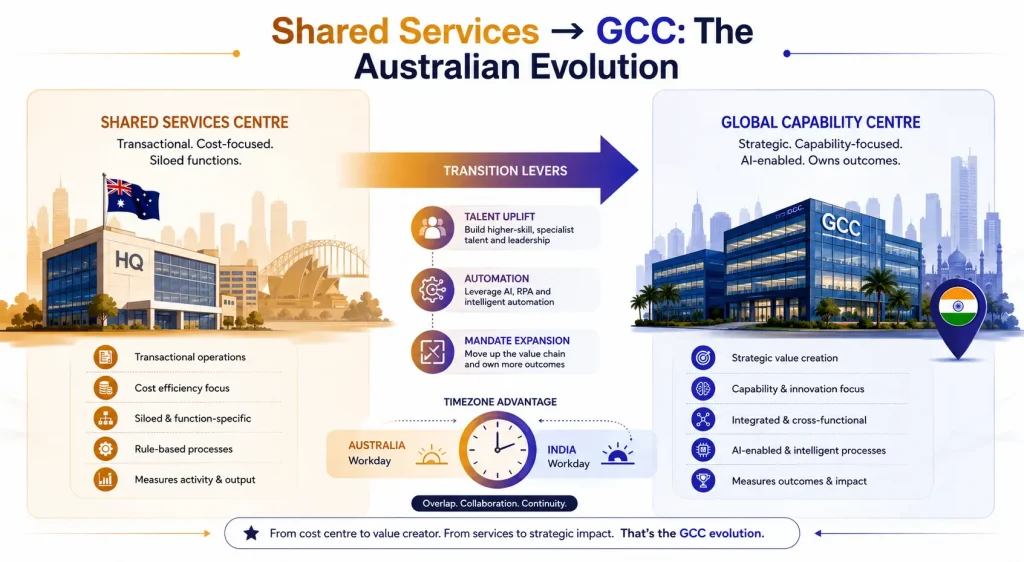
The transition typically follows a defined path. Most Australian enterprises use a build-operate-transfer, or BOT, model to reduce risk, allowing an experienced partner to establish and run the center in India before transferring ownership once it is stable. Others build an owned offshore team from the outset, with governance and reporting lines set up from day one to match the mandate of a GCC rather than a shared services center.
Either path requires the same shifts: expanding the talent mix beyond transactional roles, redesigning governance so the India center reports on outcomes rather than service-level agreements alone, and investing in automation to free capacity for higher-value work.
Timezone is a practical advantage Australian enterprises often underuse. India and Australia have a substantial overlap in working hours, closer than most Western markets get with India, which supports real-time collaboration between Sydney or Melbourne teams and an India-based GCC, rather than the handoff model common in traditional shared services.
Is Your Shared Services Centre Ready to Become a GCC?
A few questions help Australian leaders gauge highest termreadiness:
- Has cost optimization plateaued, with diminishing returns from further efficiency efforts?
- Does the center still handle mostly transactional work, or has demand shifted toward capability such as analytics, engineering or digital initiatives?
- Is the local talent market unable to keep pace with the skills the business needs?
- Is governance built only for service-level compliance, or is it ready to expand to outcome ownership?
If the answers point toward transition, the next step is not tearing down what works. It is evolving. ANSR works with Australian enterprises to plan and execute this shift, from build-operate-transfer structures to governance design, so that a shared services investment becomes a lasting strategic asset.