
How Do You Build an ESG Strategy That Works for Global Capability Centers?
Published on
As regulatory mandates tighten and investor scrutiny grows, embedding Environmental, Social, and Governance principles into global operations has moved from aspirational to non-negotiable. For enterprises running Global Capability Centers, ESG integration presents both a challenge and a structural advantage. A GCC that operates as a direct extension of the parent company can embed ESG into its operating model from day one, something outsourced or vendor-managed operations structurally cannot do with the same depth.
According to a recent survey of over 45 GCCs in India, 52% have already adopted ESG policies and are refining internal processes to support them. Another 70% are actively seeking technology partnerships to implement ESG norms. These aren’t token commitments. They signal a shift where GCCs are becoming critical enablers of responsible, future-focused business practices.
This guide covers how to build an ESG strategy for global operations, what framework to use, how to measure what matters, and the specific ESG best practices that apply when you’re running a multi-hundred-person operation in a market like India.
Why Does ESG Matter for Global Operations?
Before diving into the how, it’s worth being clear about the why. ESG isn’t a compliance checkbox. It’s a strategic lever that affects multiple dimensions of how a GCC operates and how the parent company is perceived.
Investor and stakeholder expectations. Consistent ESG performance and transparency builds trust among investors. ESG-aligned companies increasingly access better funding terms and lower capital costs. High ESG ratings frequently correlate with stronger market performance.
Talent attraction and retention. Fair, sustainable workplaces help attract and retain skilled professionals. In competitive talent markets like Bengaluru, Hyderabad, and Pune, where GCCs compete head-to-head for engineering and analytics talent, a clear ESG commitment strengthens the employer brand and differentiates the company from competitors who treat sustainability as an afterthought.
Client and partner requirements. Global clients increasingly expect ESG-aligned practices in partner operations. For GCCs serving regulated industries (financial services, healthcare, pharmaceuticals), ESG compliance is becoming a procurement prerequisite, not a nice-to-have.
Regulatory alignment. ESG requirements are expanding across jurisdictions. India’s BRSR (Business Responsibility and Sustainability Reporting) framework, the EU’s CSRD (Corporate Sustainability Reporting Directive), and SEC climate disclosure rules in the US are all raising the bar. A GCC that builds ESG governance early avoids the scramble of retrofitting compliance later.
Operational resilience. ESG alignment supports long-term resilience against environmental disruptions, social instability, and governance failures. An operation built on sustainable principles is structurally more durable than one optimised purely for short-term cost.
What ESG Framework Should a GCC Use?
An ESG framework provides the structure that turns broad sustainability ambitions into measurable, actionable initiatives. For GCCs operating as part of global enterprises, the framework needs to work across jurisdictions and align with the parent company’s corporate sustainability strategy while addressing local conditions.
The most widely adopted ESG reporting frameworks include the GRI (Global Reporting Initiative), which provides the most comprehensive sustainability reporting standards and is used by over 10,000 organisations worldwide, SASB (Sustainability Accounting Standards Board), which focuses on financially material ESG factors by industry, TCFD (Task Force on Climate-Related Financial Disclosures), which centres on climate risk and is increasingly mandated by regulators, the UN Sustainable Development Goals (SDGs), which provide a universal reference point for goal-setting, and CDP (formerly Carbon Disclosure Project), which focuses specifically on environmental disclosure.
A GCC doesn’t need to adopt every framework. The right approach is to align with whichever ESG reporting framework the parent company uses for investor and regulatory disclosure, then supplement with local standards (India’s BRSR, for example) where required. The ESG reporting standards you follow should be driven by your industry, your regulatory exposure, and your investors’ expectations, not by trying to check every box.
How Do You Implement an ESG Strategy in a GCC?
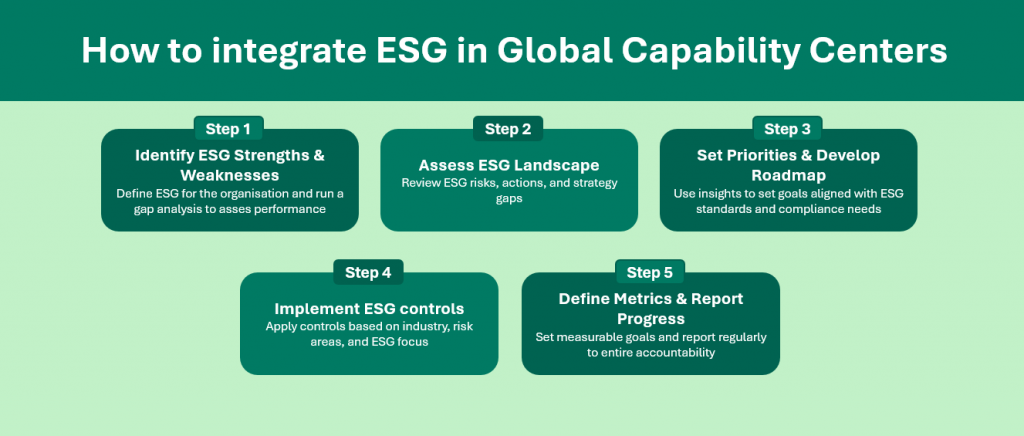
ESG implementation in a GCC follows a phased approach. Trying to do everything at once creates initiative fatigue and shallow adoption. A structured ESG roadmap prevents that.
Phase 1: ESG assessment and baseline (Weeks 1-6)
Start by understanding where the operation stands today. An ESG assessment covers current energy consumption, waste generation, and carbon footprint of the facility, existing workforce policies around diversity, equity, pay fairness, health and safety, governance structures including compliance controls, data privacy practices, and ethical business policies, and supply chain and vendor ESG exposure. This baseline is what every future ESG goal and ESG KPI gets measured against. Without it, you’re setting targets in the dark.
Phase 2: ESG policy and goal setting (Weeks 4-10)
Based on the assessment, define a formal ESG policy that establishes the organisation’s commitments across all three pillars. Set specific, measurable ESG goals with timelines: reduce energy consumption by 30% within three years, achieve gender parity in leadership by 2028, complete annual ESG audits across all vendor relationships. Vague goals (“we’re committed to sustainability”) produce vague results. Specific ESG goals produce accountability.
Phase 3: ESG program design and tool selection (Weeks 8-16)
Design the ESG program that will deliver against those goals. This includes selecting ESG tools and ESG technology platforms for data collection, monitoring, and reporting (more on this below), establishing ESG governance with clear ownership (who is accountable for environmental targets, social initiatives, and governance controls), designing training and awareness programmes to embed ESG thinking across the workforce, and defining the ESG supply chain standards that vendors and partners must meet.
Phase 4: ESG integration into operations (Ongoing)
ESG integration is not a one-time project. It’s an ongoing operational discipline. The ESG program needs to be embedded into procurement decisions, facilities management, talent acquisition, performance reviews, and strategic planning. The GCCs that do this well treat ESG as a dimension of every operational decision, not a separate initiative run by a sustainability team in isolation.
What ESG Metrics and KPIs Should a GCC Track?
The difference between an ESG program that generates value and one that generates slide decks is ESG measurement. You need metrics that are specific, trackable, and tied to operational reality.
Environmental metrics
Energy usage and efficiency (kWh per employee, per square metre of office space). Greenhouse gas emissions (Scope 1, 2, and where feasible, Scope 3). Carbon footprint reduction against baseline year. Water consumption and conservation progress. Waste diversion rate (percentage diverted from landfill through recycling and composting). Use of renewable energy (percentage of total energy from renewable sources). Sustainable office operations (LED lighting, smart HVAC, occupancy-based systems, green building certification status).
Social metrics
Workforce diversity ratios across gender, ethnicity, and disability (at all levels, not just aggregate). Gender pay gap analysis. Employee engagement and satisfaction scores. Health and safety incident rates. Training hours per employee (including ESG-specific training). Community engagement investment (hours and funding). Employee attrition by demographic group (to identify equity gaps in retention). Sustainable workplace indicators covering mental health support, flexible work arrangements, and work-life balance programmes.
Governance metrics
Board and leadership diversity. ESG risk management maturity (assessed against a defined framework). ESG audit completion rate (internal and external). Compliance incident tracking and resolution timelines. Data privacy and cybersecurity posture. Ethical business practices training completion. ESG integration into executive compensation (percentage of leadership incentives tied to ESG KPIs). Whistleblower and grievance mechanism usage and resolution.
The best ESG metrics are ones the organisation can act on. A metric nobody reviews or responds to is just noise. Build a quarterly review cadence where ESG KPIs are discussed alongside financial and operational performance, not in a separate meeting that leadership treats as optional.
What Role Does ESG Technology and Data Management Play?
You can’t manage what you can’t measure, and you can’t measure ESG at scale without the right technology infrastructure.
ESG data management is one of the fastest-growing enterprise challenges because ESG data comes from everywhere: utility bills, HR systems, procurement records, facility sensors, vendor questionnaires, employee surveys, regulatory filings. Consolidating this into a single, auditable data platform is what separates ESG programmes that produce actionable intelligence from ones that produce annual reports nobody reads.
The ESG tools landscape includes dedicated ESG software platforms (Watershed, Persefoni, Sphera, Workiva) for carbon accounting and sustainability reporting, enterprise ERP modules (SAP, Oracle) that incorporate ESG data alongside financial and operational data, IoT and building management systems that track energy, water, and waste in real time, and supply chain ESG platforms that assess vendor compliance and flag risks.
For GCCs specifically, ESG technology needs to integrate with the parent company’s global reporting infrastructure. The GCC generates local data (facility energy use, local workforce metrics, regional compliance status) that feeds into the enterprise’s consolidated ESG reporting. If the local systems don’t connect to the global platform, you end up with manual data consolidation that’s slow, error-prone, and impossible to audit cleanly.
Investing in ESG data management infrastructure early, ideally during GCC setup rather than as a retrofit, is one of the highest-ROI ESG decisions an enterprise can make.
What Are the Biggest ESG Challenges for GCCs?
ESG challenges in a GCC context differ from those in a single-country operation because you’re managing across jurisdictions, cultures, and regulatory regimes simultaneously.
Regulatory fragmentation. ESG requirements differ by country, industry, and reporting framework. A GCC in India serving a US-headquartered company with European clients faces BRSR, SEC, and CSRD requirements simultaneously. Aligning these without duplicating effort requires careful ESG governance design.
Data quality and consistency. ESG measurement depends on accurate, consistent data across all three pillars. Many GCCs inherit inconsistent data practices from their setup phase, with different systems tracking environmental, social, and governance data in incompatible formats. Fixing this retroactively is expensive.
Cultural integration. ESG priorities that resonate at headquarters may not translate directly to the local context. A diversity initiative designed for a US workforce may need significant adaptation for India. Effective ESG integration requires local sensitivity alongside global standards.
Greenwashing risk. Publishing ESG goals without the operational infrastructure to achieve and verify them creates reputational risk. ESG due diligence from investors, clients, and regulators is increasingly sophisticated. Claims that can’t be substantiated with data do more harm than silence.
Supply chain visibility. ESG supply chain standards are only as strong as the enterprise’s ability to monitor them. Many GCCs work with local vendors (facilities, catering, security, IT hardware) whose ESG practices are unknown or unaudited. Building vendor ESG assessment into procurement is essential.
What Do ESG Best Practices Look Like in a GCC?
The ESG best practices that matter most for GCCs combine global standards with operational specifics.
Environmental best practices. Design and operate a sustainable office: renewable energy sourcing, LED and smart lighting, occupancy-based HVAC, green building certification (LEED, IGBC). Set a net-zero target with a defined timeline and interim milestones. Track Scope 1 and 2 emissions and reduce them year over year. Implement zero-waste-to-landfill programmes using recycling, composting, and vendor partnerships. Optimise water consumption through conservation systems and monitor usage per capita. Follow recognised ESG guidelines for environmental disclosure (GRI, CDP, TCFD).
Social best practices. Build a sustainable workplace that prioritises employee wellbeing: mental health support, flexible work, health and safety training. Ensure pay equity through regular gender and demographic pay gap analysis. Drive diversity and inclusion with measurable targets at every level, not just entry level. Invest in community development through education programmes, volunteering, and local partnerships. Embed ESG standards into the supply chain through vendor codes of conduct and regular audits. Promote employee career development with structured training and progression pathways.
Governance best practices. Establish ESG oversight through a dedicated board-level committee or ESG leadership role. Tie executive compensation to ESG KPIs so leadership accountability is structural, not voluntary. Maintain transparent ESG reporting aligned with chosen ESG reporting standards. Conduct regular ESG audits (both internal and third-party) across all three pillars. Implement strong anti-bribery, anti-corruption, and ethical business policies. Align data privacy and cybersecurity practices with ESG governance standards (GDPR, DPDP, SOC 2). Integrate ESG risk management into the enterprise risk register so ESG risks are assessed alongside financial and operational risks.
How Does ANSR Build ESG-Ready GCCs?
ANSR’s work with a Fortune 500 healthcare company to establish a digital GCC in Bengaluru illustrates how ESG integration works in practice. The centre was built with inclusive hiring practices, structured governance, and scalable infrastructure from day one. These weren’t add-ons. They were design principles embedded into the workspace strategy, the talent acquisition approach, and the operational governance framework.
This is the approach that works: ESG doesn’t require a separate track. It gets integrated into every layer of GCC setup, from facility design (sustainable office standards, energy efficiency, green certification) through talent strategy (diversity targets, pay equity, employee wellbeing) to governance (compliance controls, data privacy, ethical business practices, ESG audit readiness).
ANSR has helped global enterprises build over 80 capability centres. For organisations that want to combine operational excellence with responsible growth, ANSR’s ESG-ready GCC models provide the framework, the infrastructure, and the execution capability to make ESG integration real, measurable, and sustainable.