
Digital Center of Excellence: A Future-Ready Blueprint for Digital Transformation
Modified on
In recent years, globally operating companies have poured billions into digital transformation. They’ve adopted new platforms, migrated to the cloud, and hired data teams. And yet, according to McKinsey, while 89% of enterprises are actively pursuing digital optimization, only about one in four have actually realized meaningful cost savings from those efforts.
That’s a staggering gap between ambition and execution. And it raises an uncomfortable question: why do so many transformation programs stall?
The answer, in most cases, isn’t the technology. It’s the absence of an internal structure designed to make transformation stick. That’s where a digital center of excellence comes in. A digital transformation center of excellence (CoE) serves as the organizational engine that turns scattered digital initiatives into coordinated, scalable, and measurable progress. It’s the difference between running 15 disconnected pilot projects and building a company that actually operates differently.
This guide breaks down how a digital CoE works, why it matters for digital transformation, and how to build one that doesn’t just look good on a slide deck but delivers real outcomes.
How Has the Center of Excellence Model Evolved for Digital Transformation?
The Center of Excellence concept isn’t new. Organizations have been using CoEs for decades to standardize processes, enforce compliance, and centralize expertise in domains like IT, finance, and HR. But the traditional model was built for stability, not speed.
Here’s what’s changed.
Traditional CoEs operated as governance hubs. They defined standards, created documentation, and ensured teams followed established procedures. That worked fine when business cycles moved slowly and the technology stack changed once every five years. But in a world where AI capabilities shift every quarter and customer expectations evolve weekly, a governance-only CoE becomes a bottleneck rather than an accelerator.
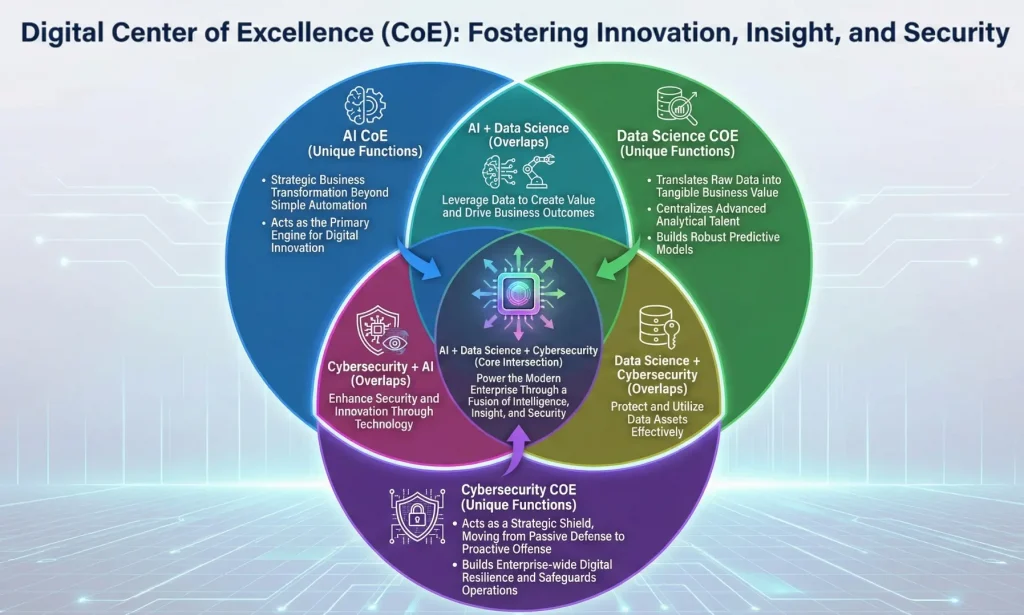
The modern digital CoE flips the model. Instead of enforcing process compliance, it drives experimentation, enables rapid adoption of emerging technologies, and embeds digital capabilities across the entire organization. The role of a center of excellence (CoE) in digital transformation initiatives has shifted from passive standardization to active enablement.
Think of it this way: the traditional CoE was a librarian. The digital CoE is a lab director. Both care about knowledge, but one guards it while the other generates it.
What separates a digital CoE from the traditional model:
A traditional CoE focuses on standardizing processes, enforcing compliance, managing knowledge, and operating in a centralized, top-down structure. The digital CoE, on the other hand, prioritizes experimentation and innovation, rapid technology adoption, cross-functional enablement, and operates in a distributed, collaborative structure. Where the traditional model measures efficiency and adherence, the digital CoE measures adoption rates, speed to value, and innovation output.
What Role Does a CoE Play in Digital Transformation Initiatives?
Let’s get specific. The role of CoEs in digital transformation initiatives falls into four areas that most standalone digital teams can’t cover on their own.
1. Strategic alignment across silos
Digital transformation fails when it happens in pockets. Marketing launches a customer data platform. Engineering migrates to a new cloud provider. Finance automates invoicing. None of these teams are talking to each other, and none of their tools integrate. A digital CoE sits above these silos and ensures every initiative connects back to the same enterprise-wide transformation goals. It doesn’t replace departmental ownership. It coordinates it.
2. Technology evaluation and adoption
New tools, platforms, and AI models hit the market constantly. Without a CoE acting as a filter, organizations either adopt too slowly (missing competitive advantages) or too quickly (creating technical debt and vendor sprawl). The digital CoE evaluates emerging technologies, runs proof-of-concept pilots, and creates adoption playbooks that other teams can follow.
3. Capability building and upskilling
Buying technology is the easy part. Getting 5,000 employees to actually use it effectively is the hard part. A digital transformation CoE owns the upskilling agenda: identifying skill gaps, designing training programs, creating internal certification paths, and building a culture where continuous learning is the default, not the exception.
4. Governance without bureaucracy
Yes, governance still matters. But the digital CoE applies it differently. Instead of approval gates that slow everything down, it creates lightweight frameworks: decision criteria for technology adoption, data governance standards, security baselines, and compliance checklists that teams can self-serve. The goal is to accelerate digital transformation by removing friction, not adding layers.
How Do You Build a Digital Transformation Roadmap Through a CoE?
This is where most articles on the topic go vague. They tell you to “align with business goals” and “get executive buy-in.” That’s like telling someone to “cook something delicious” without mentioning ingredients or temperature.
Here’s what a digital transformation roadmap actually looks like when it’s built and managed through a CoE.
Phase 1: Assess the current state (Weeks 1-4)
Before building anything, the CoE needs a clear picture of where the organization stands. That means auditing the existing technology stack and integration landscape, mapping business processes to identify automation and optimization opportunities, surveying workforce capabilities and identifying critical skill gaps, and benchmarking digital maturity against industry standards.
This isn’t a PowerPoint exercise. It requires interviews with department heads, analysis of actual tool usage data (not just licenses purchased), and honest conversations about what’s working and what isn’t. Many organizations discover during this phase that they’re paying for tools nobody uses or running parallel systems that do the same thing.
Phase 2: Define the target state and prioritize (Weeks 4-8)
Based on the assessment, the CoE defines what “transformed” looks like for this specific organization. Not a generic vision statement, but concrete outcomes: reducing customer onboarding time from 14 days to 3, automating 60% of accounts payable processing, or enabling real-time supply chain visibility across all regions.
From there, initiatives get prioritized using a framework that weighs business impact against implementation complexity. High impact plus low complexity goes first. That early momentum matters more than most people realize because it builds organizational confidence that transformation actually works.
Phase 3: Execute in waves (Months 3-12)
The CoE doesn’t try to transform everything simultaneously. It runs transformation in waves, each one building on the capabilities established by the previous wave. Wave 1 typically focuses on foundational infrastructure: cloud migration, data platform consolidation, and core process automation. Wave 2 shifts to intelligence: analytics dashboards, predictive models, and AI-powered decision support. Wave 3 moves into innovation: new digital products, customer experience redesign, and business model evolution.
Each wave has its own timeline, budget, success metrics, and review cycle. The CoE manages cross-wave dependencies and ensures learnings from earlier waves inform later ones.
Phase 4: Measure, iterate, scale (Ongoing)
A digital transformation roadmap is never “done.” The CoE continuously monitors KPIs, gathers feedback from teams using new tools and processes, and adjusts the roadmap based on what’s actually happening versus what was planned.
The metrics that matter here go beyond simple adoption rates. They include time-to-value for new technology deployments, reduction in manual process hours, employee satisfaction with digital tools, customer experience improvements tied to digital initiatives, and cost savings realized versus projected.
Organizations that treat the roadmap as a living document, updated quarterly and reviewed with executive leadership, see significantly better transformation outcomes than those that build a roadmap once and file it away.
What Does a Modern Digital CoE Framework Look Like?
A digital CoE isn’t just a team. It’s a framework with interconnected components that reinforce each other. Get one wrong and the whole structure underperforms.
Digital capabilities
At its core, a digital CoE needs to house (or have access to) deep expertise in the technologies driving transformation: cloud architecture, data engineering, AI/ML, automation, cybersecurity, and user experience design. This doesn’t mean the CoE employs every specialist. It means the CoE knows where the expertise lives, how to deploy it, and how to keep it current through continuous learning and upskilling programs.
Integration strategies
A digital CoE that operates in isolation will fail. It needs to be embedded into the organization’s broader digital ecosystem. That means aligning CoE initiatives with enterprise-wide transformation goals, adopting shared platforms and tools that other departments already use, promoting cross-functional collaboration through joint working groups and embedded CoE members, and establishing clear handoff protocols between the CoE and operational teams.
The best digital CoEs don’t feel like separate entities. They feel like a capability that’s woven into how the company works.
Success metrics
Traditional CoEs measured success by compliance rates and process adherence. A digital CoE needs metrics that reflect actual business value creation.
The most effective digital CoE metrics fall into three categories. Adoption metrics track how widely new technologies and processes are being used across the organization. Value metrics measure tangible business outcomes like revenue impact, cost reduction, and time savings. Capability metrics assess whether the organization’s digital skills and infrastructure maturity are improving over time.
How Can a Generative AI Center of Excellence Accelerate Transformation?
If you’re building or evolving a digital CoE in 2025 or 2026, you can’t avoid the AI question. And specifically, you can’t avoid the generative AI question.
Here’s the reality: most organizations are experimenting with generative AI, but very few have a structured approach to scaling it. Individual teams are using ChatGPT for content drafting, GitHub Copilot for code generation, or AI-powered analytics tools for data exploration. But these experiments are fragmented. There’s no shared governance, no consistent evaluation framework, and no systematic approach to identifying which use cases actually deliver ROI.
That’s exactly the problem a generative AI center of excellence is designed to solve.
What an AI CoE framework should include:
A practical AI CoE framework starts with use case identification and prioritization. Not every process benefits from generative AI, and the CoE’s job is to separate the high-impact opportunities from the hype. This means evaluating potential use cases against criteria like data availability, process complexity, risk tolerance, and expected ROI.
Next comes the model governance layer. Which AI models are approved for enterprise use? What are the data privacy and security requirements? How do you handle outputs that need human review? The CoE establishes these guardrails so that teams can move fast without creating compliance nightmares.
Then there’s the enablement layer. Training programs, prompt engineering best practices, integration playbooks, and internal communities of practice that help employees across the organization use AI tools effectively. This is where most AI initiatives stall, not because the technology doesn’t work, but because people don’t know how to use it well.
Finally, the CoE needs a measurement framework specific to AI. Traditional software ROI metrics don’t fully capture the value of generative AI. You need to track productivity gains (hours saved per workflow), quality improvements (error reduction, consistency), innovation velocity (new capabilities enabled), and risk metrics (hallucination rates, compliance incidents).
The organizations getting this right aren’t treating AI as a separate initiative. They’re embedding it into their existing digital CoE as a capability layer that enhances everything the CoE already does: technology evaluation, capability building, process optimization, and governance.
Read more about ANSR’s approach to building AI-powered GCCs →
What Drives the Shift Toward a Digital Transformation CoE?
Several forces are converging to make the digital CoE model not just useful, but essential.
Technology is moving faster than organizations can absorb it. Cloud computing, predictive analytics, artificial intelligence, and automation are redefining how businesses operate. A digital CoE creates the structured capacity to evaluate, adopt, and scale these technologies without creating chaos.
Business demands have changed. Customer expectations evolve rapidly, competitive cycles are shorter, and operational efficiency has become table stakes. Traditional CoEs that focus on process enforcement can’t keep pace with these dynamics. Today’s businesses need CoEs that act as strategic enablers, driving digital adoption across departments and ensuring new tools align with business goals.
Innovation has become a survival requirement. Companies that fail to innovate consistently don’t just fall behind. They become irrelevant. A digital CoE fosters a culture of continuous experimentation and rapid iteration. It encourages cross-functional knowledge sharing and iterative improvements that unlock new revenue streams and enhance customer experiences.
The talent equation is shifting. Digital transformation requires skills that many organizations don’t have internally. A digital CoE, particularly one built through a Global Capability Center (GCC) model, gives enterprises access to specialized talent pools in markets like India, where over 1,700 GCCs already operate. This approach combines the structured governance of a CoE with the talent depth and cost efficiency of a GCC.
Explore how GCCs and CoEs work together →
Case Study: Building a Digital CoE Through a GCC
The world’s leading consumer health company by revenue, with a presence in 165 countries, set out to establish its first Global Capability Center in Bengaluru, India, to fuel transformative innovation. But they faced a fundamental challenge: building a high-performing technical center from the ground up while simultaneously assembling a workforce with the specialized skills needed to drive meaningful digital transformation.
After partnering with ANSR, the company’s trajectory shifted. ANSR’s teams laid the foundation for a robust technical hub, handling everything from sourcing and securing the right workspace to equipping it with enterprise-grade IT infrastructure. The CoE was designed not as an outsourced support function, but as a true center of excellence embedded within the company’s global digital transformation strategy.
The results speak for themselves. Today, the center is responsible for more than 100 product innovations and plays a central role in bringing over 12 brands to users across the globe. It has evolved from a startup operation into a strategic asset that directly contributes to the parent company’s competitive position.
This is the model that works: a digital center of excellence built with the operational discipline of a GCC, the talent depth of a global market like India, and the strategic integration that ensures the center doesn’t drift into isolation but stays tightly connected to enterprise priorities.
Building a Future-Ready Digital Center of Excellence
The center of excellence model for digital transformation is no longer optional for enterprises that want to compete in 2026 and beyond. As digital adoption becomes more prevalent, these centers will evolve from static governance entities to dynamic ecosystems of intelligence and automation. Future-ready organizations will leverage AI-driven insights, real-time analytics, and predictive modelling to accelerate digital transformation and make faster, more informed decisions.
But structure alone isn’t enough. The organizations that get the most value from a digital CoE are the ones that pair the framework with the right execution partner, the right talent, and the right operating model.
ANSR has helped global enterprises build over 80 high-performing capability centers. Whether you’re building a digital center of excellence from scratch, evolving an existing CoE, or exploring how a GCC model can give your transformation the talent and scale it needs, ANSR brings the experience to make it work.