
The Quiet Rise of Mid-Market GCCs in India
By April 1, 2026, India’s unified Labour Codes will be fully operational, forcing a fundamental reset of offshore payroll through the 50% Wage Rule. For US enterprise leaders, the most significant shift in GCC trends is not coming from the Fortune 50, but from mid-tier players. This article analyzes the mid-market GCC India 2026 landscape, exploring why centers at the 100M−1B revenue level are outpacing legacy giants. We deliver a roadmap of the agile Micro GCC model, helping you identify how to evolve your large-scale captive into a more skill-dense, outcome-driven organization.
The GCC Growth Segment Hiding in Plain Sight
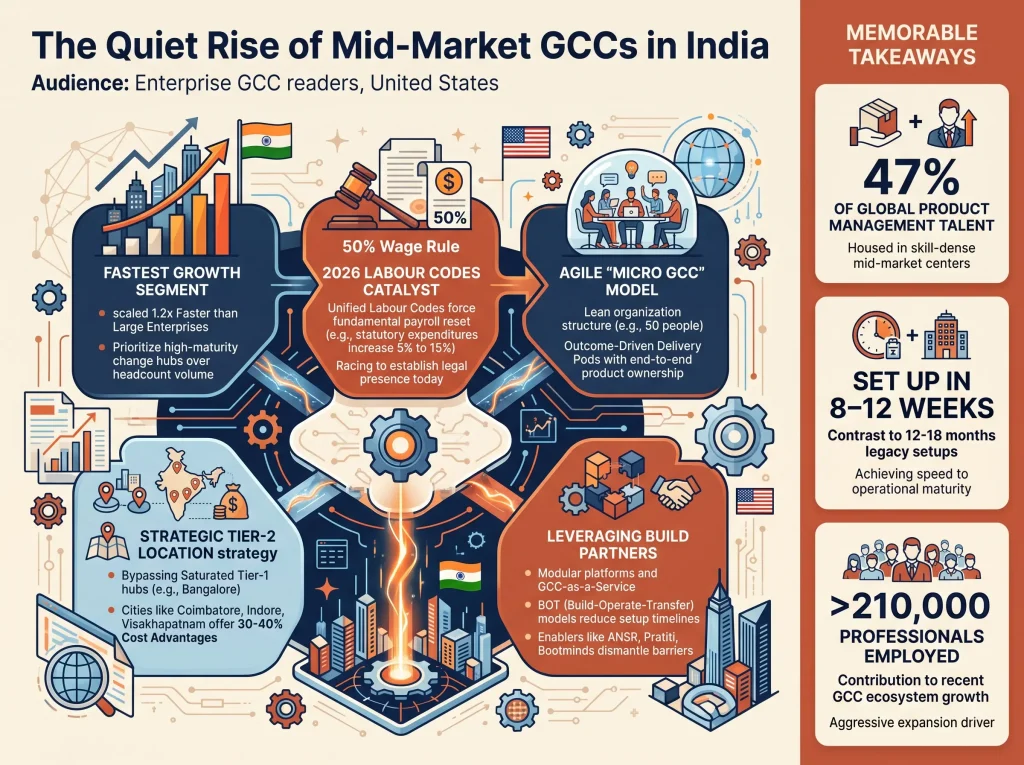
Mid-market entities are the most aggressive expansion engine in the current ecosystem, contributing to over 35% of all recent growth. Far from being mere back offices, the mid market GCC India segment now comprises 480 centers and 680 units, employing more than 210,000 professionals. These organizations are scaling 1.2 times faster than their large-enterprise counterparts because they prioritize high-maturity change hubs over simple headcount volume.
For instance, Terex Corporation, a global manufacturer with revenues under $1 billion, utilizes its Hyderabad center to drive core engineering and digital innovation rather than support functions. This segment also houses a staggering 47% of the global product management talent and 25% of the global talent in deep tech. By late 2026, an additional 120 mid-market centers are expected to establish operations, further solidifying their role as a primary driver of India’s technological maturation. They have moved from being cost centers to becoming active market makers.
Why 2026 Is the Inflection Year for Mid-Market GCCs
The April 2026 deadline for full compliance with the new labor codes has presented a critical now or never opportunity for mid-market entrance. This legal shift requires that basic pay make up at least 50% of an employee’s total compensation, raising statutory expenditures such as Provident Fund (PF) and gratuity by 5% to 15% for most firms. Companies are racing to establish their legal presence before these higher-cost structures become the norm, thus locking in personnel and operating models ahead of the curve.
Mid-market leaders are rushing to establish their legal footprint before these higher-cost arrangements become the new standard. Additionally, contemporary design trends have changed toward modular as-a-service and Build-Operate-Transfer (BOT) models, which reduce setup timeframes from 12 months to 8-12 weeks. Waiting until 2027 means entering a market with far greater talent prices and overcrowded Tier-1 hubs. By acting today, these firms capture first-mover advantages in emerging hubs before the next wave of enterprise expansion resets the pricing landscape.
How Their Playbook Differs From F500 GCCs
Mid-market leaders are aggressively bypassing saturated Tier-1 hubs in favor of skill-dense Micro GCCs and Tier-2 satellites. While legacy giants struggle with the bureaucracy of massive campuses in Bangalore, smaller firms are choosing cities like Coimbatore or Indore, which provide 30% to 40% cost-index advantages over Tier-1 centers. This playbook replaces broad functional silos with outcome-driven delivery pods that take end-to-end product ownership.
|
Feature |
Legacy Captive |
Mid-Market Agile |
|
Location Strategy |
Saturated Tier-1 Hubs |
Efficient Tier-2 Satellites |
|
Setup Timeline |
12–18 Months |
8–12 Weeks |
|
Operational Focus |
Headcount Scale |
Outcome-Driven Pods |
This capital-light approach allows a 50-person center to operate with enterprise-grade security, but with lower operational exposure and attrition rates that stay 3% to 5% below Tier-1 averages. These right-sized models are optimized for innovation velocity and regulatory alignment rather than sheer headcount.
The Build Partners Behind the Mid-Market GCC Surge
Specialized enablers are dismantling traditional barriers to entry by offering modular GCC-as-a-service platforms that replace heavy upfront infrastructure bets. Pratiti Technologies specializes in architecting BOT journeys for PE-backed firms, allowing them to stand up zero-CapEx pods that align with business evolution rather than static headcount. ANSR manages the entire center lifecycle through a pay-as-you-grow subscription model, currently supporting nearly half of the mid-market expansion.
Meanwhile, Boot minds utilize a 90-day launch methodology with a specific 25-day promise for executive leadership search, ensuring centers reach operational maturity in record time. These vendors provide the digital operating system for first-time entrants, handling everything from entity setup to AI-led talent sourcing. By leveraging these specialists, companies navigate the complexities of the mid-market GCC India 2026 regulatory environment without dedicating significant internal leadership bandwidth to the build-out phase. This allows firms to build capability with certainty.
What Large GCCs Should Borrow from the Mid-Market Playbook
Enterprise leaders must replace monolithic captives with a federated hub-and-spoke architecture to reclaim agility. By deploying Digital Capability Centers (DCC) as specialized multipliers, organizations can shift execution-heavy roles to Tier-2 satellites like Visakhapatnam or Lucknow while maintaining a lean Tier-1 anchor for senior leadership. Adopting this function-fit framework reduces the risk of single-site saturation and improves innovation velocity.
Replicating the mid-market’s focus on end-to-end ownership can boost annual innovation output by 25% to 35%. This structural change ensures centers remain always on engines rather than rigid cost centers. Transitioning toward outcome-based pods allows large organizations to match the speed of aggressive, smaller competitors while managing cost increases.
Conclusion
The shift toward agility is a structural necessity for 2026. To safeguard your center’s future value and manage incoming statutory increases, commission a comprehensive payroll audits this week to model the 50% Wage Rule’s impact on your 2027 manpower projections. Embracing this lean playbook today is the only way to maintain your offshore competitive edge.