
Benefits of the Shared Services Model in a Multinational Environment
Multinational Corporations face the dual challenge of addressing local operational needs while maintaining enterprise-wide efficiency and strategic alignment. The traditional decentralized model where each business unit manages its own support functions often leads to duplicate efforts, inconsistent processes and lost opportunities to leverage economies of scale.
The shared services model streamlines enterprise operations by consolidating functions like finance, HR, IT, and procurement into a unified structure delivered through centralized service hubs.
This shift goes beyond cost savings, enabling benefits such as operational excellence, access to global talent, greater agility, stronger resilience, and enhanced governance ultimately shaping an innovation-driven business landscape.
What Is a Shared Service and Shared Services Organization?
A Shared Services Organization (SSO) is a centralized entity that manages specific business functions for multiple units in a business. Instead of each unit handling its own finance, HR, IT, procurement, or other administrative operations, these services are delivered from a single, coordinated hub.
Key characteristics of an SSO include:
- Centralization: Functions are consolidated to eliminate redundancies.
- Standardization: Processes and systems are harmonized across the enterprise.
- Efficiency-Driven: Uses technology, automation, and analytics to deliver services at scale.
When integrated with Global Capability Centers (GCCs), shared services also gain access to specialized talent and regional expertise, enabling organizations to combine operational efficiency with innovation.
Benefits of Shared Services in a Multinational Setting
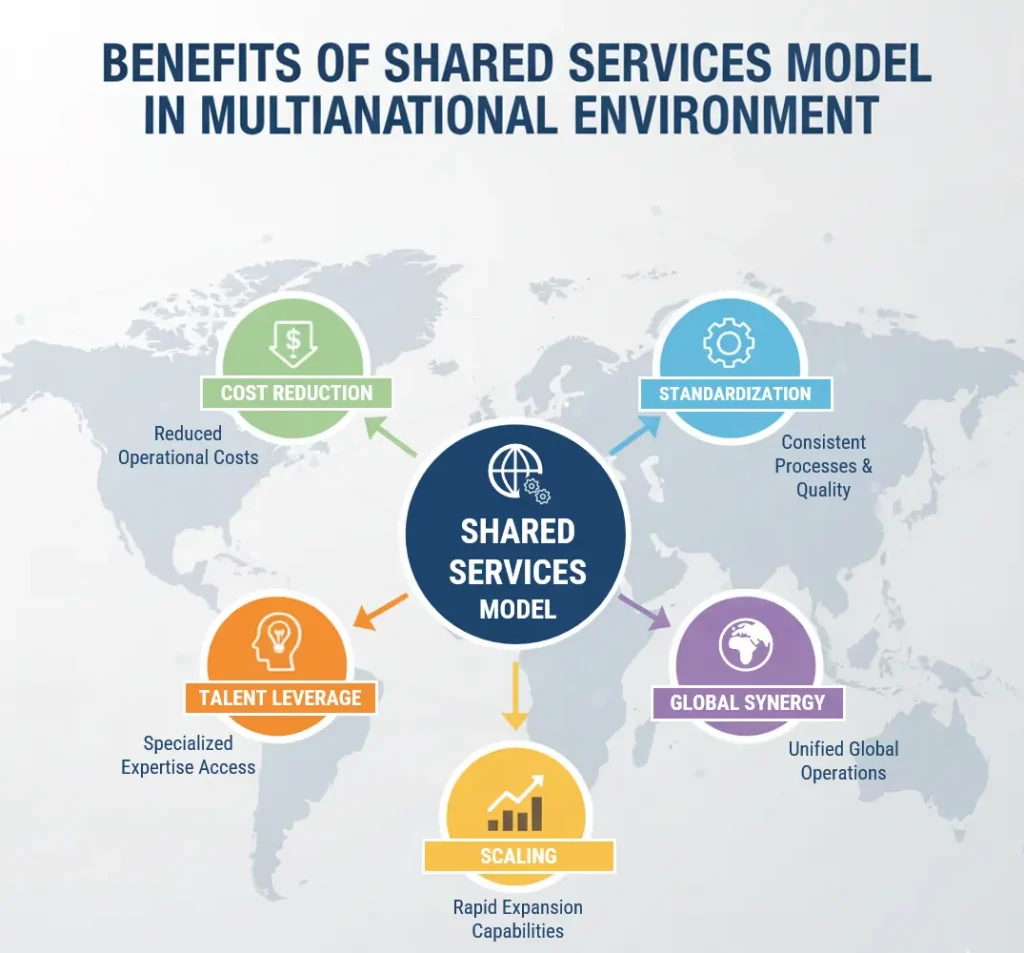
- Beyond the Bottom Line: Strategic Cost Optimization
- Elimination of Redundancy: Centralizing functions reduces duplication of effort and administrative overhead.
- Economies of Scale: Consolidated purchasing and vendor negotiations deliver cost advantages.
- Optimal Resource Allocation: Centralized expertise ensures efficient deployment across business units.
- Fuelling Efficiency with Technological and Process Excellence
- Process Standardization: Consistent workflows improve service quality and reduce errors.
- Automation and AI: RPA and AI streamline routine tasks, accelerate processes, and enable data-driven decision-making.
- Data Integration and Analytics: Centralized data supports accurate reporting and actionable insights.
- Cultivating a Global Talent Ecosystem
- Access to a Global Talent Pool: Centralized hiring taps into diverse skill sets worldwide.
- Standardized HR Practices: Ensures consistent performance management and employee experience.
- Enhanced Workforce Analytics: Supports talent development, workforce planning, and engagement.
- Navigating Volatility: Agility and Scalability in a Dynamic Market
- Flexibility and Responsiveness: GBS enables companies to quickly adjust operations, scale resources, or shift priorities in response to market changes, customer demands, or growth opportunities.
- Accelerated Market Entry: By leveraging centralized processes and shared platforms, companies can set up in new markets faster—avoiding duplication of systems and reducing time-to-launch.
- Enhanced Resilience: Standardized governance, compliance, and risk frameworks across geographies strengthen business continuity, ensuring operations remain stable even during disruptions.
- Fortifying Governance, Compliance, and Risk Management
- Consistent Regulatory Adherence: Standard policies ensure compliance across regions.
- Minimized Risk Exposure: Centralized risk functions enable proactive threat mitigation.
- Increased Transparency and Control: Improved oversight via centralized systems.
Global Business Services (GBS) and Their Role
Global Business Services (GBS) represent an evolved form of shared services, integrating multiple functions finance, HR, IT, procurement, customer service, and more into a single, enterprise-wide delivery model. GBS models not only focus on efficiency but also aim to deliver business value by:
- Enhancing the end-to-end customer and employee experience.
- Using advanced analysis to support strategic decision-making.
- Serving as a transformation hub that continuously improves processes and features.
GBS Services Driving International Value
Global Business Services (GBS) structures let companies scale globally without duplicating infrastructure. By unifying systems, processes, and talent, GBS provides consistent service quality across borders, supports rapid market expansion, and promotes innovation to help companies compete effectively in the global economy.
- Finance & Compliance: A global retailer centralizes accounts payable, payroll, and tax compliance into a single GBS hub. This ensures uniform reporting standards across 50+ markets and reduces errors, enabling faster financial closes.
- HR & Talent Mobility: A pharmaceutical firm uses its GBS hub to standardize onboarding, employee self-service portals, and global mobility programs. This allows seamless relocation of researchers between labs in the U.S., Switzerland, and India.
- Customer Experience: A leading consumer electronics company runs multilingual customer support and warranty services through a GBS center. Customers receive consistent service whether they’re in Tokyo, Berlin, or São Paulo.
- IT & Cybersecurity: A global bank leverages GBS to unify IT infrastructure and cybersecurity monitoring. This provides real-time risk detection across continents and prevents local duplication of expensive security systems.
- Data & Analytics: A logistics company pools data from shipping, customs, and local operations into a GBS-led analytics hub. This enables predictive insights on supply chain disruptions and faster rerouting decisions worldwide.
- Innovation & R&D Support: An automotive giant uses its GBS center in India to handle data modeling, prototype testing support, and supplier collaboration, accelerating electric vehicle development for global markets.
Conclusion
Shared services, especially when integrated with Global Business Services (GBS) and Global Capability Centers (GCCs), are no longer just a cost-cutting mechanism. They are a strategic imperative for multinationals seeking operational excellence, innovation and resilience.
By centralizing and optimizing functions, organizations unlock efficiencies, access talent, strengthen governance, and position themselves for sustainable growth in an increasingly competitive world.