Operate-To-Own: The New BOT Path for AI-Intensive Teams
Global companies forming AI-focused teams are reconsidering conventional outsourcing strategies. The traditional Build-Operate-Transfer (BOT) model is transforming into a more flexible and responsive structure: Operate-to-Own (O2O). This innovative route merges operational efficiency, strategic coherence, and advancing ownership into an ongoing initiative aimed at enduring innovation.
Why BOT 2.0 is Evolving
The shift from the ‘Transfer’ endpoint of BOT to the ‘Own’ mindset of O2O is driven by the unique demands of modern AI and data science initiatives. Unlike traditional IT projects, AI solutions are rarely completed. They are systems that require constant model retraining, data pipeline optimization, and ethical certification. This necessitates a dynamic relationship between the enterprise and its operational partner, extending beyond a simple handover.
IP, Governance, and Risk
The primary drivers for the O2O evolution include Intellectual Property (IP) ownership, governance agility, and risk mitigation. In a standard BOT model, the full legal and operational transfer of IP usually occurs only at the end of the process. This delay creates confusion regarding IP generated during the Operate phase, precisely when most bespoke AI models and datasets are refined. O2O incorporates progressive IP ownership into service-level agreements (SLAs) from the beginning. As the AI model or data pipeline progresses and meets established milestones, partial or full ownership immediately transfers to the client. This accelerates strategic control and ensures that the enterprise builds an outstanding asset from day one.
From a governance standpoint, BOT often produces an “us versus them” divide, reducing decision-making and AI iteration. O2O regulates joint governance from day one, with the partner’s team being culturally and functionally integrated into the client’s risk, compliance, and data security frameworks. This dual accountability ensures capabilities are built for the enterprise, not just handed over.
Finally, O2O is a proactive risk mitigation strategy. A sudden transfer under BOT poses a risk of knowledge loss, staff attrition, and operational disruption. O2O, in contrast, allows the client’s teams to co-manage, shadow, and gradually absorb systems and expertise, thereby reducing the risk associated with the final transfer of ownership.
Integration Milestones and Value
The successful implementation of O2O depends on comprehensive integration milestones that link operational performance to the phased transfer of ownership. This process must be measurable, transparent, and aligned with strategic business outcomes, extending beyond simple uptime metrics to focus on capability development.
30/60/90-Day Checkpoints
Checkpoint | Key Focus | Ownership/Value Realization |
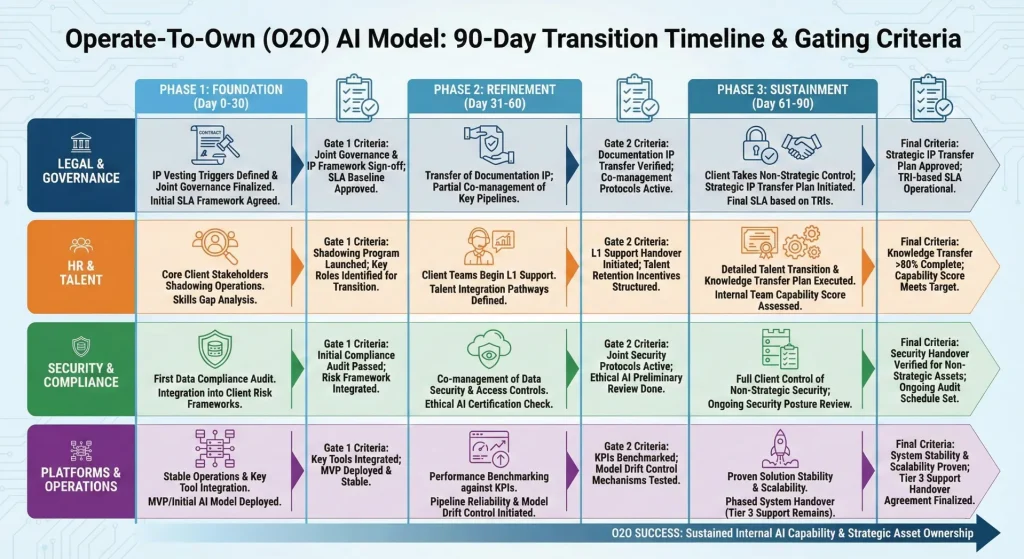
30-Day | Foundation and Alignment | * Value: Stable operations, key tool integration, and first data compliance audit. * Ownership: IP vesting triggers and joint governance finalized, with core client stakeholders shadowing operations. |
60-Day | Capability Proof and Refinement | * Value: MVP or initial AI model deployed, with a focus on performance benchmarking against business KPIs. * Ownership: Transfer of documentation IP and co-management of key data pipelines, as client teams begin handling Level 1 support. |
90-Day | Sustained Operation and Readiness | * Value: Proven solution stability and scalability with target operational efficiency achieved (e.g., model drift control, pipeline reliability). * Ownership: Client takes full control of non-strategic components, with a detailed plan initiated for talent transition and knowledge transfer of strategic areas. |
The checkpoints ensure that the relationship remains centered on strategic asset creation, not just service delivery. Each milestone is a crucial factor for both payment and the incremental transfer of intellectual and operational control, tying the partner’s success to the client’s ability to own and utilize the solution effectively.
Playbook for Transition and SLAs
The O2O model requires a robust playbook and specialized Service Level Agreements (SLAs) that reflect the shifting boundaries of control and accountability. The transition is not an event; it is meticulously managed.
The Transition Playbook must detail three core components: Knowledge Transfer, Talent Integration, and System Handover. Knowledge transfer goes beyond documents; it includes recorded expert interviews, process simulations, and a minimum of three months of mandated co-management.
Talent Integration involves clear pathways for key operational staff to move from the partner’s payroll to the client’s, with retention incentives built into the O2O contract to prevent crucial brain drain. System Handover is phased, with the partner remaining the Tier 3 escalation point for a defined period (e.g., six months post-transfer) to ensure continuity and prevent operational failure.
Service Level Agreements (SLAs) in an O2O framework must shift away from standard operational metrics to focus on Transition Readiness Indicators (TRIs). Examples include:
- Internal Team Capability Score: Measures the client team’s proficiency in managing the solution, often assessed via third-party audits.
- Knowledge Transfer Completion Rate: Tracks the percentage of required training modules and shadowing hours completed by internal staff.
- IP Compliance Rate: Ensures that all generated IP and code adhere to the client’s internal coding standards and repository structures from inception.
By integrating the goal of ownership into the operational contract, O2O transforms the outsourcing partner from a service provider to a strategic co-builder. It is the necessary evolution of the BOT model, offering AI-intensive enterprises a sustainable, low-risk path to accelerating their internal AI capability and ensuring that every dollar spent on operations contributes directly to internal, appreciating, and proprietary assets.