Unlock Digital Transfomation with The BOT 2.0 Model
Summary
BOT 2.0 is a modernized Build-Operate-Transfer model that companies use as a structured digital transformation roadmap, not just to cut costs, but to drive IT modernization, legacy modernization, and technology modernization through dedicated global teams. Unlike the traditional BOT model, BOT 2.0 gives the enterprise full control and IP ownership from day one, with no transfer fees. It works in three phases — Build, Operate, Transfer. These map directly onto a modernization journey: stand up the team and infrastructure, modernize and run the systems, then take full internal ownership. The result is faster transformation, lower risk, and a permanent in-house capability rather than a one-time outsourcing engagement.
What is BOT 2.0 and how is it different from the traditional BOT model?
The Build-Operate-Transfer (BOT 2.0) model is a business approach where a company partners with a service provider to set up, manage, and ultimately take full ownership of an offshore operation, but with a critical shift from the original model. Traditional BOT focused on cost-cutting and lacked flexibility. BOT 2.0 is built for technology-driven growth: it puts the enterprise in control from the start, with full IP security and the ability to take over at any time without transfer fees.
In BOT 2.0, the build phase sets up an R&D office with a local provider handling hiring and infrastructure, while the company stays the decision-maker. The operate phase covers HR, payroll, and compliance, freeing the company to focus on innovation. Instead of merely transferring operations, BOT 2.0 emphasizes transformation, helping companies build durable Global Capability Centers that deliver long-term value rather than short-term savings.
Why Use BOT 2.0 as a Digital Transformation Roadmap?
Rather than handing a company a slide deck and walking away, BOT 2.0 builds the capability that delivers the roadmap, global teams, modern infrastructure, and agile processes that remain with the enterprise after transfer. For companies that have struggled to move from transformation strategy to execution, the BOT 2.0 roadmap closes that gap. Companies weighing their options often compare BOT against a direct captive setup before committing.
How Does BOT 2.0 Drive IT Modernization?
IT modernization is the most common driver behind a BOT 2.0 engagement today. Legacy systems, fragmented infrastructure, and internal skill gaps block transformation — and BOT 2.0 addresses all three at once by standing up a dedicated team equipped to modernize the IT landscape.
The classic example is General Electric. Facing internal limits on digital skills and infrastructure, GE used the BOT approach to modernize its fragmented IT landscape and launch its industrial IoT platform, Predix. GE outsourced early development to an IT service provider, then transferred operational control and knowledge to internal teams through structured training. The outcome: improved operational efficiency, reduced costs, and new revenue-generating services — saving its clients millions.
What Role Does BOT 2.0 Play in Legacy Modernization?
Legacy modernization — replacing or re-platforming aging systems — is high-risk when attempted with a thin internal team. BOT 2.0 de-risks it by sharing the initial investment and setup burden with a provider, then transferring a fully operational, modernized capability back to the enterprise.
Consider a logistics company modernizing its delivery infrastructure: in the operate phase, the BOT team monitors digital delivery-tracking systems, refines route-optimization software, and ensures timely updates — replacing manual legacy processes with optimized digital ones. Once stable, the system and the team that runs it transfer to the in-house organization, so the modernization is permanent rather than dependent on an external vendor.
What Are the Phases of Technology Modernization Through BOT 2.0?
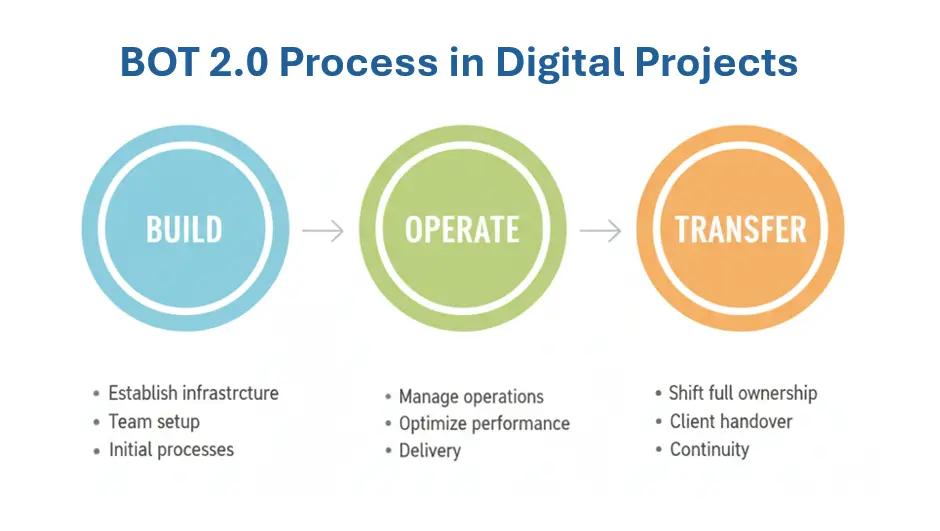
Technology modernization through BOT 2.0 follows three phases, each a concrete step in the transformation:
Build Phase — Lay the groundwork: set up infrastructure, select the right technology stacks, and hire talent. A healthcare provider, for example, might build a patient-management system — installing databases, setting up cloud infrastructure, and onboarding developers and IT specialists.
Operate Phase — Manage daily operations and optimize digital processes, implementing improvements and documenting systems for long-term efficiency. This is where modernization is actively executed and stabilized.
Transfer Phase — Hand full control to the organization’s internal team, supported by comprehensive training and documentation. A bank’s internal IT team, for instance, takes over a new mobile banking app after the partner provides operational guidelines, protocols, and system documentation.
FAQs
Is BOT 2.0 only about cost savings?
No. Traditional BOT focused on cost reduction; BOT 2.0 prioritizes IT modernization, innovation, and building permanent in-house capability, with cost efficiency as a secondary benefit.
Who owns the IP in a BOT 2.0 model?
The enterprise retains full IP control from day one — a core difference from the traditional model.
How is BOT 2.0 different from standard outsourcing?
Outsourcing keeps the capability with the vendor. BOT 2.0 transfers the team, systems, and knowledge to the enterprise, leaving a lasting internal asset.