
Playbook for Migrating Work from Vendors to a Captive GCC or COE
The reliance on third party outsourcing, which was once the gold standard for cost efficiency, is now being re-evaluated. Large enterprises are increasingly pivoting toward GCCs and center of excellence (CoEs). This transition from a vendor-dependent model to a self-managed, captive entity represents a fundamental shift in mindset; from buying capacity to building capabilities.
Migrating work from vendors to a global capability center is a high-impact strategic decision, requiring a fundamental shift beyond SLA-driven delivery to enterprise ownership.
Why Enterprises Shift from Vendors to GCCs
While third party partnerships provide a necessary foundation for rapid scaling, they often reach a point of diminishing returns regarding strategic depth. As organisations mature, the need for direct control over innovation and corporate necessitates a move toward internal ownership. The shift is driven by a desire to transform global operations from an operations and support center into a proprietary engine for growth.
Strategic Limits of Vendor-Only Delivery
While vendors offer scalability and rapid deployment, their business models often rely on high utilization and standardized processes. For an enterprise, this can lead to an innovation ceiling. Vendors are incentivized to meet the minimum requirements of a contract rather than deeply understanding the long-term product roadmap. Over time, the separation between the business intent and the execution layer creates technical debt and knowledge silos.
Business Outcomes a Captive GCC or COE can Unlock
A captive GCC functions as an extension of the headquarters, not a distant contractor. By bringing work in-house, enterprises unlock:
- Talent Continuity: Employees in a GCC are part of the company culture, leading to higher retention and deeper domain expertise.
- Agility and Speed: Free from change requests and contractual negotiations, GCCs can rapidly reallocate resources to emerging priorities.
- Innovation: When teams are fully immersed in the company’s product roadmap, they move from keeping the lights on to suggesting features that drive revenue.
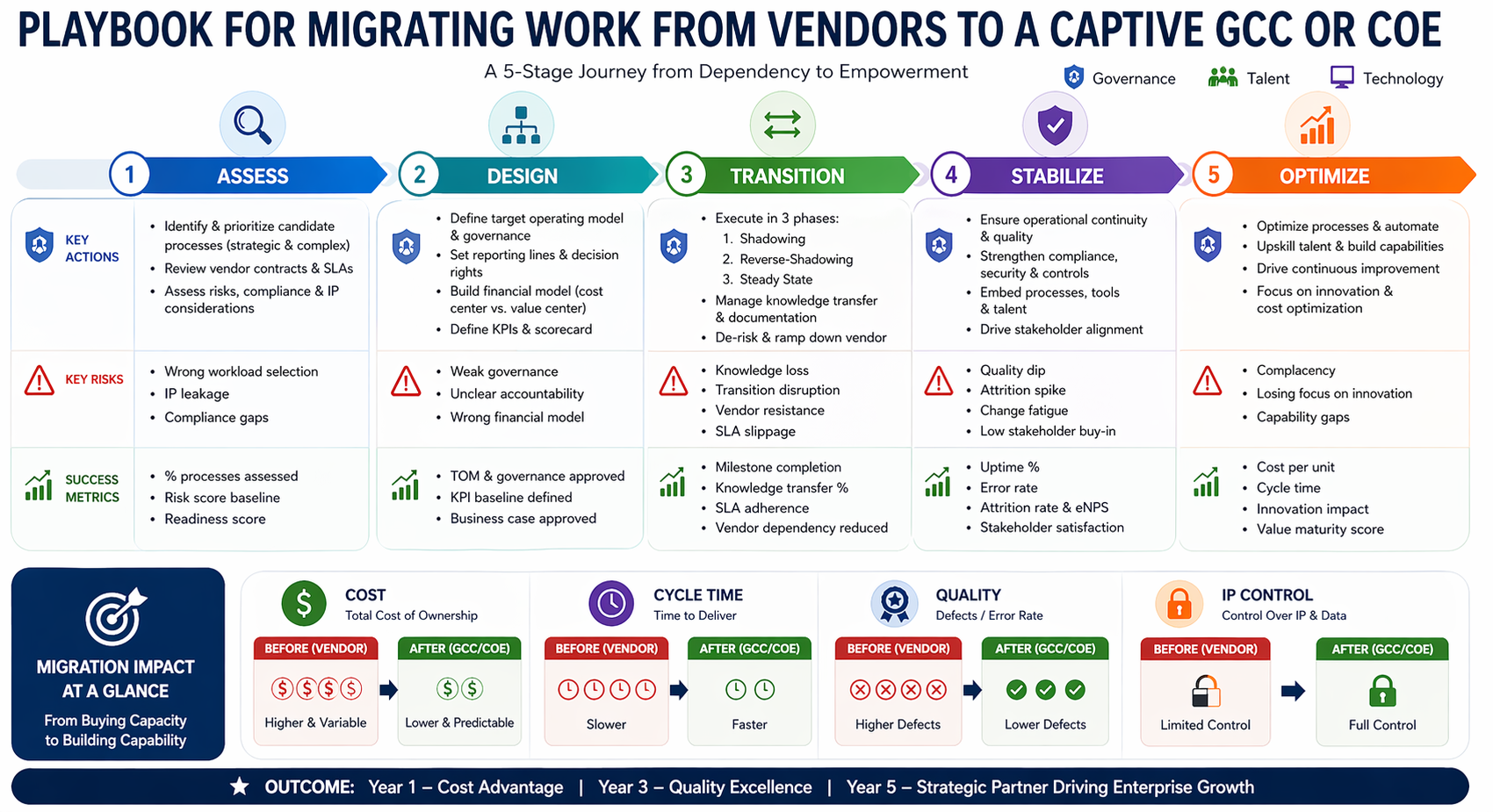
Assessing Readiness for Vendor-to-GCC Migration
The desire to build a GCC is one thing, the readiness to execute the migration is another. Migrating work from a vendor is a high-stakes surgery that requires a steady hand.
Workload Selection and Prioritization
Not every process belongs in a GCC. Organizations must evaluate workloads based on two axes: strategic criticality and complexity.
- High Priority: Proprietary software development, data analytics, and core customer experience functions.
- Lower Priority: Highly commoditized back-office tasks, hardware maintenance, or seasonal volume spikes that require massive, temporary headcount.
Risk, Compliance, and IP Considerations
The transition phase is the most vulnerable time for intellectual property (IP). Enterprises must audit their existing vendor contracts to identify knowledge transfer clauses and ensure there are no legal blockers to re-hiring or porting processes. Additionally, the GCC must meet the same, if not higher compliance and cybersecurity standards as the headquarters. Moving work in-house means the enterprise now carries 100% of the operational risk that was previously shared with or hedged by the vendor.
Use this GCC readiness checklist to assess if your organization is ready for a GCC before committing to a large-scale vendor-to-captive migration.
Step-by-Step Migration Playbook
Designing the Target Operating Model and Governance
Before a single line of code or process is moved, the enterprise must define the target operating model (TOM). This includes:
- Reporting Lines: Does the GCC head report to the Global CIO, or is it a matrix structure?
- Financial Model: Is the GCC a cost center, or a value center with its own P&L?
- Decision Rights: Who decides on tech stacks or hiring standards? Establishing a clear governance framework prevents the GCC from becoming a shadow IT organization that operates in a silo.
Transition phases: shadow, reverse-shadow, steady state
The actual transfer of work is best handled in three distinct stages:
- Shadowing: GCC employees observe vendor teams performing the tasks. They document organizational knowledge that isn’t in the official manuals.
- Reverse-Shadowing: The GCC team takes the driver’s seat while the vendor observes and provides a safety net. The vendor is still responsible for the SLA, but the GCC performs the work.
- Steady State: The GCC assumes full ownership. The vendor contract is ramped down, and the GCC begins the process of optimization and transformation.
Change management for stakeholders and teams
Perhaps the most overlooked element is the human factor. The existing vendor may feel threatened, leading to a drop in service quality during the transition. Internally, onshore teams may fear that a GCC is just a precursor to more layoffs. Clear, transparent communication is essential. Leaders must frame the GCC as an opportunity for onshore teams to focus on higher-value work while the GCC provides the dedicated engine room for growth.
Measuring Success After Migration
The ultimate board test is simple: Was it worth it? Answering it requires moving beyond skill arbitrage to enterprise value creation.
Cost, speed, quality, and innovation metrics
A robust GCC scorecard should balance four key pillars:
Metric Category | Key Performance Indicators (KPIs) |
Financial | Total Cost of Ownership (TCO) vs. Vendor Billing, Cost per Unit of Output |
Operational | Cycle Time Reduction, Error Rates, System Uptime |
Human Capital | Employee Net Promoter Score (eNPS), Attrition Rates, Internal Promotion Rates |
Strategic | Number of Patents Filed, New Product Features Launched, Revenue Influenced by GCC Insights |
Ultimately, the success of a GCC migration is measured by its value maturity. In year one, the win is cost. In year three, the win is quality. By year five, the GCC should be a strategic partner, driving the company’s global agenda rather than just executing tasks. The migration from vendor to captive is a journey from dependency to empowerment. By following a structured playbook, enterprises can reclaim their intellectual assets and build a global workforce that is truly their own.