
The ‘Internal VC’: Funding Innovation Inside Your GCC
Summary
GCCs are shifting from efficiency-focused support units to innovation hubs, with many now owning end‑to‑end product delivery and acting as global cores for AI, analytics, and digital engineering.
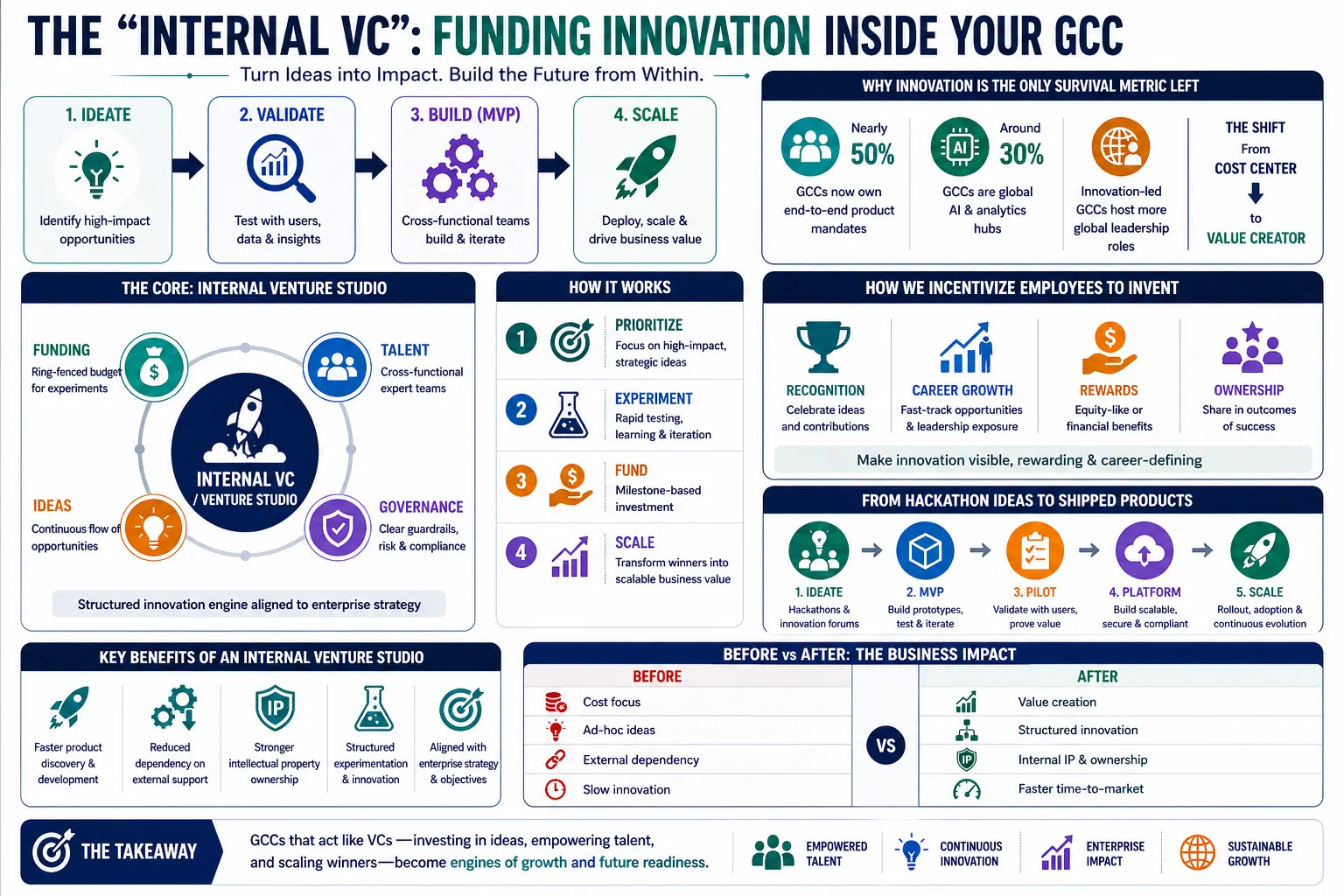
An internal venture studio gives this shift structure: it provides governance, funding, and cross‑functional talent to move ideas through clear stages—ideation, validation, MVP build, and scaling—tied directly to enterprise priorities.
Ring‑fenced innovation capital, a clear fail‑fast policy, and visible career/incentive paths (recognition, promotions, equity‑like rewards, leadership access) are essential to turn sporadic hackathon ideas into a steady pipeline of shipped products.
When experimentation is resourced, rewarded, and connected to commercialization, GCCs stop being seen as cost centers and become internal “VC portfolios” that drive resilience, growth, and differentiated capabilities for the global enterprise.
Recommendation: Design your GCC as an internal VC—set up a venture studio with dedicated budget, governance, and talent, and hardwire pathways from ideas to shipped, compliant products so intrapreneurs can repeatedly create measurable business value.
Intrapreneurship is reshaping how Global Capability Centers generate sustained enterprise value. It empowers employees to innovate within defined governance and strategic alignment. This model links organisational priorities with continuous, internally driven transformation. As competition grows, enterprises increasingly rely on GCC-led innovation for agility and resilience.
Across India, GCCs are expanding far beyond traditional support or cost-efficiency roles. Nearly 50% GCCs now manage end-to-end product delivery mandates. Also, around 30% are emerging as global hubs for AI and analytics. These trends reflect rising confidence in local talent, digital capability, and execution maturity.
Incorporating an intrapreneurial spirit can help GCCs become innovation launch pads with the potential to scale. This is because innovation labs, funding, and leadership support fast-track experiments. They also enable faster time-to-market and business results. Eventually, this enables sustainable growth, business resilience, and differentiation for global corporations.
Why Innovation is The Only Survival Metric Left
Global Capability Centers are in a phase where efficiency is not the only criterion for relevance. Enterprises are facing tech disruption, regulations, and changing customer behaviour. GCCs must change and evolve into innovation centres that generate value. Innovation is no longer a differentiator but a survival factor.
Evidence across India’s GCC ecosystem reinforces this shift. Nearly half of GCCs now own end-to-end product delivery mandates. A growing share is emerging as global hubs for AI, analytics, and digital engineering.
At the same time, leading organizations investing in innovation host more global leadership roles. They demonstrate a direct link between innovation and enterprise trust. On the other hand, the centres that are efficiency-oriented may experience a gradual process of marginalization.
Competitiveness is realised through innovation integration into their culture, governance, and operations. It entails experimenting, taking risks, having good compliance, and measuring business impact.
When innovation embeds into habits, GCCs will no longer be perceived as cost centres. Instead, they become architects of growth and future preparedness. Here are some of the key reasons why innovation is now defining global GCC survival:
- Shift to value creation: Enterprises now evaluate GCCs on business outcomes, not savings alone.
- Acceleration of AI-led transformation: Advanced analytics, automation, and digital platforms demand continuous innovation capability.
- Rising global ownership: End-to-end product and platform mandates require solution design, not just execution.
- Leadership pipeline creation: Innovation-driven GCCs produce more global CXO-ready leaders and strategic decision-makers.
- Regulatory and trust requirements: Secure, compliant innovation is essential in finance, healthcare, and retail ecosystems.
- Talent attraction and retention: High-skill professionals gravitate toward experimentation-led, purpose-driven environments.
- Resilience in uncertainty: Continuous innovation enables faster adaptation to market, technology, and geopolitical change.
Structuring an Internal Venture Studio Within a GCC
An internal venture studio helps GCCs build scalable products within the enterprise. It moves the centre beyond execution support toward structured innovation and commercialization. This approach brings together governance, funding, talent, and experimentation into one framework, helping teams develop and scale new solutions faster.
Key benefits of an internal venture studio include:
- Faster product discovery and development
- Reduced dependency on external support
- Stronger intellectual property ownership
- A structured approach to experimentation and innovation
A properly structured venture studio is also well-aligned with enterprise strategy and business objectives. Strong leadership offers direction, credibility, and investment backing, while cross-functional teams facilitate quick prototyping, validation, and testing.
A structured venture studio typically focuses on:
- Prioritising high-impact ideas
- Managing innovation risks
- Supporting rapid validation and learning
- Scaling successful products for revenue and business value
- Creating broader ecosystem and enterprise impact
This structured approach helps GCCs move from experimentation to measurable business outcomes. Here are some core steps to build and structure an internal venture studio within a GCC environment:
Ideation and Opportunity
The studio can help develop and enhance internal venture concepts through insight, research, and expertise. It helps identify unserved customer needs and strategic capability gaps. It also plays a huge role in discovering scalable innovation opportunities that are aligned with business priorities.
Validation and Business Model Testing
Promising concepts can undergo structured validation by the studio through customer feedback, prototype testing, and feasibility analysis. The studio evaluates product–market fit, revenue potential, cost, and strategic relevance before deeper investment.
Venture Build and MVP Development
Dedicated cross-functional teams in the studio help design, engineer, and operationalize the solution. The focus remains on MVP creation, iterative learning, and establishing a core operating foundation.
Ring-fencing Budget for Experiments
Studios should be allocated innovation funding separated from core operational delivery and cost efficiency targets. GCCs can release capital through milestone-based validation to ensure disciplined experimentation and measurable outcomes.
Fail Fast Policy in a Risk-averse Culture
The studio can leverage rapid testing cycles that identify weak ideas early and redirect resources toward stronger opportunities. The idea is to normalise learning from failure through leadership messaging, governance support, and transparent evaluation metrics.
How Organizations can Incentivise Employees to Invent
Incentivising employees requires more than financial rewards or one-time recognition. Organizations must create visible pathways where creative contributions translate into career growth. Leadership exposure and meaningful ownership of outcomes are key here. When employees see that experimentation is valued and innovation efforts influence business decisions, participation becomes intrinsic.
Structured incentives show that innovation matters by linking effort with clear rewards and growth opportunities, such as:
- Recognition for new ideas and contributions
- Performance-based promotions or career advancement
- Equity-like rewards or financial benefits
- Involvement in the outcomes of successful initiatives
Such mechanisms align employee efforts with organisational priorities and encourage sustained engagement in innovation initiatives. Equally important is providing the resources required to turn ideas into tangible solutions. Dedicated time, mentorship, funding, and access to appropriate tools enable employees to move from ideation to execution. This combination of tangible and developmental support:
- Builds confidence
- Strengthens capability
- Fosters long-term commitment to innovation
Moving from Hackathon Ideas to Shipped Products
Transforming hackathon ideas into shipped products requires disciplined intrapreneurship, not isolated creativity. GCCs must connect experimentation with governance, funding, and measurable enterprise outcomes. This shift moves centres from showcase innovation toward scalable business impact.
Structured pathways ensure promising ideas survive beyond demo stages and reach customers. Sustained success depends on:
- Leadership sponsorship
- Cross-functional ownership
- Continuous validation with users
Here are some key steps:
- Institutionalize Ideation Mechanisms: Run recurring hackathons, forums, and innovation time allocations across teams.
- Convert Prototypes into Focused MVPs: Prioritise core features, test rapidly, and refine using user feedback.
- Secure Stakeholder Buy-in Early: Demonstrate proof of value through pilots, metrics, and customer validation.
- Build Scalable, Compliant Platforms: Strengthen architecture, security, and integration for global deployment readiness.
- Embed Solutions into Operations: Assign ownership, fund incubation, and track measurable business outcomes.
- Create Repeatable Commercialization Pathways: Enable rollout, adoption tracking, and continuous product evolution.
Intrapreneurship is becoming the defining force behind the next generation of GCC evolution. Centers that embed experimentation, ownership, and commercialization move beyond efficiency into enterprise impact. This shift transforms GCCs into innovation hubs that drive products, platforms, and global growth. Sustained value now depends on structured innovation, empowered talent, and measurable business outcomes.
Organisations accelerating this journey benefit from experienced ecosystem partners who understand GCC transformation. ANSR supports enterprises with GCC strategy, build, talent, and innovation enablement under one integrated model. Its platforms and operating frameworks help convert intrapreneurial ideas into scalable, revenue-generating solutions. Schedule a call with our team of experts to see how your GCC can become an engine of innovation and competitive advantage.