
From Delivery Centers to Talent Platforms: How GCCs Build Leaders and Tap Ecosystems
Summary
GCCs are evolving from delivery hubs into leadership factories and innovation platforms
-
Enterprises are using GCCs to develop high-potential leaders, offering exposure to global, cross-cultural, and distributed leadership – building future-ready executives.
-
Leadership and strategic ownership (P&L, product, platforms) are increasingly anchored in GCCs, shifting them from support centers to core decision-making hubs.
-
GCC locations like India provide stronger access to advanced tech talent and innovation ecosystems, making them ideal for housing strategic capabilities.
-
Employee-driven innovation is accelerating through AI enthusiasm, self-learning, and internal crowdsourcing – turning GCCs into engines of continuous experimentation.
Recommendation: Design GCCs as fluid, ecosystem-connected platforms that integrate leadership development, strategic capabilities, and workforce-driven innovation to future-proof enterprise growth.
GCCs as training grounds for future global leaders
Using GCCs to stretch high‑potential talent
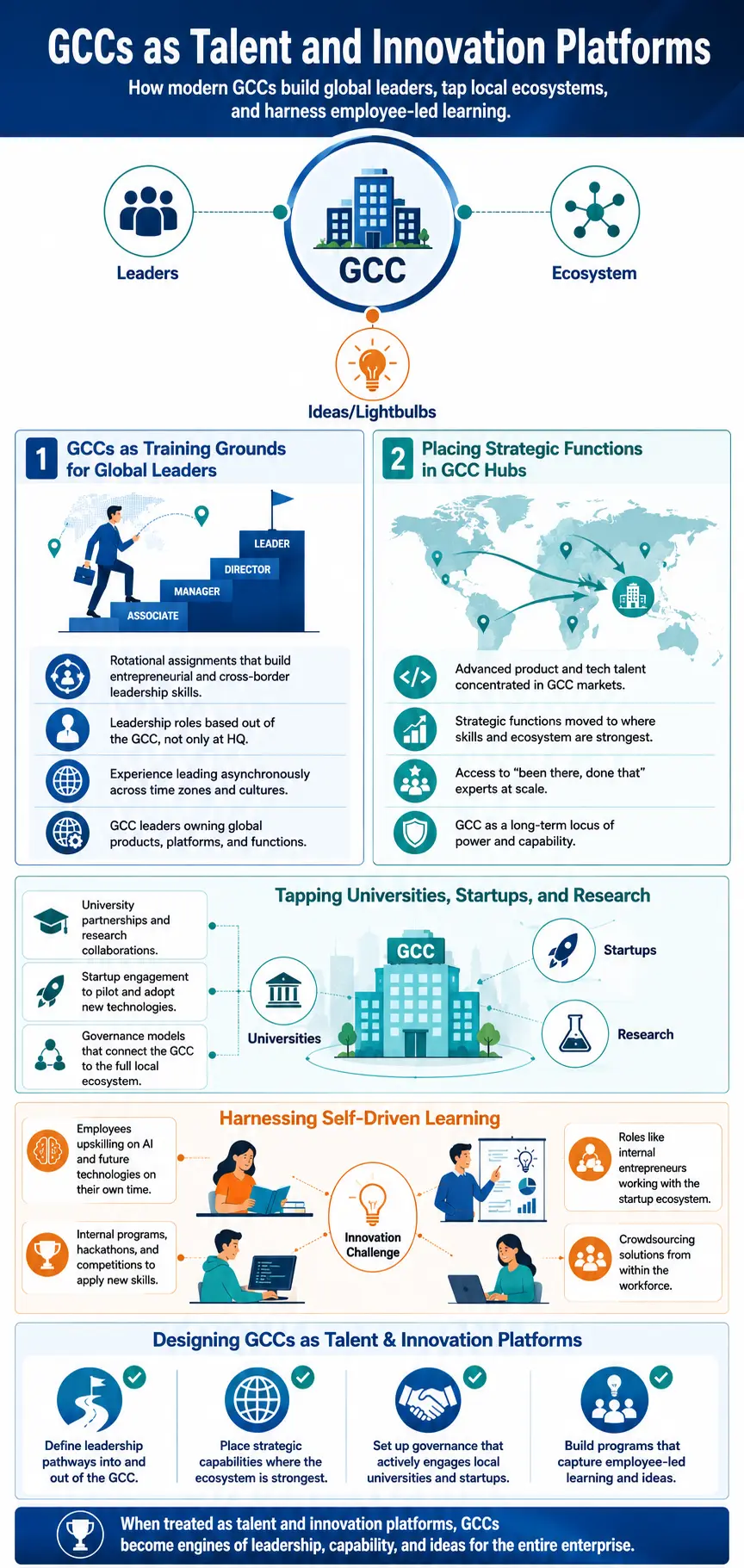
Over more than a decade of GCC build-outs, a growing number of enterprises have begun to use their centers as training grounds for high‑potential leaders. Instead of treating these locations purely as execution arms, organizations rotate leaders into GCC roles to give them exposure to entrepreneurship, new environments, and asynchronous leadership across time zones.
This model builds capabilities that are increasingly critical in global organizations: leading distributed teams, navigating diverse cultures, and driving change from emerging markets. Over time, the GCC becomes a structured pathway for future-ready leadership, not only for operational roles but for strategic enterprise positions as well.
Growing global leaders out of GCCs
The trend has now moved beyond short-term expatriate assignments. Many companies are establishing global leaders directly out of their GCCs, placing P&L, product, and platform ownership in these locations. The question shifts from “How do we staff the center?” to “Where is the locus of power and capability?”
When a significant share of capabilities and functions operate out of the center, and leadership is anchored there, the GCC becomes deeply integrated with the enterprise. This not only signals long-term commitment to the market but also ensures that the center is viewed as a core part of how the company is run – not a satellite.
Locating capabilities where the ecosystem is strongest
Shifting strategic functions into GCC hubs
Enterprises are increasingly asking whether some strategic functions might actually be better situated in GCC hubs than in headquarters. In markets like India, there is a dense concentration of product, technology, and digital talent across sectors.
Certain capabilities – especially in advanced technology, digital product development, and emerging tech – may be more mature in GCC locations than in the company’s home base. Moving these functions into the GCC allows organizations to access “been there, done that” talent at scale and often at a lower relative cost, while also positioning these teams closer to cutting-edge ecosystems.
Leveraging universities, startups, and research ecosystems
GCC locations benefit from proximity to universities, research institutions, and startup ecosystems. Universities are attracting research grants and building partnerships with companies, particularly in deep tech and AI. Startups are experimenting with new technologies and business models at high speed.
GCCs that are designed with robust local governance and leadership can tap into this full ecosystem. They build partnerships, co-create with startups, and recruit from universities, turning the GCC into an access point for innovation that would be harder to replicate from headquarters alone.
Aligning to a changing workforce and AI-driven future
Listening to employees and designing modern work models
The global workforce is being reshaped by social, environmental, and technological forces, and GCCs sit at the heart of this shift. Organizations that succeed are those that actively listen to employees – understanding what drives them, how they want to work, and what they expect from their careers.
Enthusiasm around AI and future technologies is particularly strong in GCC markets. Companies that position their centers as places to build the future of work, experiment with new technologies, and solve meaningful problems are better able to attract and retain top talent. This often requires evolving policies around hybrid work, flexible roles, and new profiles such as “internal entrepreneurs” who can bridge between the enterprise and the startup ecosystem.
Harnessing self‑driven learning and internal crowdsourcing
With the explosion of freely accessible learning resources, employees are increasingly investing in their own upskilling outside formal corporate programs. Many are already taking courses, experimenting with tools, and building side projects in AI, data, and other emerging fields.
Forward-looking GCCs actively harness this self‑driven learning. They create programs, challenges, and competitions where employees apply new skills to real business problems. Internal hackathons, innovation challenges, and crowdsourcing platforms allow the organization to capture ideas and solutions from its own people, effectively running “future of work” experiments inside the enterprise rather than only relying on external training or consultants.
Designing GCCs as fluid talent and innovation platforms
The most advanced enterprises now design GCCs as fluid platforms that combine leadership development, strategic capabilities, and ecosystem access. Leadership roles deliberately move into and out of the center, capabilities gravitate to where the ecosystem is strongest, and employee-driven innovation is encouraged through structured programs.
Instead of being defined by a static delivery mandate, the GCC becomes a dynamic construct: building global leaders, plugging the enterprise into external ecosystems, and capturing the energy of a workforce eager to shape the future of work and technology.