
Why 40% of GCC Transitions Stall at the Same Point
Summary
Australian mid‑market GCCs won’t fail for lack of talent – they fail when mandates, transitions, and governance aren’t built to scale beyond the pilot
Most GCC stalls happen at the same point: moving from pilot success to enterprise‑scale, when weak documentation, rushed stabilization, and limited local authority keep teams dependent on headquarters and stuck in transactional work.
Founder exits are a hidden transition risk; without structured succession and codified institutional knowledge, global teams see rising attrition, slower decisions, and fraying alignment across time zones.
A structured pre‑transfer audit – covering process documentation, dependencies, governance, compliance, and workforce readiness – is critical, especially in BOT models where 30 – 40% of Indian GCCs operate and knowledge transfer is central to success.
Scaling GCCs that last treat transition management as a strategic capability: they set a clear long‑term mandate beyond cost arbitrage, empower local leaders, invest in robust knowledge transfer and governance, and regularly ask six hard diagnostic questions on mandate, documentation, authority, stabilization, foundations, and shared vision.
Recommendation: Before scaling in 2026, run a pre‑transfer audit and 6‑question diagnostic, clarify the GCC’s long‑term mandate, and strengthen governance and founder/leadership continuity – ideally with specialist partners who bring proven transition frameworks and operating models.
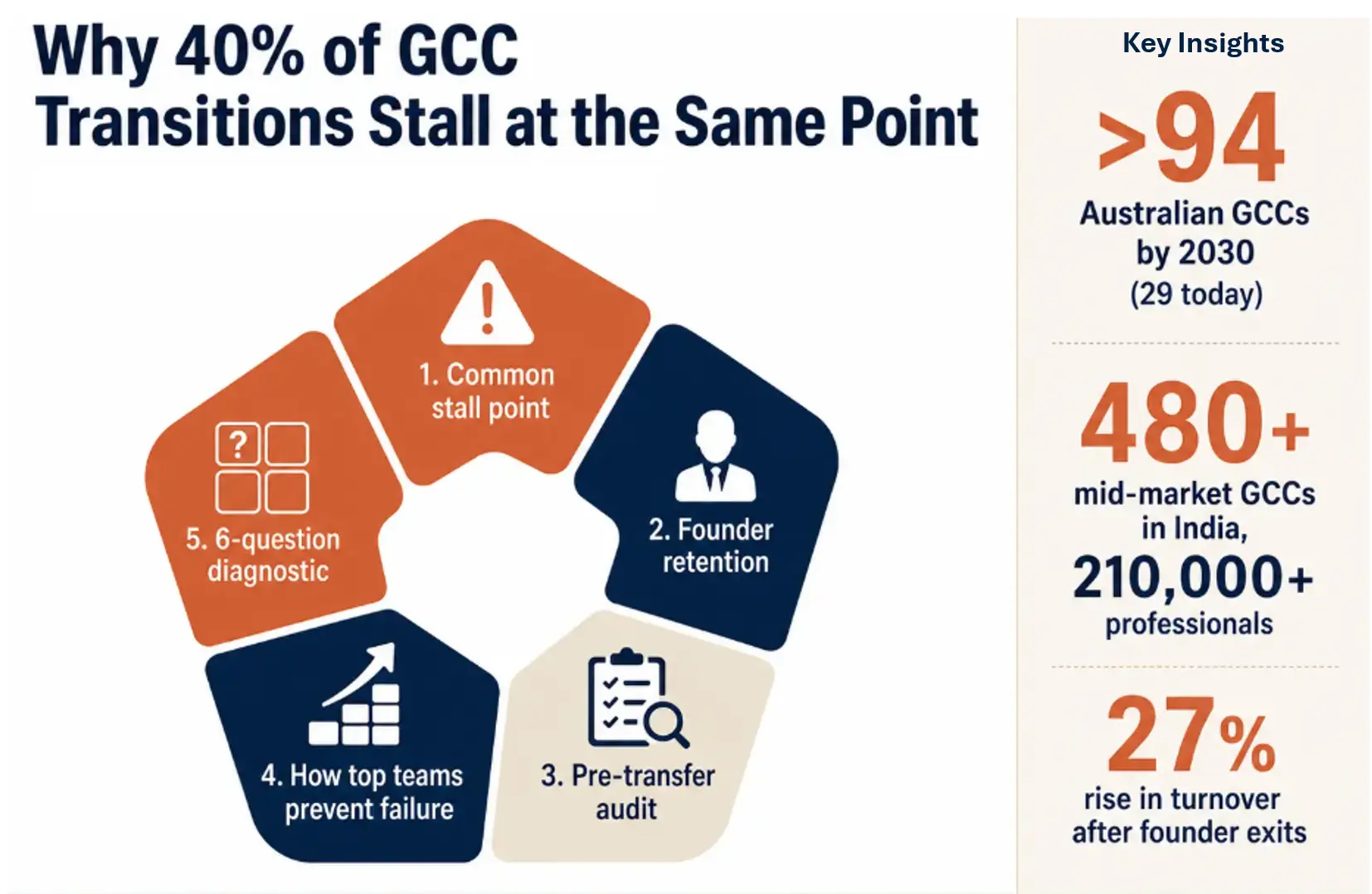
As 2026 unfolds, Australian companies are accelerating GCC investments in India. The number of Australian GCC operators is projected to grow from 29 today to more than 94 by 2030. For mid-market GCC leaders in Australia, the challenge is not launching a center. It is avoiding a GCC transition failure in 2026 as operations move beyond the pilot stage.
Building effective global teams requires more access to talent. It demands strong governance, integration, and execution. Read to know where GCC transitions stall, why progress breaks down, and what leaders can do to scale successfully.
Common Point Where GCCs Stall (It’s Always the Same)
The stall almost always happens when a GCC moves from pilot success to enterprise-scale execution. Early momentum fades. This leads to slowing down of knowledge transfers and the emergence of governance gaps. In no time, business stakeholders begin questioning the value of the model.
A common example is the transition of critical processes from headquarters to the GCC. Documentation may be incomplete. Stabilization periods may be too short. Local leaders may lack decision-making authority. As a result, teams remain dependent on the parent organization long after the transition is complete. Common challenges include business integration, transition management, operational management, and employee attrition.
This is also where many global business services ambitions lose momentum. Instead of becoming strategic hubs, GCCs remain focused on transactional work. By the time the struggle to integrate with core business functions becomes apparent, it is often too late.
Mid-market GCCs in India now account for more than 480 centers employing over 210,000 professionals. For Australian organizations managing global teams across markets and time zones, identifying common factors that slow down progress is key. Some of these include attracting and retaining talent, cultural alignment issues, and stakeholder resistance. Organizations that move past this stage don’t treat transition management as an operational handoff. Instead, they think of it as a strategic capability.
Why Founder Retention is an Important Lever
Founder exits often create more disruption than operational setbacks or market pressures. Employee turnover can rise by roughly 27% following a founder’s departure as per industry research. The impact goes beyond leadership succession. Founders often hold critical institutional knowledge. They also influence key decisions and maintain relationships, shaping how the business operates.
When they leave without a structured transition, uncertainty spreads quickly across the organization. Teams lose context. Decision-making slows. It is common for high performers to then begin reassessing their future. The risks become even greater when managing a global team. Distributed employees rely heavily on shared direction, consistent communication, and cultural alignment.
A founder’s departure can weaken these connections. It can also create gaps that are harder to address across geographies and time zones. Many companies prioritize fundraising, expansion, and product development. As a result, leadership continuity receives less attention than it deserves. Organizations that plan early and document critical knowledge are better positioned to preserve momentum after the founder steps back. Structured transition pathways can further strengthen continuity.
Crucial Need for Pre-Transfer Audit
Most GCC transition issues are visible before the knowledge transfer begins. The problem is that organizations rarely assess their readiness in a structured way. A pre-transfer audit helps identify gaps before work moves to the GCC. It helps team review process documentation, system dependencies, governance structures, compliance requirements, stakeholder ownership, and workforce readiness.
The objective is simple: determine whether the GCC can operate independently once the transition is complete. This step is often overlooked, yet it can have a significant impact on outcomes. That is especially true in transition-heavy operating models. Industry estimates suggest that 30–40% of GCCs in India use a build-operate-transfer (BOT) model, where knowledge transfer and operational handover are central to success. As GCC mandates become larger and more strategic, transition readiness becomes increasingly important.
Without a pre-transfer audit, critical dependencies often emerge too late. Key processes may rely on a small group of subject-matter experts. Documentation, system access, and ownership structures may also be incomplete. These gaps slow knowledge transfer and prolong dependence on headquarters teams, becoming one of the key reasons for a GCC transition failure in 2026. This risk is even greater in organizations that rely on global outsourcing services. A structured audit helps identify gaps before the transition begins, enabling a smoother handover and faster ramp-up.
How the Best Teams Prevent It
Many small-to-mid-sized GCCs (with less than 500 full-time employees) that fail to scale do so within their first two to three years. The difference is not usually talent availability. It is whether the GCC is built as a strategic extension of the enterprise or treated as a low-cost delivery center. Effective global teams establish a clear long-term mandate from the outset. They align leadership around the role the GCC will play in the business and create a roadmap for that role to evolve over time. This helps avoid a common problem: headquarters expects transformation, while the GCC is limited to execution.
Such teams also invest heavily in transition fundamentals ensuring that documentation is comprehensive, knowledge transfer is structured, and stabilization periods are realistic. Entity setup, compliance, and governance receive the same level of attention as hiring and workforce planning. Most importantly, successful GCCs avoid operating like outsourcing vendors right from the outset. Local leaders are given ownership, decision-making authority, and accountability for outcomes. This allows the global center to become an integrated part of the business.
6-Question Diagnostic
Many GCC transitions show signs of trouble long before performance declines. The only way to avoiding a GCC transition failure in 2026, is recognizing these signals early. Use the following questions to assess whether your GCC is positioned to scale successfully. Start by asking whether the GCC has a clearly defined long-term mandate beyond cost arbitrage. If the answer is no, the center may struggle to evolve beyond transactional work.
Next, assess whether critical processes have been fully documented and transferred. Gaps in documentation often create dependency on headquarters and slow decision-making. Then, evaluate whether local leaders have sufficient authority to make operational decisions. If key decisions continue to sit with headquarters, the GCC may find it difficult to scale its responsibilities.
Review the stabilization process. Was enough time allocated for knowledge transfer, stakeholder alignment, and operational handover? Short stabilization periods often create problems that surface later. Consider whether entity setup, compliance, and governance structures are fully established. Weak foundations can become major barriers as the GCC grows. Finally, ask whether headquarters and the GCC share the same vision for success. Misaligned expectations remain one of the most common reasons for transitions to lose momentum.
GCC transition failure rarely comes down to a lack of talent or investment. More often, it happens when mandates are unclear, governance is weak, knowledge transfer is incomplete, or expectations between headquarters and the GCC are not aligned. Organizations that address these challenges early are better positioned to scale their GCCs and create long-term value.
ANSR helps companies navigate this journey through proven operating models, transition frameworks, and capability-building strategies. Get in touch with our experts today to evaluate your GCC’s readiness for scale and build a stronger foundation for long-term growth.