
What Should Stay at HQ? Rethinking GCC Ownership and Leadership
Summary
The next GCC breakthrough comes from moving ownership – not merely work – to India, and asking what truly needs to remain at headquarters.
-
India’s GCC ecosystem now has the leadership depth across product, technology, operations, and transformation to take on enterprise-critical mandates. The differentiator is no longer access to talent, but whether leaders receive the authority and context to use it.
-
Role migration alone creates an execution ceiling: when teams deliver roadmaps without owning priorities, architecture, budgets, or outcomes, innovation remains constrained. Mature GCCs instead take end-to-end ownership of products, platforms, and functions.
-
Placing senior leaders in GCCs brings strategic decisions closer to the teams building AI, digital products, and engineering platforms – strengthening accountability, accelerating innovation, and creating credible global leadership paths for high-potential talent.cnbc+1
-
Reversing the HQ question changes the mandate: assess which work genuinely requires proximity to customers, regulation, or executive leadership, rather than assuming strategic work must remain at headquarters by default.
Recommendation: Redesign the GCC charter around strategic control – explicitly transfer decision rights, product/platform ownership, and outcome accountability alongside work; move senior enterprise leaders closer to core GCC mandates; and measure success through business impact, innovation, and customer outcomes rather than headcount.
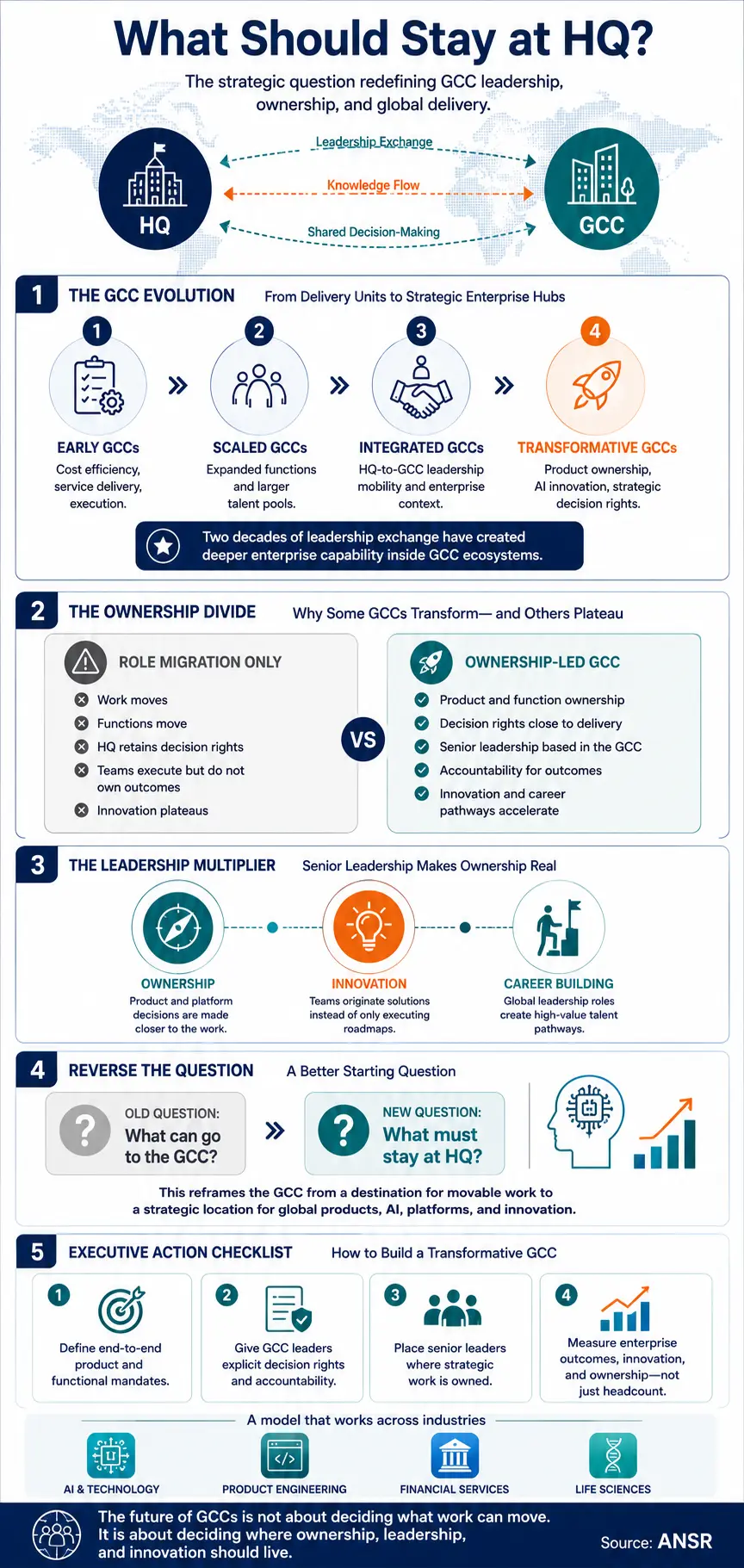
Mukul Gupta, Managing Director at ANSR, explains why the GCC conversation must move beyond asking, “What can go to the GCC?” The more strategic question is: What genuinely needs to remain at headquarters? As India’s GCC ecosystem has matured, it has accumulated the leadership depth, capabilities, and product expertise to own far more of the enterprise agenda.
The GCC leadership equation
Over the past 20 – 25 years, GCCs have progressed from fledgling delivery units into dynamic enterprise environments. In the early phase, leadership was often drawn from services organizations or a small group of executives returning from headquarters. That shaped centers primarily around execution.
Today, the leadership equation is fundamentally different. Global corporations have created sustained interchange between headquarters and GCCs: senior leaders have moved into GCC roles, while GCC leaders have taken on headquarters assignments. This exchange has brought enterprise context, global operating experience, and HQ decision-making DNA into GCCs.
The result is a deeper leadership bench. India’s GCC ecosystem now offers a concentration of experienced middle and senior leaders across product, technology, operations, and transformation – capabilities that are increasingly central to global enterprise strategy.
Why role migration is not enough
Move ownership, not just work
Transformative GCCs do more than absorb roles or functions. They become the center of gravity for product ownership and decision-making.
Centers plateau when work moves to the GCC but authority does not. Teams may execute roadmaps, operate functions, or deliver programs, yet lack the mandate to set priorities, influence architecture, own product outcomes, or make critical decisions. This creates a ceiling on innovation and limits the GCC’s relevance to the parent organization.
By contrast, GCCs that own products, platforms, and end-to-end functions create stronger accountability. Decision rights enable leaders to build innovative solutions, strengthen careers, and develop a durable ownership culture. Research on GCC evolution similarly identifies local leadership and unique capabilities as key accelerators of value creation.
Leadership drives transformative mandates
The most advanced companies place an equal – or greater – share of senior leadership in their GCCs when the mandate demands it. This model does more than decentralize reporting lines. It brings strategic judgment closer to the teams building AI capabilities, digital products, engineering platforms, and future-facing solutions.
Senior leadership inside the GCC creates three advantages:
- Ownership: Decisions can be made near the product, customer problem, and delivery reality.
- Innovation: Teams gain the confidence and authority to originate ideas, not merely execute them.
- Career building: High-potential talent sees meaningful global leadership pathways without having to leave the GCC ecosystem.
Reversing the HQ question
Ask what must remain, not what can move
Most enterprises begin by asking what activities can be transferred to a GCC. That framing assumes headquarters is the default location for strategic work and the GCC is a destination for selected tasks.
A more ambitious question is: What should stay at HQ, onshore, or in existing development locations? This reverses the burden of proof. Instead of limiting the GCC to work deemed movable, leaders assess which activities truly require physical proximity to headquarters, local regulation, market access, or executive presence.
This broader framing expands the possible GCC mandate across product, technology, AI, operations, and even science-led domains. Leading technology firms, banks, and pharmaceutical companies are already challenging traditional location assumptions as they pursue cutting-edge global work.
Build GCCs around strategic control
The goal is not to hollow out headquarters. It is to build a globally integrated enterprise in which strategic control, capability, and leadership sit where they can create the most value.
For GCC leaders, that means making ownership visible: defining product mandates, clarifying decision rights, moving senior leaders closer to core work, and measuring outcomes rather than headcount. For enterprise leaders, it means treating GCCs as places where strategy can be authored—not simply delivered.
Frequently Asked Questions
What work should typically remain at headquarters?
HQ should retain work requiring direct board, investor, regulator, or market proximity; all other work should be evaluated based on value and capability fit.
Why do some GCCs plateau after scaling?
They scale roles and functions without transferring the decision rights, product ownership, and accountability needed to drive innovation.
What distinguishes a transformative GCC from a delivery center?
A transformative GCC owns end-to-end outcomes, products, and decisions, while a delivery center primarily executes assigned work.
Why is senior leadership presence important in a GCC?
Senior leaders bring decision-making closer to the work, strengthen ownership, and create credible global career pathways.
How can leaders measure whether a GCC has true ownership?
Measure end-to-end mandates, independent decision rights, strategic outcomes, innovation impact, and senior-leadership presence – not headcount alone.