
Offshoring for New Zealand Businesses: Where to Start
New Zealand’s current talent market is posing serious structural hurdles for local business owners. Wages in the private sector grew by 2.3% annually to June 2025, compared to 3.6% in 2024, but productivity remains substandard. The substandard performance affects the local companies since they end up earning more but producing less. Moreover, New Zealand is one of the countries that perform the worst globally when it comes to income increase within the last decade. This makes the employers feel the burden of increasing expenses and lack of pricing powers. Most of the SMEs operating in New Zealand find themselves seeking employees from offshore to create capabilities, improve efficiency, and expand. Through offshoring strategy, New Zealand companies can effectively cope with local talent shortages without spending too much money.
What is Offshoring and Why do New Zealand Businesses Do It?
In other words, offshoring means transferring certain business functions to professionals with a particular skill set that are in global talent markets. There are several reasons why New Zealand is facing special business operations. Firstly, it is a small and competitive market with very high cost of living. It implies that wages there are among the highest in the world. Secondly, it takes 4-6 months to fill a senior engineering position in Auckland, Wellington, or Christchurch. The salary of a fully loaded senior engineer can range from NZD $170,000 to $215,000 per annum.
With the help of offshoring, companies can find good talent with the help of a global delivery partner at a lower price. Thus, the senior engineer that works with a Kiwi company through such a delivery partner in India can cost about NZD $65,000-$95,000 per annum. As for SME, scaling with the help of five people in an offshore pod can lead to NZD $400,000 to $550,000 capital saved per year that could be invested in a sales or marketing team.
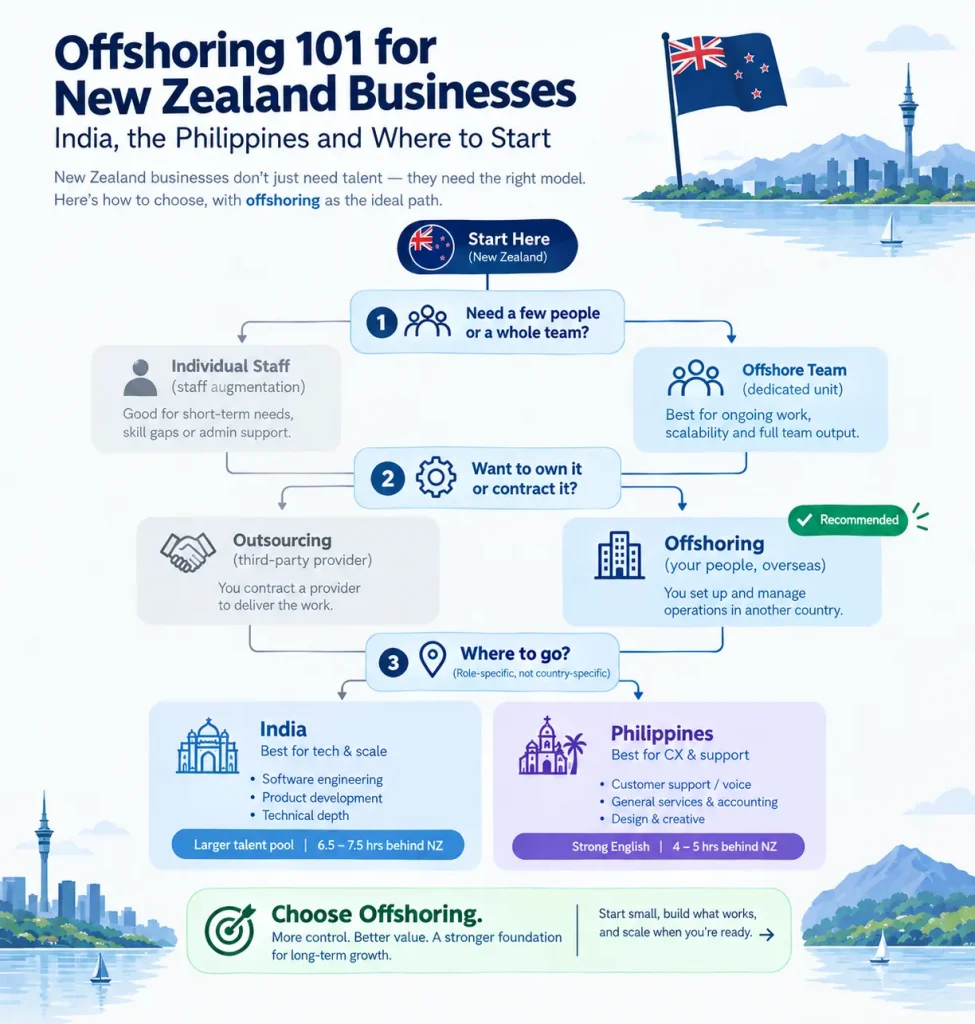
Offshore staff vs an offshore team: what’s the difference?
As such, when creating a global talent strategy, it is important to draw a line between hiring individual offshore employees and offshore team building. Individual staff augmentation is a good way to fill up resource shortages for a limited period or assist in solving administrative challenges. Individual staff augmentation means that you employ a virtual assistant or a specialized contractor that performs a task within your workflow.
In turn, offshore team building implies that you set up a fully functioning offshore unit that works as part of your team daily. In other words, unlike individual staff augmentation, offshore team building does not include performing isolated tasks but rather means that you get a whole team to perform certain duties.
Thus, in software development, an efficient initial team (pod) will include a tech lead, two developers, a part-time designer and a part-time tester. Such a structure gives the output of a six-person local team at a highly predictable monthly price.
Outsourcing vs offshoring: which does your NZ business need?
People frequently use these words interchangeably, but the debate of outsourcing vs offshoring boils down to a clean distinction: one changes who does the work, while the other changes where the work is done.
- Outsourcing: This means contracting a specific function, task, or project to a third-party provider instead of performing it internally with your own employees. The provider might be based right here in New Zealand (such as a local bookkeeper or marketing agency) or located overseas.
- Offshoring: This is purely geographical; it involves relocating your business operations to another country. The people doing the work can be your direct employees working under a foreign subsidiary (known as captive offshoring), or they can be managed by a partner.
For most New Zealand SMEs, the sweet spot is offshore outsourcing hiring dedicated offshore resources through a specialist agency. This hybrid model delivers the significant cost savings of offshoring while bypassing the massive administrative complexity of setting up a foreign legal subsidiary, managing international compliance, or building separate HR networks from scratch.
India or the Philippines: where should a New Zealand business offshore?
Selecting the right destination is crucial, and the choice should be role-specific rather than country-specific.
India
India is the global powerhouse for technical depth and software engineering. The country graduates approximately 1.5 million engineering students annually and boasts a massive, mature technology ecosystem. If your Kiwi business is in B2B SaaS, mobile engineering, or cloud migration, India is a natural choice.
Additionally, India is 6.5 to 7.5 hours behind New Zealand. This timezone gap translates into a highly productive rhythm: a 3-hour late-afternoon overlap when your day is winding down, followed by overnight engineering execution and morning demos.
Philippines
The Philippines takes charge when it comes to customer-oriented voice functions, general services, accounting services, and design services. It is the second most proficient country in Asia when it comes to English language skills. It has professionals that do not have accents and are aligned to Western-style businesses.
Manila, Philippines, is just 4 to 5 hours behind New Zealand. A Filipino employee can easily work the early shift from 5:00 AM to 6:00 AM Philippine time, which is perfectly in sync with New Zealand’s regular office hours (9:00 AM to 10:00 AM NZT).
How does a New Zealand company get started with offshoring?
If the business has reached the stage where it is time for offshore capacity, the EOR service is undoubtedly the safest and most efficient way to go. The EOR company will become your legal employer in the foreign country of choice and take care of all local payroll and compliance, including SSS, PhilHealth, Pag-IBIG, and the 13th month pay in the Philippines, allowing you to fully manage the daily activities and performance of your team members.
From the point of view of taxation, the rules of the Inland Revenue Department are quite unambiguous – New Zealand companies do not usually make any PAYE payments, KiwiSaver contribution (mandatory 3% from the employer), ACC levy, or non-resident contractor tax for foreign employees who are non-residents doing their entire work abroad. It is always better to start with something small, maybe even with one virtual assistant or a pre-construction pod of two workers.