
EOR vs PEO: Which Employment Model Does Your UK Expansion Need?
As UK enterprises navigate a post-Brexit talent landscape, the search for skilled technical and operations professionals has shifted further afield, with India emerging as a primary corridor due to a shared commercial history and a favorable 4.5 to 5.5-hour time zone overlap. However, for a PEO UK expansion or global hiring strategy to succeed, choosing the right structural vehicle is critical. While both models aim to streamline international growth, the PEO vs EOR decision determines who carries legal liability and whether business need to establish a local presence.
When comparing EOR vs PEO, the fundamental difference lies in the legal employment relationship: an EOR acts as the sole employer in a country where business have no entity, whereas a PEO is a co-employment partner for a market where it is already registered. For most UK firms scaling into India, an EOR is the necessary bridge to get talent live in days without the red tape of immediate incorporation.
EOR vs PEO: What’s the Difference?
The difference between EOR and PEO rests on employment, compliance and location of hiring in business. The Employer of Record (EOR) acts as the employer in law of the global workforce, thus enabling HQ to hire globally without having to establish local companies or take employment compliance risks. The Professional Employer Organization (PEO), on the other hand, offers a co-employment arrangement to the company that already has legal companies to facilitate the management of HR and payroll services for the employees while taking care of the employment compliance for business.
What is a PEO and How does it work?
It is essential to recognize it as an HR outsourced solution that manages payroll, recruitment, and benefits management on behalf of an existing corporate entity. The PEO meaning is rooted in co-employment, a structure where both company and the PEO are considered employers of the workers. Under this model, business retain control over daily work and performance, while the PEO handles the administrative support functions.
Key features of PEO services include:
- Shared Liability: Both parties share legal responsibility for the workforce.
- Economies of Scale: PEOs pool employees from multiple clients to negotiate better rates for insurance and pensions.
- Local Entity Requirement: Business must already have a registered legal presence in the jurisdiction where business is using the PEO.
It is vital to note that co-employment is largely a US construct. In many other regions, including India, the law does not formally recognise split employer liabilities, making traditional PEO arrangements less common for international hiring.
What is an EOR and How is it Different?
An employer of record is a third-party organisation that legally employs workers on behalf in another country. Unlike a PEO, the EOR is the sole legal employer, meaning business do not need to establish a foreign subsidiary to start hiring. This model is purpose-built for global expansion, as the EOR’s existing local infrastructure allows to onboard talent in as little as 3 to 10 working days.
The EOR assumes full responsibility for:
- Drafting locally compliant employment contracts.
- Managing payroll, taxes, and statutory contributions (such as India’s Provident Fund).
- Ensuring adherence to local labour laws, such as India’s new Labour Codes, which consolidated 29 laws into four comprehensive codes in 2025.
EOR vs PEO for UK Companies Hiring Abroad: Which one do you need?
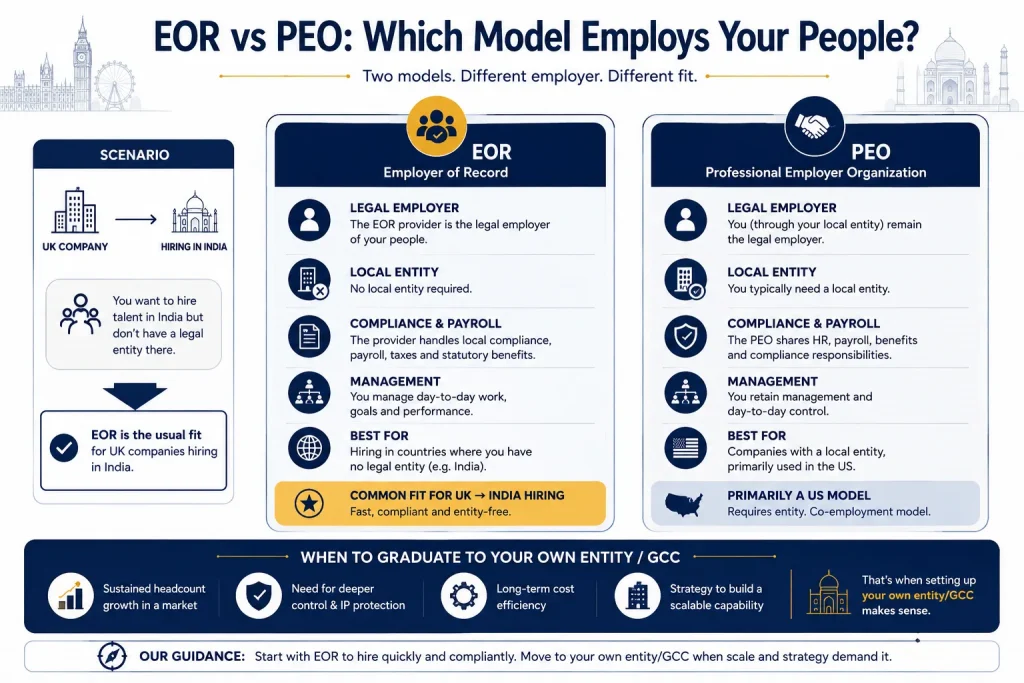
When deciding between an EOR and a global PEO, the choice is usually dictated by legal footprint. For most UK firms expanding into India without a pre-existing subsidiary, the EOR is the only compliant choice.
Why UK Firms in India Need an EOR
In India, the co-employment model central to PEOs is not formally recognised. Indian regulatory bodies, such as the EPFO and the Income Tax Department, expect employment responsibilities to sit with a single legal entity. Therefore, what is often marketed as PEO India is an EOR service where the provider assumes the role of the legal employer under the state Contract Labour (Regulation and Abolition) Act, 1970.
Using an EOR allows UK companies to:
- Test the Market: Hire a small team to explore potential without committing to a full legal setup that can take months.
- Ensure Compliance: Protect the business from Permanent Establishment (PE) risks and misclassification liabilities.
- Speed to Market: Seize opportunities by hiring in days rather than waiting for entity incorporation.
EOR vs PEO vs Setting up your Own Entity: When to Switch?
While an EOR is an excellent bridge, it is rarely the destination for a large-scale expansion. Business should model the EOR vs entity crossover when single-country hiring plan reaches a certain scale. In the Indian market, the crossover typically occurs between 10 and 15 employees. At this stage, the per-employee monthly margin charged by an EOR often exceeds the fixed annual compliance costs of running its own Wholly Owned Subsidiary (WOS).
Triggers to graduate from an EOR to own entity include:
- Headcount: Scaling past 15–25 people often make an owned entity more cost-effective.
- Commercial Triggers: Needing to invoice Indian customers in Rupees (INR) or leasing permanent office space.
- IP and Equity: Wanting direct ownership of India-created intellectual property or granting group equity to local staff.
- PE Risk Management: If staff habitually conclude contracts, a dependent-agent Permanent Establishment (PE) can arise, making a transparently taxed subsidiary a safer long-term choice.
Which Employment Model Fits your UK Expansion?
Choosing the right structure is a point-in-time decision that should evolve as operations scale. For initial expansion into markets like India, the PEO vs EOR debate is won by the EOR for its ability to provide rapid, entity-free compliance. However, as the team grows and the market commitment deepens, moving toward a direct employment model with own subsidiary will likely provide better control and long-term ROI.