
Nearshoring vs Offshoring vs Outsourcing: Which Model Fits a UK Firm?
For UK tech leaders, scaling a software engineering or product team is no longer a localized challenge. As of 2026, Over half and up to 73% in specialized sectors of UK organizations face ongoing digital and technical skill shortages. UK Firms must look beyond their borders to remain competitive. However, navigating the modern sourcing landscape can be dizzying.
When deciding between nearshoring vs offshoring, many executives get caught in a web of overlapping definitions, often conflating geographic location with operational ownership. Choosing the wrong path can lead to misaligned expectations, runaway costs, and cultural friction. This guide provides a decision-making framework tailored specifically for UK firms.
Nearshoring vs offshoring: what’s the actual difference?
The distinction between nearshoring and offshoring comes down to two primary variables: geographical proximity and time zone alignment relative to the United Kingdom.
|
Factor |
Nearshoring |
Offshoring |
|
Geographical Proximity |
Primarily neighboring European markets such as Poland, Romania, Portugal, Spain, and the Balkans. South Africa can also be considered an honorary nearshore market for UK firms. |
Primarily distant global markets, with India being a major offshore destination for UK businesses, particularly Bengaluru, Hyderabad, and Pune. |
|
Time Zone Alignment |
Typically, 0–2 hours from the UK, enabling strong working-day to overlap and real-time collaboration. |
India is 4.5 hours ahead of BST and 5.5 hours ahead of GMT, still allowing meaningful afternoon overlap but with less synchronous collaboration. |
|
Travel & Team Integration |
Short European flights make in-person visits, workshops, and team integration relatively easy and frequent. |
London–India flights typically take 9–11 hours, making physical visits longer and generally more strategic or less frequent. |
Nearshoring prioritises proximity and maximum time zone overlap, while offshoring provides access to larger global talent pools with a greater geographic and time zone distance.
What is nearshoring, in one paragraph?
To understand the core nearshoring meaning, think of it as a model that combines the cost advantages of global sourcing with the operational ease of local teams. It is the practice of outsourcing business processes, particularly software development, to a nearby country with shared cultural affinities, similar data privacy laws (such as GDPR-compliant European nations), and minimal time zone friction. For a deeper dive into the technical mechanics and regional advantages of this model, explore ANSR’s existing nearshoring guide.
Offshoring vs outsourcing: are they the same thing?
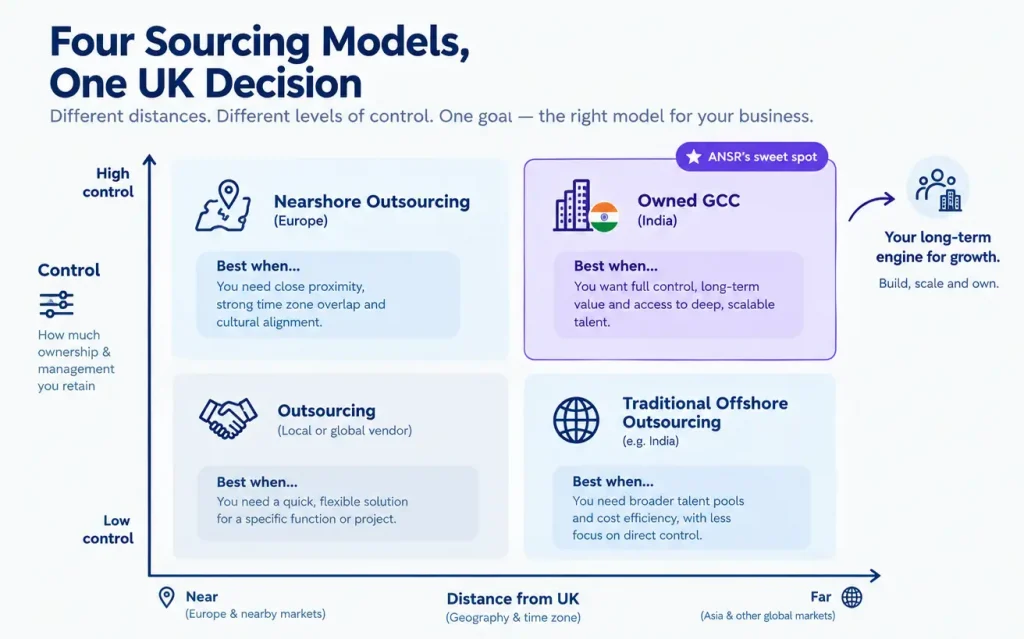
It is common for companies that source globally to confuse offshoring and outsourcing. They are different from each other. Outsourcing refers to the owner or the person in charge of the operation while offshoring deals with the location of the operation. Outsourcing usually requires the employment of a third party in handling talent, delivery, or business processes. Offshoring just requires the relocation of the operation to another country but does not mean loss of ownership or management. Thus, an organization can outsource locally, nearshore through third party providers, or offshore through vendors. Or the organization can offshore while keeping full ownership of the operation through setting up their own GCC.
For instance, a company in the UK can outsource software development either in another company in the same UK or a Polish company or an Indian vendor. Or the company in the UK can set up their own GCC in India and hire talents and control the operation there.
Where does reshoring fit for UK firms?
As global supply dynamics shift, some UK organisations are exploring reshoring and bringing previously offshored or nearshored operations back to the UK. However, the decision is usually driven less by cost and more by security, compliance, and strategic control.
- Regulatory pressure: Financial services face strict FCA requirements, while critical infrastructure must meet evolving cybersecurity and resilience standards.
- Public sector shift: The UK government is increasingly assessing whether major contracts can be delivered more effectively in-house.
- Supply chain resilience: More than half of UK manufacturers are exploring reshoring to reduce exposure to global disruptions.
However, UK tech talent shortages and higher operating costs can make full reshoring difficult. For many scaling businesses, controlled offshore models offer a balance between operational control, resilience, and access to talent.
Which model should a UK firm choose and when?
There is no one-size-fits-all sourcing model. The right decision depends on your firm’s growth stage, capital availability, and tolerance for operational complexity.
|
Strategic Vector |
Nearshore Outsourcing (Europe) |
Traditional Offshore Outsourcing |
Owned Offshore GCC (India) |
Reshoring / Onshore (UK) |
|
Cost Efficiency |
Moderate (CEE rates average $65/hr) |
High (India rates average $37/hr) |
High (Direct labor costs + long-term ROI) |
Low (Premium UK market rates) |
|
Operational Control |
Low to Moderate (Vendor-managed) |
Low (Vendor-managed, high turnover) |
High (Direct hire, brand alignment) |
Absolute (Direct UK employees) |
|
IP & Data Security |
High (GDPR alignment) |
Moderate (Dependent on vendor contract) |
High (Your security protocols & systems) |
Absolute (UK legal jurisdiction) |
|
Scale & Talent Depth |
Limited (Smaller national talent pools) |
Massive (Abundant talent pools) |
Massive (Access to India’s top tier-1 talent) |
Extremely Limited |
To UK firms who have grown beyond traditional outsourcing, a GCC in India that is wholly-owned could provide the company more control and long-term gains. In contrast with traditional outsourcing, which may come with vendor markups, high attrition rates, and limited control, creating a GCC could enable integration and IP protection in addition to cost-effectiveness. For a lot of UK firms, the real challenge has become not to gain offshore talent alone but to develop a strategic extension of the organization.
Ready to build an offshore operation?
ANSR helps businesses establish and scale owned GCCs in India, from initial setup and talent acquisition to operations and long-term growth. Build a dedicated India team with the control, flexibility, and capabilities to grow with your business. Contact Now