
ANSR’s Playbook to De‑Risk GCC Setup End‑to‑End
Across the global enterprise landscape, GCCs have emerged as a core engine enabling enterprises to innovate faster, scale smarter, and optimize costs without compromising on quality. However, despite the potential for long-term value, the path from idea to operational maturity is filled with uncertainties. Missed deadlines, budget overruns, and weak ROI are common obstacles that can undermine even the strongest strategies.
A modern GCC is no longer an offshore extension but a fully integrated part of the enterprise. ANSR’s structured framework transforms a complex, risk-heavy setup into a streamlined transition built on clarity, control, and long-term value.
The Setup Risks That Derail Timelines, Budgets, and ROI
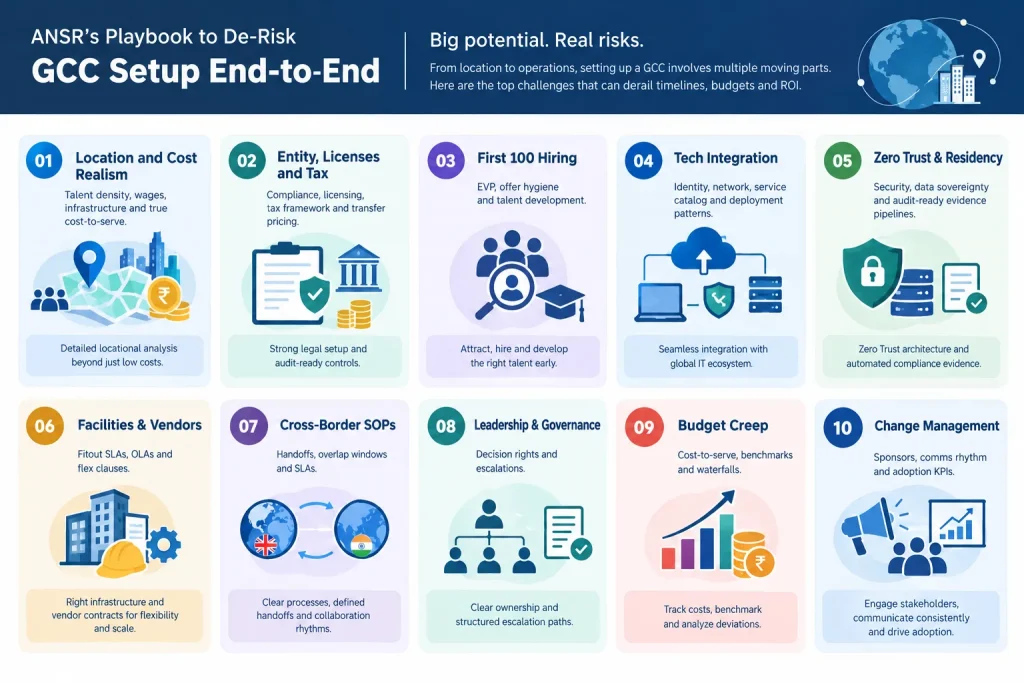
The initial stage of establishing a GCC typically lasts between 12 to 18 months and is a crucial time. A setback in any of the following areas can trigger a chain reaction that significantly undermines the initiative’s success. The advanced enterprise comprehends that these risks are interrelated, necessitating a comprehensive approach to risk mitigation.
Location and Cost Realism: Talent Density, Wages, Infra Signals
The foremost and most significant risk pertains to location selection. A decision made solely based on low operating costs inevitably neglects essential market indicators. The selected city must have a high density of talent, with a sustainable supply of specialized skills such as cloud architecture, AI/ML, and cybersecurity without causing immediate wage inflation.
Establishing a GCC must move beyond simple cost arbitrage. The strategy requires realistic cost models that account for infrastructure stability, quality of life for employees, and the fully loaded Cost-to-Serve, including facilities, IT, and governance overhead. Dependence on broad, outdated market averages is a significant contributor to budget creep in the future. An effective strategy employs proprietary data models to forecast wage growth and attrition trends, thereby ensuring long-term financial sustainability.
Add: The importance of detailed locational analysis – what is the average salary benchmark for the required roles, cost of real estate, ecosystem and competitors in the area, governmental incentives and various regulatory policies.
Entity, Licenses, and Tax: Policy Ops and Audit-Ready Controls
Engaging in operations within a new geographical area exposes the business to intricate local compliance requirements and international tax regulations. The associated risk is the potential for future non-compliance. It is highly essential to establish the legal entity, obtain the required licenses, and develop the tax framework with an audit-ready approach from the very beginning.
The operational model must incorporate clear, documented intercompany agreements (ICAs), strong transfer pricing policies, and controls that can endure examination from both local and parent-country auditors. Any error in this process could lead to financial penalties and reputational harm that far exceed the initial costs of setup.
First 100 Hiring: EVP Launch, Offer Hygiene, and Academies
The initial hires, referred to as the “First 100,” serve as the cultural and technical bedrock of the GCC. The risk is a slow, low-quality talent acquisition process that is driven by an unengaging narrative. The strategy should encompass a carefully planned Employee Value Proposition (EVP) Launch that is customized for the local market, effectively conveying the opportunities for career advancement and the strategic significance of the center.
Ensuring offer hygiene is of utmost importance. A meticulous and standardized offer process is crucial in preventing candidate drop-off and upholding fairness in the market. Additionally, the initiation of targeted academies or training programs is vital for addressing specific skill deficiencies and demonstrating a commitment to talent development, thereby reducing the likelihood of high early attrition rates among highly sought-after candidates.
Tech Integration: Identity, Network, Service Catalog, Patterns
A GCC that cannot seamlessly integrate into the enterprise’s global IT ecosystem becomes an isolated and costly inefficiency. The greatest technical risk is misaligned infrastructure. To avoid this:
- Prioritize effective Identity & Access Management (IAM) to ensure day-one compliant access.
- Establish a secure, low-latency network that can seamlessly support global traffic.
- Maintain a clear service catalogue that aligns GCC capabilities with enterprise IT services.
- Ensure strict adherence to global IT deployment patterns, including standard images and software stacks.
- Recognize that poor integration leads to operational friction and slows value realization.
Zero Trust & Residency: Evidence Pipelines for Audits
Security and regulatory compliance are non-negotiable. With rising scrutiny on data sovereignty, failing to establish a compliant and secure operating posture is a critical risk. The GCC must adopt a Zero Trust architecture, assuming no user or device is inherently trustworthy. Equally important are evidence pipelines automated logs, monitoring, and reporting that continuously prove data residency and control adherence for internal and external audits. Proactive evidence generation is essential to de-risk operations in regulated sectors.
Facilities & Vendors: Fitout SLAs, OLAs, and Flex Clauses
Physical infrastructure and vendor dependencies introduce significant execution risk. A robust plan requires rigid service level agreements (SLA) with the fit-out contractor, clear operational level agreement (OLA) with key vendors such as security, catering, and IT hardware, and flexible lease and vendor contract clauses that enable rapid scaling based on hiring velocity. Together, these safeguards prevent underutilized assets, avoid delays, and eliminate space constraints.
Cross-Border SOPs: Handoffs, Overlap Windows, SLAs
Operational risk peaks during transitions between the parent company and the GCC. Without explicit cross-border SOPs, quality and consistency inevitably suffer. To make this work seamlessly, the operating model must be anchored in clarity, consistency, and well-defined collaboration rhythms.
- Define precise handoffs that clearly outline what transitions, when they occur, and how they should be executed.
- Establish overlap windows that enable real-time collaboration between teams.
- Set clear service SLAs that quantify delivery expectations and performance standards.
Leadership & Governance: Decision Rights and Escalations
Lack of clarity within the chain of command stalls progress. Governance misalignment is one of the fastest ways to derail a GCC. The setup phase must clearly define decision rights specifying which stakeholders approve budgets, hiring, architecture changes, and escalations supported by a documented escalation framework that outlines thresholds, responsible owners, and review bodies. Together, these elements enable swift, conflict-free issue resolution and help maintain operational momentum.
Budget Creep: Cost-to-Serve, Benchmarks, Waterfalls
Even with an optimized location strategy, long-term financial health can erode due to cost-escalation risks. Controls must include a robust Cost-to-Serve model that captures true operating expenses, regular benchmarking against peer GCCs to validate efficiency, and detailed cost-waterfall analyses that trace deviations back to their root causes. Together, these mechanisms preserve financial discipline and ensure full transparency.
Change Management: Sponsors, Comms Rhythm, Adoption KPIs
The most underestimated risk is internal resistance. If a GCC changes workflows, ownership, and expectations without structured change management, the shift will face friction. A mature plan requires influential global sponsors who actively advocate for the GCC, supported by a consistent communication rhythm through regular updates, town halls, and leadership messaging. It must also include clear adoption of KPIs that track the actual transition of work and measure stakeholder satisfaction. Together, these elements ensure the GCC is embraced not resisted by the global organization.
By proactively managing these ten risk dimensions through a structured, data-backed, and people centered approach, enterprises can move beyond simply setting up a GCC. They can enable a high-certainty, high-value transition that positions the center as a true engine of global transformation.