
India vs Poland for Your Offshore Centre: A UK Decision Matrix
Choosing a UK-based Nearshore/Offshore center in India or Poland really boils down to three key priorities – cost efficiency, time zone alignment and scale of talent. Poland offers 1 to 2 hours’ time difference and EU regulatory compliance, while India provides niche workforce and operational arbitrage.
Nearshore vs Offshore: What’s the Difference for a UK Company?
The distinction between nearshore vs offshore is defined by three primary friction points: travel time, time zone overlap, and regulatory alignment. For a UK-based company, Poland represents the premier nearshore option. Located just a two-hour flight from London, it offers a business trip experience comparable to domestic travel.
In contrast, India is the classic offshore destination. While the flight is longer, India offers a different strategic profile, often characterized by significantly lower cost floors and a follow-the-sun workflow that enables 24-hour development cycles. While other offshore destinations such as the Philippines or Mexico offer niche advantages, the scale of India’s IT workforce makes it the primary comparison point for any enterprise-grade nearshore operation in Poland.
Why do UK Companies Consider Poland for a Nearshore Centre?
The business case for a nearshore Poland center is built on the principles of low-friction collaboration. Currently, 57% of Polish service centers have UK companies as their primary clients, which demonstrates the infrastructure created for the UK. Key drivers for Poland it outsourcing include:
- Time-zone and Proximity: Poland is only an hour ahead of the UK (CET vs GMT) so we have a full eight-hour overlap in our workday. This is great for teams that need ongoing synchronous collaboration or pair programming.
- Regulatory Ease: Being a member of the EU, Poland is fully subject to GDPR. The UK-EU adequacy decision makes transfers easier without additional Standard Contractual Clauses (SCCs) for UK firms handling EU resident data, as data remain under EU jurisdiction by default.
- Cultural and Communication Fit: Poland is the 13th best english-speaking country in the world. The direct style of communication and common European business standards reduce the management overhead often occurring in more remote locations.
However, Poland software development faces a growing cost and scale ceiling. Senior engineering salaries in tech hubs like Warsaw and Krakow have risen sharply, often reaching £50,000 – £85,000, a figure that is converging with some UK remote rates.
Why do UK Companies Consider India for an Offshore Centre?
When UK firms look toward India outsourcing, they are typically prioritizing scale, specialization, and long-term cost-to-capability. India’s IT workforce, exceeding 5.4 million professionals, is roughly 12 times the size of Poland’s, allowing for rapid team scaling that is often impossible in smaller markets.
Strategic advantages of the Indian model include:
- Unmatched Talent Depth: India produces 2.5 million STEM graduates annually. This creates a senior engineering bench that is deep enough to support highly specialized roles in AI, machine learning, and cloud architecture at a volume Poland cannot match.
- Economic Advantage: On a like-for-like basis, senior engineers in India cost 40–60% less than their Polish counterparts. A mid-level IT professional in India typically earns £21000–£34000 annually, compared to £38000–£60000. in Poland.
- GCC Maturity: India has pioneered the Global Capability Center (GCC) model. Centers for giants like SAP and Bosch handle up to 40% of global product engineering from India, moving far beyond simple body shopping into high-value R&D.
India vs Poland: How do they Compare Across Cost, Talent, Time Zone, and Scale?
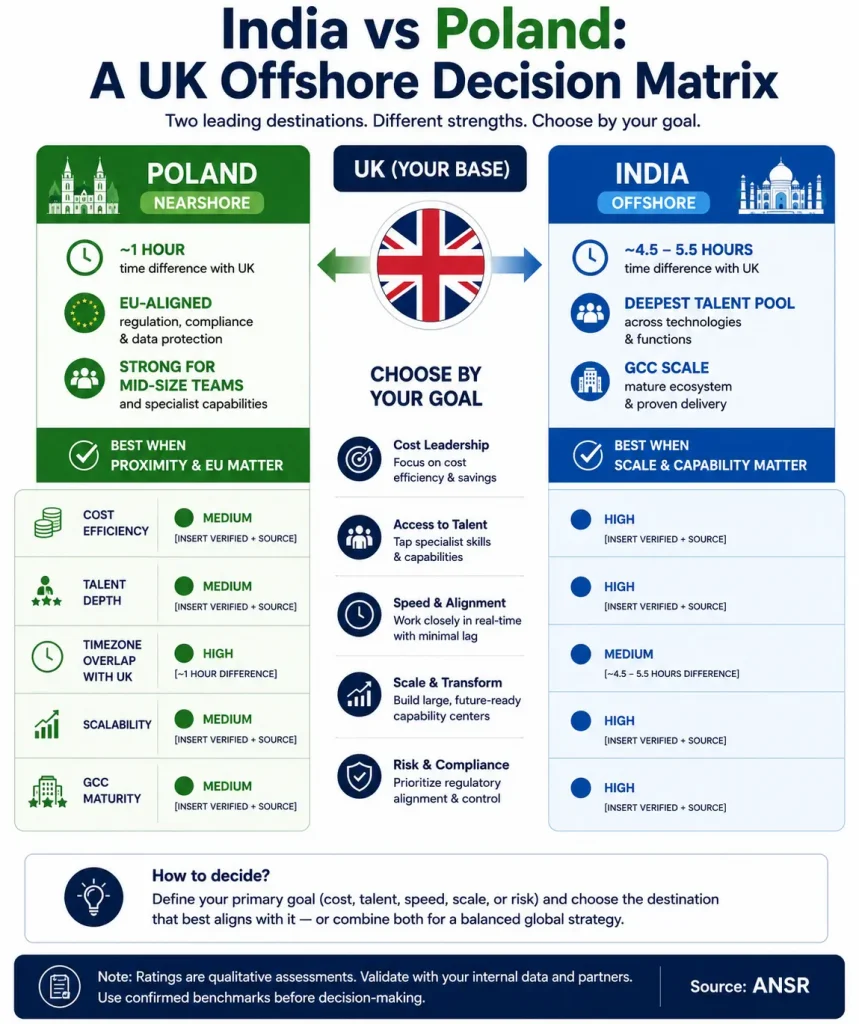
When making a direct India vs Poland comparison, the choice depends on which performance metric the UK company prioritizes most.
Which is Better for Scale?
India is the definitive leader for scale. While Poland’s 600,000 developers are excellent for building boutique teams of 5–20 specialists, India’s talent pool allows for the creation of massive engineering hubs. For projects requiring a sudden ramp-up such as moving from 4 to 12 developers in a single quarter. India’s ecosystem provides a much higher probability of success.
Which is Better for Time Zone Overlap?
Poland offers the most seamless overlap. The one-hour difference allows for real-time Slack conversations and same-day code reviews throughout the entire UK business day. However, India provides a manageable 4.5–5.5 hours of overlap with the UK. Many UK firms now leverage this 5.5-hour gap as an advantage. A UK product manager can define requirements by the end of their day, the Indian team builds overnight, and the code is ready for review the following morning.
Which is Better for Cost-to-Capability?
India offers a superior ROI for long-term capability building. For a 500-employee center, a GCC in India can generate over £235M in savings over five years compared to an equivalent setup in Western Europe. While Poland remains more cost-effective than the UK, the annualized gap for a single senior engineer can reach £30,000–£40,000. For companies building a product over a 12+ month timeline, these savings compound into significant additional runway.
Which Destination Should your UK Company Choose?
The decision between these two top-tier locations should be guided by the project’s endgame.
- The company requires GDPR compliance by default within the EU framework.
- The project requires intensive, daily pair programming and constant synchronous communication.
- The company is building an MVP with a volatile spec where real-time pivots are more valuable than cost savings.
If you choose India:
- The company is looking to scale and develop a large multi-functional engineering center that can grow.
- The company’s roadmap, focused on AI and data, needs access to one of the largest pools of machine learning specialists in the world.
- The company plans to leverage the GCC maturity model to transform its offshore center into a global innovation hub.
Ultimately, for UK companies looking beyond short-term fixes, India + the GCC model is increasingly viewed as the strategic endgame for building high-performing, cost-efficient, and future-proof technology organizations.