
How UK Enterprises Use Build-Operate-Transfer to Set Up in India
The BOT model is the most sought-after approach to enter the Indian market for UK enterprises planning to set up a Global Capability Center (GCC). This is because the approach helps the companies build a sustainable footprint and minimize entry complexities in the market. Companies can leverage the local expertise and partner with an expert to build and run the GCC in its initial stage.
What does Build-Operate-Transfer mean for a UK Firm?
In comparison, the Build-Operate-Transfer (BOT) method is more of a systematic ownership transfer model rather than an outsourcing model. The BOT model starts off with a risk-sharing strategy whereby the UK company takes charge of establishing the strategic framework, vision, process models, and business objectives while its seasoned partner from India takes charge of building the GCC, recruiting people, and governing the operations.
Once the GCC is operational and mature, the ownership will be transferred back to the organization together with everything it entails. This way, the organization gains full ownership of a mature, culture-aligned, and ready-to-enterprise GCC that it can use without involving the outsourcer anymore unlike in traditional outsourcing model.
BOT vs Captive vs Outsourcing: Which Fits a UK Enterprise?
Choosing the right model depends on the strategic intent and internal readiness of the UK firm.
- Build-Operate-Transfer: It is best for mid-market UK firms or those entering India for the first time. It provides a turnkey operation that eventually grants the enterprise the same control and IP ownership as a captive setup but with a much faster, lower-risk ramp-up.
- Outsourcing: Best for non-core, peripheral functions where the firm never intends to own the IP or the team. However, this leads to perpetual vendor dependence.
- Captive Setup (Greenfield): Ideal for large UK MNCs with existing Indian experience and a high tolerance for upfront risk and capex. It offers maximum control from day one but is slower to launch.
How Long Does a Build-Operate-Transfer Engagement Take?
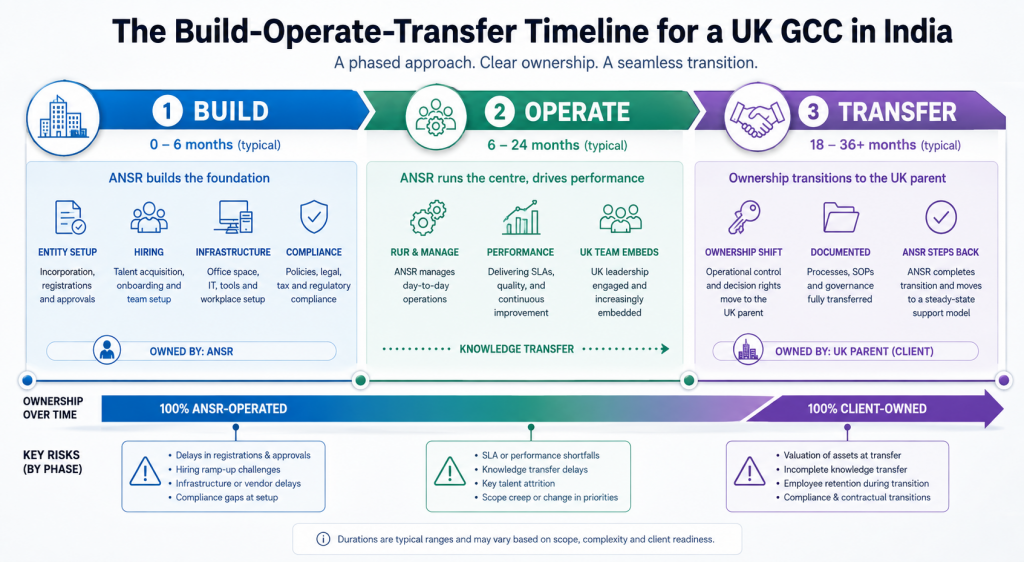
A standard build-operate-transfer engagement lasts between three and five years from start to finish. Typically, the timeline is separated into three different stages:
- Build Phase (6–9 Months): The partner secures office space, establishes the legal framework, and hires the foundational leadership team. In fast-track engineering scenarios, the first teams can often begin work within 90 days.
- Operate Phase (2–4 Years): This is the longest phase, where the partner manages payroll, compliance, and day-to-day operations while the team matures against headquarters’ KPIs.
- Transfer Phase (3–6 Months): The final stage involves the legal migration of assets, employee contracts, and IP from the partner to the UK firm’s newly registered Indian entity.
By utilizing the build-operate-transfer model, UK enterprises can navigate the corridor with confidence, ensuring they build a strategic asset in India that is ready for long-term global impact.