
Building Successful GCCs: Foundations and the Shift Up the Value Chain
Summary
Successful GCCs require clarity, integration, and strategic evolution – not just cost arbitrage
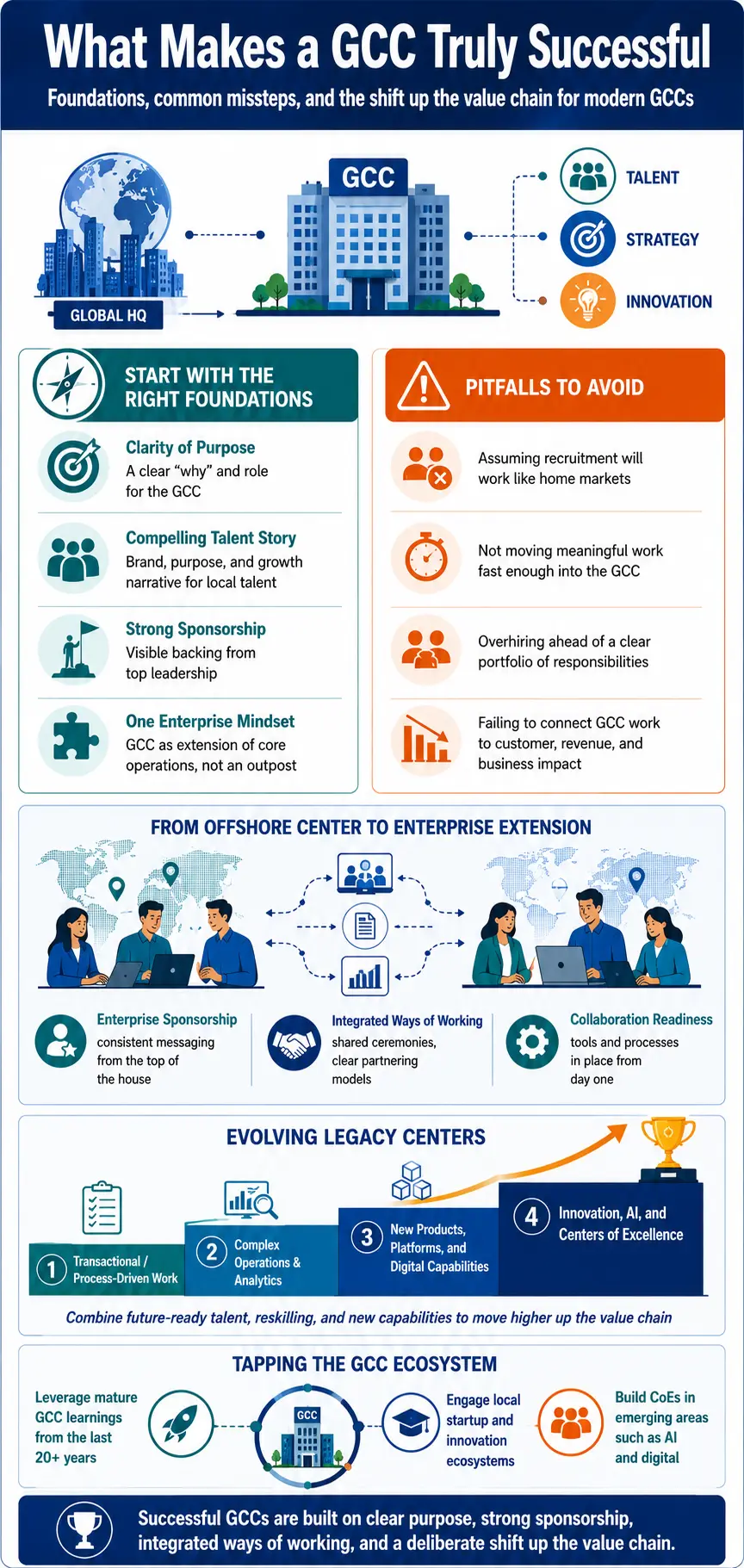
Foundation starts with a clear “why” and compelling talent story; underinvesting in employer brand and local market presence leads to talent attraction failures in competitive hubs.
Common missteps include misaligned hiring (too fast or too slow relative to work transfer) and failing to connect GCC work to customer impact, reducing the center to a task factory.
Enterprise-level sponsorship and true integration – shared tools, processes, and “one team” mindset – are non-negotiable; GCCs must be extensions, not outposts.
Legacy centers are shifting up the value chain by building CoEs in AI, data, and cloud, sourcing future-ready talent, and exporting innovation back to the parent enterprise.
Recommendation: Treat your GCC as a strategic ecosystem node from day one—invest in brand, align work transfer with hiring velocity, secure top-level sponsorship, and build capabilities that drive enterprise-wide innovation, not just delivery efficiency.
Foundations every successful GCC needs
A clear “why” and compelling talent story
Successful GCCs start with absolute clarity on why they are entering a market and what the center is expected to be. That clarity then translates into a compelling talent story: who the company is, what it stands for, and why the GCC matters in the wider enterprise.
This requires building the employer brand from day one-not assuming talent can be recruited the same way as in the home market. The most effective GCCs articulate purpose, values, and impact: how work done in the center contributes back to the parent organization and to the end customer, not just to a local job description.
Brand building as a non‑negotiable
A common misstep is underestimating the need to build brand visibility in the local ecosystem. In highly competitive talent markets, companies that do not proactively tell their story-purpose, values, growth opportunities, and the strategic role of the center-struggle to attract and retain the right people.
In contrast, stronger players treat brand as a foundational capability: they invest early in market presence, community engagement, and narrative clarity so that candidates understand they are joining an enterprise platform, not a generic offshore shop.
Avoiding early missteps in setup and scale
Moving work too slowly – or hiring too fast
Several predictable missteps recur across GCC journeys. One is not moving work into the center fast enough. When meaningful workloads are delayed, early hires become underutilized, momentum is lost, and organizational confidence in the GCC erodes.
The opposite problem is overhiring ahead of clearly defined work. Bringing in talent faster than the portfolio of responsibilities matures creates frustration, attrition, and reputational damage in the local market. Getting the sequencing right-aligning ramp-up of work and people-is decisive in the first 12-18 months.
Failing to connect work to impact
Another common failure is not clearly communicating how GCC work connects to end customers, business outcomes, profitability, or revenue. When teams cannot see the impact of their contributions, the center risks being perceived as a task factory rather than a strategic node.
Leading organizations address this by framing roles and projects in terms of business outcomes and by making impact visible: how a release improved customer experience, how an analytics product changed decisions, or how a new capability opened a market.
Sponsorship and integration: treating GCCs as extensions, not outposts
Enterprise sponsorship from the “top of the house”
High-performing GCCs are backed by strong sponsorship at the very top. Senior leaders consistently reinforce that the GCC is part of the enterprise fabric, not an experiment on the side. Messaging is cascaded across functions so that teams globally understand why the center exists and how they are expected to partner with it.
This sponsorship is reinforced in behavior: leaders show up, listen, unblock, and hold their teams accountable for integrating the GCC into everyday ways of working. It is not enough to sign off on a business case; the enterprise must visibly stand behind the center.
Integration, collaboration tools, and “one team” mindset
A GCC operates at its best when it is treated as an extension of the company’s operations, with colleagues in another time zone rather than a separate offshore center. That demands deliberate integration from day one: shared ceremonies, aligned processes, and clear partnering models.
Practical enablers include fit‑for‑purpose collaboration tools, transparent operating rhythms, and explicit guidance on how work flows between locations. When global teams know how to engage, who owns what, and how decisions are made, the GCC becomes a natural part of delivery and innovation, not a bolt‑on.
Shifting legacy centers up the value chain
From delivery centers to strategic platforms
Many organizations set up GCCs 10 – 25 years ago primarily as delivery centers. As the GCC model has matured, these legacy centers are now being repositioned to add strategic value comparable to newer, “second‑generation” GCCs.
This shift involves deliberately moving away from only low‑risk, highly documented, transactional work. Instead, organizations bring in a mix of work higher up the value chain – new products, digital platforms, complex operations, and innovation initiatives that materially shape the parent enterprise.
Future‑ready talent and new capabilities
A successful transition depends on future‑ready talent. India and similar GCC hubs offer deep pools of digitally skilled and emerging-tech talent, particularly in areas like AI, data, and cloud. The most advanced centers tap this external pipeline while also reskilling and upskilling existing teams to meet future needs.
Organizations increasingly use the GCC as a platform to build Centers of Excellence (CoEs) in new capabilities, from AI and automation to experience design and platform engineering. These CoEs often originate capabilities locally and then export them back to the parent organization, turning the GCC into a source of innovation for the entire enterprise.
Leveraging the ecosystem and accumulated GCC experience
With roughly two decades of sustained GCC growth and thousands of centers in operation globally, there is now a large body of experience to learn from. Companies can avoid early pitfalls by adopting proven best practices – around brand, sponsorship, work design, and talent – and by engaging with the local startup and innovation ecosystem surrounding GCC hubs.
The most advanced enterprises view the GCC not just as a cost-efficient delivery location but as a strategic ecosystem node. They actively connect with startups, universities, and partners; they bring in new capabilities via CoEs; and they design the center to both consume and generate innovation that benefits the wider organization.