
Why Setting Up a GCC in the USA is the New Expansion Play
Summary
US GCCs have evolved from cost-saving outposts to strategic hubs for AI and digital sovereignty.
Tap unmatched ecosystems: Access specialized talent and robust R&D infrastructure in the world’s leading tech corridors.
Eliminate latency: Leverage time zone alignment to accelerate product development and ensure real-time, cross-cultural collaboration.
Secure intellectual property: Simplify regulatory compliance and safeguard data privacy within a mature, heavily regulated digital landscape.
Mitigate entry barriers: Bypass high operational costs and fierce competition by executing a targeted, region-first expansion strategy.
Recommendation: Audit your current global footprint and pilot a specialized, region-first US GCC to accelerate high-value capability building and secure market leadership.
The Global Capability Center (GCC) narrative was synonymous with offshoring moving back-office functions to emerging economies to capitalize on labor arbitrage. However, the tide is shifting. As enterprises prioritize digital sovereignty, AI-driven innovation, and market proximity, the USA has emerged as the premier destination for a new set of high-value centers. The GCC America model has moved beyond cost arbitrage to prioritize strategic capability building in the world’s most influential economy.
The Rise of the GCC America Model
The traditional GCC framework is evolving from a service-delivery engine into a global innovation hub model. Historically, a company headquartered in Europe or Asia would look toward the East to scale. Today, global enterprises are flipping the script by establishing GCCs within the United States to tap into the epicentre of the fourth industrial revolution This shift stems from a growing realization that global capability does not always mean remote. In an era where AI, Quantum Computing, and Cybersecurity increasingly determine market leadership, a physical presence in the North American tech corridor has become a strategic advantage. The GCC America model enables organizations to combine the agility of a startup with the institutional stability and market access of the US.
Why Firms Search for a “GCC Near Me” in the US
The Firms in US are increasingly searching for “GCC near me” because they want to balance out the niche talent, cost arbitrage without the time zone disparities or cross-cultural barriers associated with the traditional offshoring. While India remains a dominant hub for GCCs, organizations are increasingly adopting nearshore models in regions like LATAM and emerging tier-2 hubs to improve collaboration, agility, and speed of execution.
Several factors indicate a shift towards nearshore GCC models in 2026. Enterprises are prioritizing on pivotal impact over cost arbitrage, transforming GCCs into internal innovation hubs that drives AI, R&D and analytics while maintaining full ownership over intellectual property (IP) & security. Nearshore locations like Mexico for US, provide efficiency such as:
- Time zone alignment
- Better cross-cultural affinity
- Faster collaboration with the HQ
This enables quicker product development and time-to market. Enterprises are also using these models to de-risk operations through geographic diversification, standardize global processes across acquired entities, and scale specialized talent more efficiently in response to changing market demands.
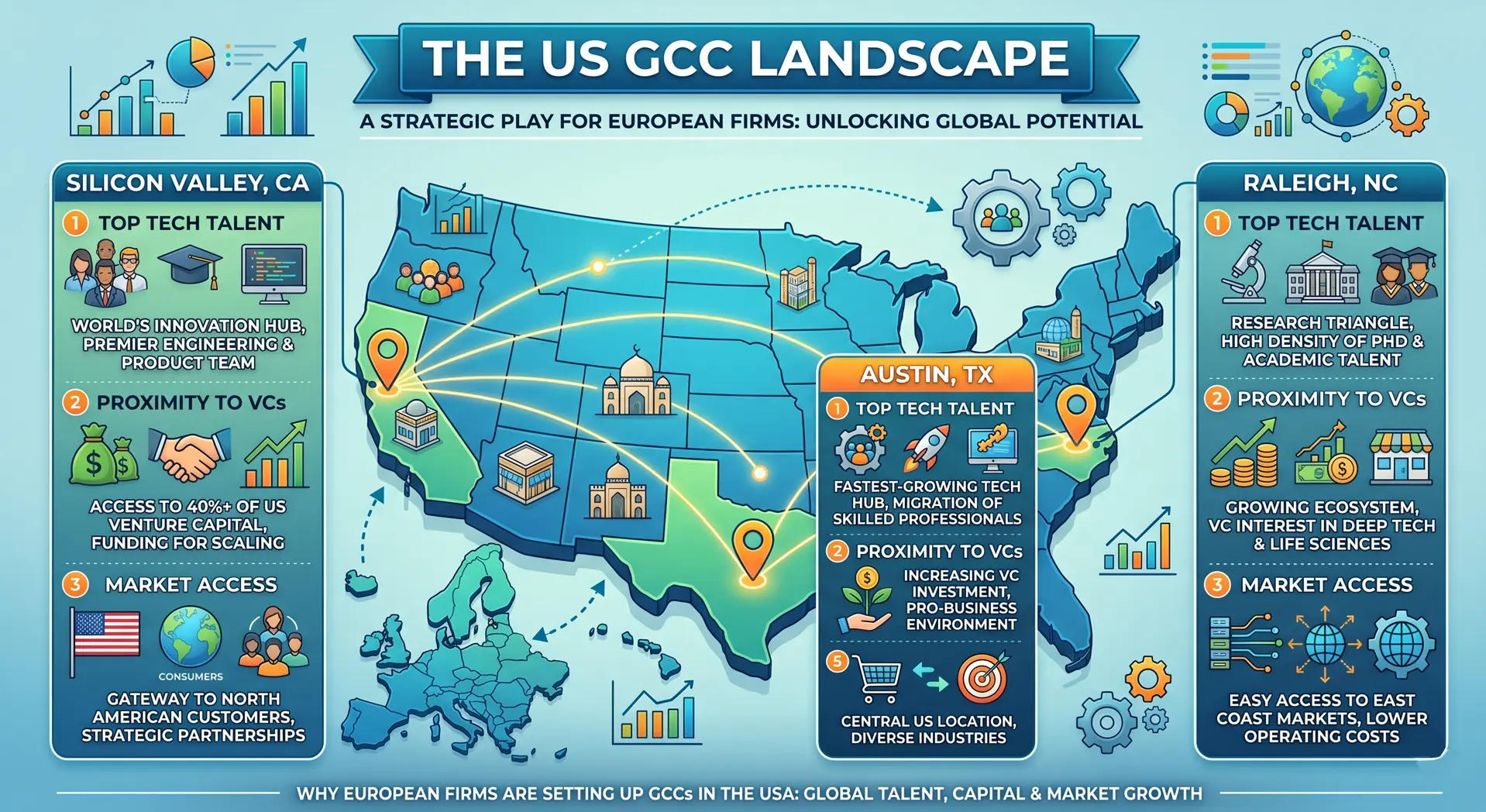
Key Advantages of a GCC USA Setup
Setting up a Global Capability Center (GCC) in the USA offers unique advantage, moving beyond traditional cost-saving models toward high-value innovation.
Unmatched Tech Ecosystems
The USA remains the global epicentre for disruptive technology. It accounts for over 64% of global venture capital funding, hosts more than half of the world’s unicorn startups, and leads global R&D spend with over $780 billion invested annually in innovation-driven sectors. A GCC here provides direct access to the world’s most advanced innovation hubs, such as Silicon Valley, the Research Triangle, and Austin.
- Talent Density: Access a specialized workforce skilled in cutting-edge fields like Generative AI, quantum computing, and advanced biotech.
- Collaborative R&D: Proximity to top-tier research universities and venture-backed startups facilitates co-innovation and rapid prototyping that is difficult to replicate elsewhere.
- Infrastructure: Benefit from a mature digital landscape, including robust cybersecurity frameworks and world-class cloud availability.
Proximity to North American Markets
Locating a GCC in the USA eliminates the logistical and cultural friction often found in offshore models.
- Zero Latency Collaboration: Operating in the same (or similar) time zones as headquarters allows for real-time decision-making and seamless integration into agile workflows.
- Customer Centricity: Being physically close to a primary consumer base enables the GCC to gather direct market insights, leading to faster product localization and improved user experience.
- Regulatory Alignment: A US-based setup simplifies compliance with domestic data privacy laws and intellectual property protections, reducing legal complexity for the parent organization.
Overcoming US Market Entry Barriers
Entering the US market in 2026 demands that companies deal with a complicated regulatory environment, significant operational expenses, and fierce competition, rendering a local-first approach crucial. Rather than attempting to enter all 50 states at once, companies should adopt a region-first strategy prioritizing high-impact markets while proactively addressing regulatory requirements such as entity structuring, tax compliance, and potential federal reviews in sensitive sectors.
Enterprises must also account for higher employment and cost arbitrage by appointing regional incentives, adopting phased expansion strategies, and building resilient local supply chains. Equally critical is bridging cultural and market gaps through localized offerings, direct communication, and partnerships with established local players to accelerate market entry and long-term growth.
Final Thoughts
For European firms, establishing a GCC in the USA is no longer just an expansion tactic but a commitment to innovation, market relevance, and long-term growth. By embedding themselves in the world’s most dynamic tech ecosystem, organizations can accelerate capability building, stay closer to customers, and future-proof their global operations in an increasingly competitive landscape.