
Establishing a Digital Technologies Hub for Rapid Change
Technology cycles are getting shorter and less predictable. Since new frameworks and tech are launched more frequently now than ever before, companies need to adapt more quickly. To help with this, many organizations are constructing a digital technologies hub.
These hubs centralize engineering know-how and speed up acceleration. They also support global product development. In fact, over 85% of firms expect accelerated adoption to help transform their ops in the near future.
The Challenge of a 6-Month Tech Lifecycle
With tech stacks evolving rapidly, the success of new languages and frameworks can rise or fall quickly. This leads to challenges for engineering teams. Their skills may quickly become outdated, leading to unforeseen hurdles. So, companies must update their capabilities regularly. Common issues include:
- Rapid changes in development frameworks
- Increasing demand for specialized technical skills
- Difficulty maintaining consistent development standards
- Pressure to deliver products faster
Due to these constant fluctuations, firms are more likely to rely on digital tech hubs. Such centres can help teams learn about and experiment with new technologies, further leading to their implementation.
What Makes a Digital Technologies Hub Truly Agile?
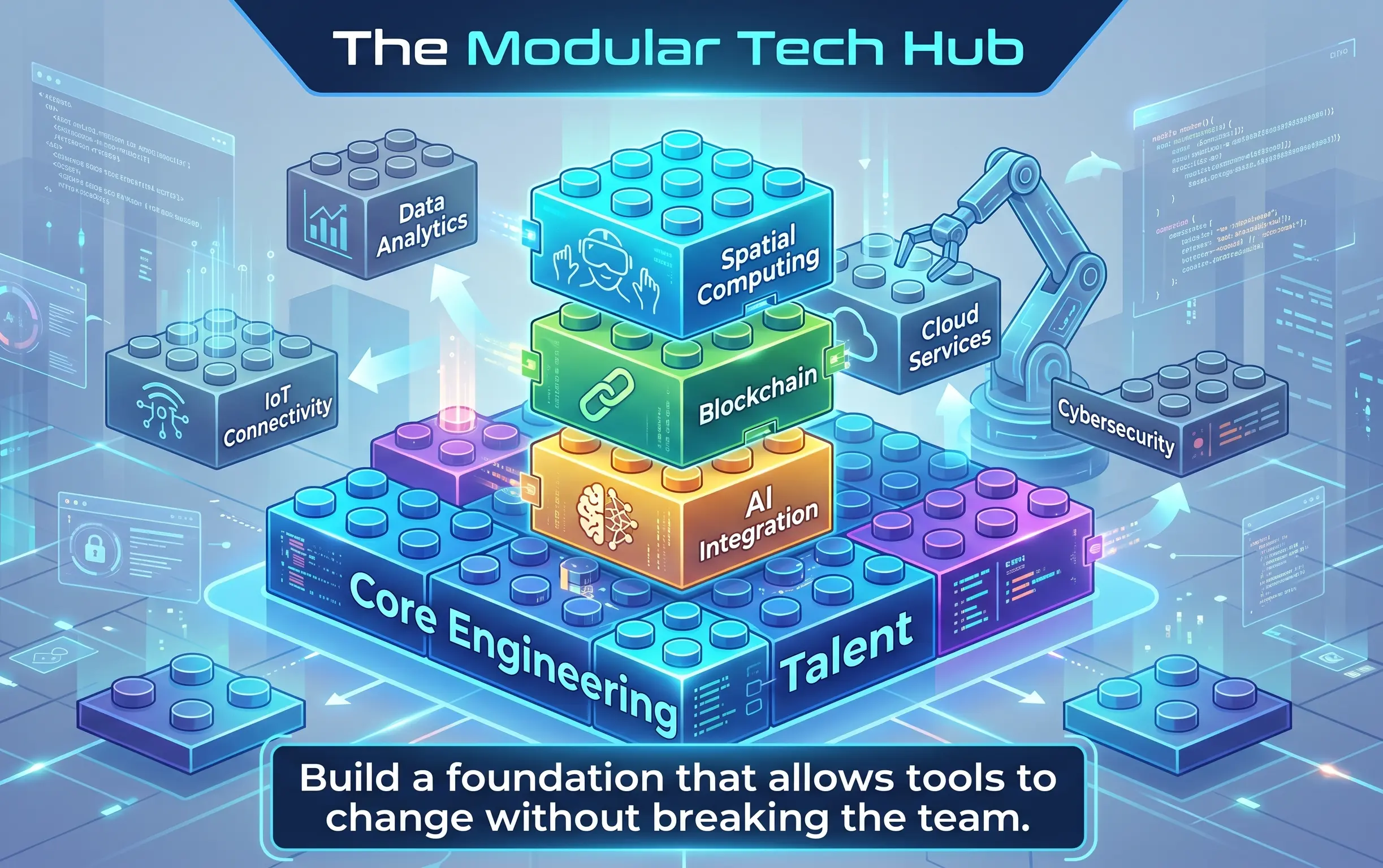
A digital technologies hub is designed to support fast-moving engineering environments. These hubs focus on adaptability, collaboration, and continuous learning. Agile technology hubs typically prioritize:
- Cross-functional engineering teams
- Rapid experimentation and iteration
- Continuous skill development
- Shared platforms and development standards
When structured efficiently together, these practices help enterprises accelerate product development while maintaining flexibility in their technology strategy.
Framework for Building an Adaptable Hub
Building an adaptable digital technologies hub requires both talent strategy and technology architecture. Companies must create teams that can learn quickly and an infrastructure that supports rapid experimentation. Two foundational elements usually drive adaptability:
- Hiring engineers with strong problem-solving and system design skills
- Implementing modular technology architectures that allow components to evolve independently
These principles help engineering teams adapt as technologies and frameworks change.
Hiring for Core Logic vs. Niche Syntax
Rapid technology change makes it difficult to hire for specific frameworks alone. Instead, many companies prioritize engineers with strong core programming fundamentals. These professionals can adapt to new tools more easily and transition across technology stacks. Hiring strategies often emphasize:
- Strong problem-solving and algorithmic thinking
- Deep understanding of system architecture
- Ability to learn new frameworks quickly
- Experience with multiple programming paradigms
This approach helps organizations maintain engineering flexibility as technologies evolve.
Implementing Modular Technology Stacks
Modular technology architectures allow systems to evolve without disrupting the entire platform. This flexibility is critical in fast-changing technology environments.
Many organizations adopt modular or microservices-based architectures to support adaptability. Key benefits include:
- Independent deployment of system components
- Faster experimentation and feature development
- Reduced risk during technology upgrades
- Improved scalability across engineering teams
Microservices architectures allow enterprises to update individual services without affecting the entire system.
Sustaining Innovation in Offshore Engineering
Offshore engineering hubs are increasingly becoming centers of innovation rather than just delivery units. They support product development, platform engineering, and emerging technology initiatives. Organizations sustain innovation by focusing on:
- Continuous learning and upskilling programs
- Collaborative global engineering teams
- Access to diverse talent pools
- Strong digital infrastructure and development platforms
These capabilities help offshore hubs support long-term digital transformation initiatives.
Building a digital technologies hub helps organizations keep up with rapidly changing technology cycles. By focusing on adaptable talent and flexible technology architectures, companies can continue innovating while scaling their engineering operations. But staying agile requires more than the right tools.
Teams need to keep learning, collaborate across global locations, and experiment with new technologies as they emerge. ANSR helps enterprises build and scale digital technology hubs that support faster product development and innovation. Connect with our experts to create an engineering hub designed to adapt and grow with changing technology needs.