India Market Entry: How Foreign Firms Can Launch Successfully
A sound India market entry strategy answers three questions before any legal entity is registered: why India, which route in, and in what order. Most guides assume you want to sell to Indian customers. Many leadership teams we speak with want something different: access to engineering, analytics and operations talent. Both goals are valid, and they lead to different structures. This guide covers both honestly, then explains why the talent-led route has become the one to watch.
What is an India Market Entry Strategy?
An India market entry strategy is a plan built on three decisions: why you are entering India, which route you will use, and in what sequence you will move. Each decision constrains the next. A company that wants Indian customers’ needs distribution, pricing and a local sales motion. A company that wants Indian talent needs an entity, a hiring plan and a delivery model. Choosing a structure before settling the purpose is how companies end up with the wrong one.
The split matters from the start. Entering to sell means taking a product or service to Indian buyers, through exports, partners or a local subsidiary. Entering to build means establishing capability in India, such as engineering, analytics, finance or operations teams that serve your global business, often through a global capability centre (GCC). Most advice treats India as a market of consumers. Increasingly, boards treat it as a base of talent. The sections below cover both, and the roadmap works for either.
Is India the Right Business Opportunity for you?
Three signals tend to drive the answer: market momentum, talent depth, and policy direction.
- Momentum: The IMF’s April 2026 World Economic Outlook projects India’s growth at 6.5% in both 2026 and 2027, which keeps it the fastest-growing major economy. The same outlook ranks India sixth by nominal GDP, so the base is already large.
- Talent: ANSR’s Emerging Cities: India’s Next Frontier for GCC Expansion Report 2026 assesses 14 emerging cities and finds more than 220 GCC units already operating there, with GCC job openings up 42%, against 19% in established metro hubs. On the candidate side, our survey of 2,000 tech professionals, What Talent Wants 2026 found that GCCs are the first choice for the next career move for 69% of respondents, and that 71% want hands-on AI to work rather than training alone. Talent is available, but it is selective.
- Policy: In March 2026 India eased its Press Note 3 rules on investment linked to land-border countries (DPIIT Press Note 2, 2026 series), which matters mainly to investors with beneficial ownership in those countries. On trade, the India–UK Comprehensive Economic and Trade Agreement, signed on 24 July 2025, entered into force on 15 July 2026, together with a social security convention designed to avoid double contributions for employees on temporary assignments.
India is not right for every company. Regulatory complexity, regional variation and competition for senior talent are real costs. The India business opportunity is strongest when your objective, selling or building, matches what India does best, and when you can commit to the medium term.
India Entry Strategy Options: Which Route Fits?
There are six practical routes. They differ in how much control you get, how fast you can start, what they cost to run, and what they allow you to do.
Exporting, Distributors and Agents
The lightest route: sell from abroad or appoint a local distributor or agent. You need no Indian entity and can test demand quickly. The trade-offs are limited control over the customer relationship, shared margin, and no local team. It suits companies validating demand before committing capital.
Liaison, Branch or Project Office
These are extensions of the foreign company, not separate legal entities, and they need permission under India’s foreign exchange rules, with the Reserve Bank of India (RBI) or an authorized dealer bank involved depending on the case. A liaison office can represent the parent and gather information but cannot carry out commercial activity or earn income. A branch office can undertake specified activities, such as import and export, consultancy or representing the parent, but is not a route into manufacturing or retail trading. A project office exists to deliver a specific contract. Because permitted activities are narrow and rules change, confirm current RBI conditions before choosing this route.
Wholly-owned Subsidiary Subsidiary
An Indian private limited company held by the foreign parent. Most sectors allow 100% foreign ownership under the automatic route. It is a separate legal entity with limited liability, can employ staff, invoice, contract and bank locally, and is the base for most operating businesses. Registration mechanics are covered in our guide to registering a legal entity in India.
Joint Venture or Strategic Partnership
Pairing with an Indian partner can speed up distribution, licensing or access in sectors where local knowledge matters. The cost is shared by control. Governance, decision rights, intellectual property and exit terms need to be settled in the agreement up front, and sector-specific foreign investment caps still apply.
EOR as a Low-risk First Step
An employer of record (EOR) hires and pays staff on your behalf under its own Indian entity, so you can start a team without registering a company. It is fast and reversible, which suits a pilot or a small team. It becomes less efficient as headcount, intellectual property, and operational complexity grow. See how an employer of record works.
GCC: Entering India for Talent
A global capability centre is your own India-based team delivering engineering, analytics, finance, HR or operations work for the global business. For companies whose goal is capability rather than Indian revenue, it is the route that most directly turns India’s talent pool into a long-term advantage. Companies build GCCs themselves or with a partner that handles setup, hiring and operations. Setup steps are in our guide to setting up a GCC in India.
India Market Entry Roadmap: Six Practical Steps
Whichever route you choose, the sequence is similar. Timeframes below are indicative and run in parallel in practice.
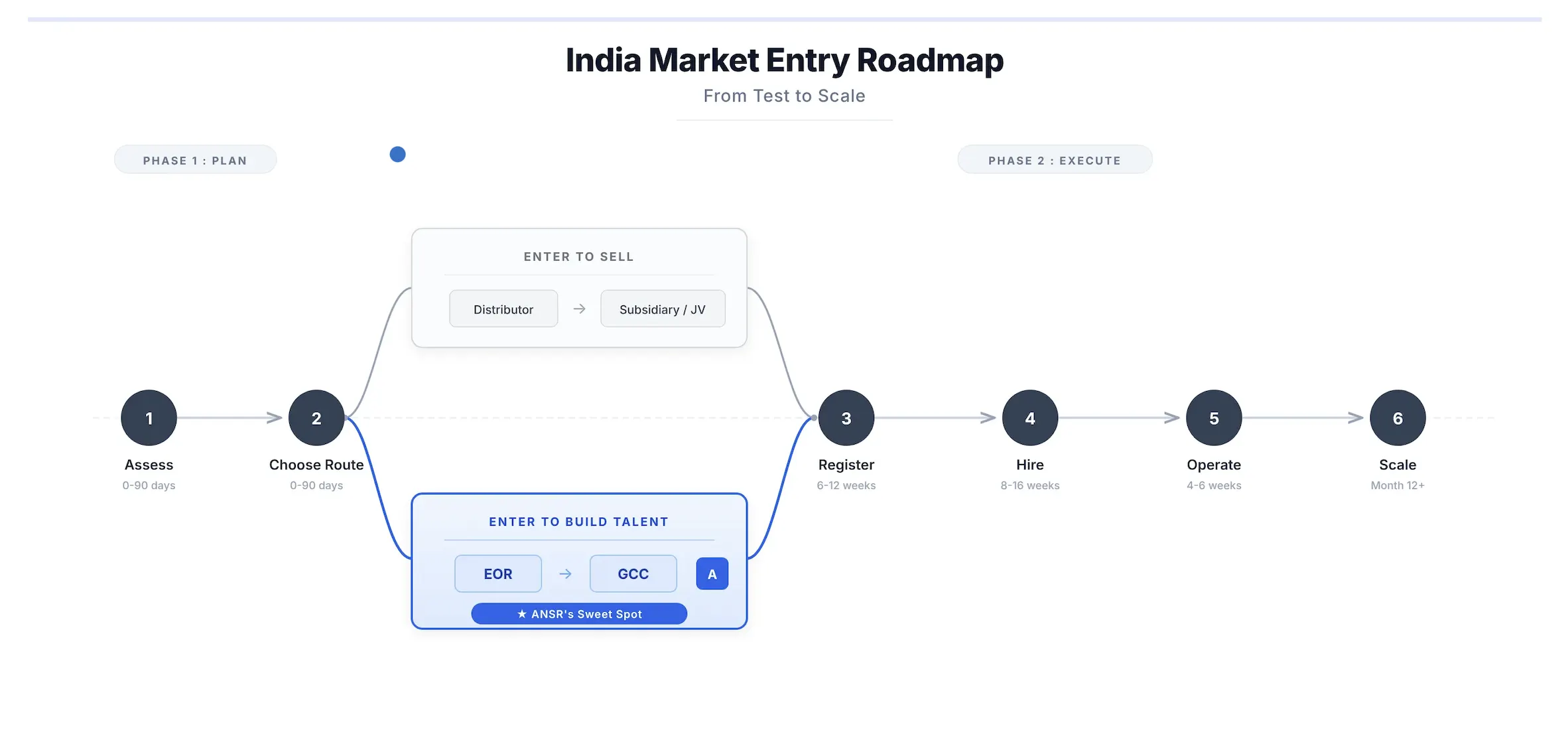
Assess the market and your reason for entering
Decide whether you are selling or building and test the business case against the market and talent data above.
Indicative timeframe | Within Phase 1 (first 90 days) |
Key output | A board-ready case that names the objective, target cities or segments and success measures. |
Choose the entry route and structure
Match the route to the objective using the table above, then settle ownership, funding and a first tax and legal review.
Indicative timeframe | Within Phase 1 (first 90 days) |
Key output | a structure paper covering route, entity type, ownership, funding and risks |
Register, bank and get tax-ready
Incorporation itself is quick, but everything around it is not. Advisers’ published estimates put incorporation at roughly 10–15 working days after filing, apostille of foreign documents at about 3–10 working days in the US, UK and EU, and bank account opening at around 20–25 days or longer for foreign-owned companies. Published end-to-end estimates range from about six to twelve weeks.
Key output | An incorporated entity with PAN, TAN, bank account, relevant tax registrations and FEMA reporting in place. |
More details are in the entity registration guide.
Hire Leadership and the First Team
Appoint the India headfirst, then the first hires who will shape culture and hiring. Competition for senior talent is real, so start searching while the entity is being registered.
Indicative timeframe | 8 to 16 weeks. |
Key output | A leadership team and a first cohort with a clear hiring plan. |
Set up Operations and Compliance
Put payroll, provident fund and insurance registrations, office space, IT, policies and a compliance calendar in place.
Indicative timeframe | 4 to 6 weeks.
|
Key output | A working operation that can pass an audit. |
See also our guide to building an offshore business in India.
Scale, then Review the Structure
Once the team is productive, grow it deliberately and revisit the structure. An EOR pilot may move into an entity, a partner-built centre may transfer to your ownership, and transfer pricing and governance may need updating.
Indicative timeframe | BOT transfer decision around month 12. |
Key output | A scale plan and a documented structure decision. |
Doing Business with India: Rules, Tax and Culture to Get Right
FDI Rules and Press Note 3
Most sectors allow 100% foreign direct investment under the automatic route, so no prior government approval is needed. Some sectors have caps or conditions. Investments where the investor or beneficial owner is from a country sharing a land border with India (Afghanistan, Bangladesh, Bhutan, China, Myanmar, Nepal and Pakistan) have needed government approval under Press Note 3. The March 2026 amendment allows certain non-controlling investments of up to 10% from such countries under the automatic route and sets a 60-day target for some manufacturing sectors, but approval remains the general rule.
Tax and Transfer Pricing
An Indian subsidiary is taxed in India as a domestic company, while a branch is taxed as a foreign company, and the difference affects your choice of structure. Transactions between the Indian entity and the parent must follow arm’s-length pricing and be documented. Rates and thresholds change with each Finance Act, so take local tax advice on the current position instead of relying on a published figure.
Labour Law and Business Culture
India’s four labour codes took effect on 21 November 2025, consolidating 29 central laws. The central rules were notified on 8 May 2026, but because labour is a concurrent subject, states must frame their own rules, so the position still varies by state. Confirm the status in the state where you will hire. On culture, relationships usually come before transactions, so expect more meetings and trust-building than you may be used to. Decision-making can sit higher in the hierarchy than titles suggest, and India is regionally diverse: language, work norms and talent markets differ between Bengaluru, Hyderabad, Pune, Chennai and Delhi NCR. Treat each city as its own market.
Common India market entry mistakes
- Treating incorporation as readiness: An entity in two weeks is not an operating business. Plan separately for banking, registrations, hiring, and compliance.
- Choose the route on upfront cost alone: The cheapest start can be the costliest to unwind. Pick the route that matches your three-year objective, then check the cost.
- Underestimating banking and apostille delays: Foreign-owned entities often wait longest here. Prepare and apostille documents before filing.
- Hiring the leader last: A team without an India head drift. Begin the leadership search alongside registration.
- Never revisit the structure: What suits a pilot rarely suits 200 people. Schedule a structure review for about 12 months.
FAQs
How long does it take to set up a company in India?
Incorporation typically takes around two to three weeks once documents are ready. Advisers’ published estimates for a foreign-owned company to be fully operational, with bank accounts and registrations, range from about six to twelve weeks. Apostille and bank onboarding are the usual bottlenecks.
Can a foreign company own 100% of an Indian company?
In most sectors, yes. The automatic route allows 100% foreign ownership without prior approval. Some sectors have caps or conditions, and investments linked to land-border countries face additional rules under Press Note 3.
What is the cheapest way to enter the Indian market?
Exporting through a distributor or using an employer of record usually has the lowest upfront cost, since neither needs an Indian entity. The cheapest start is not always the cheapest over three years, so compare total cost against your objective.