
How to Pick a GCC Operating Model in 30 Days
Summary
For UK mid-market businesses, building a Global Capability Center (GCC) requires moving beyond simple cost-cutting to create a scalable, compliant, and strategic global operation.
Here is the strategic playbook for evaluating and selecting your Global Business Services (GBS) model in a single month:
-
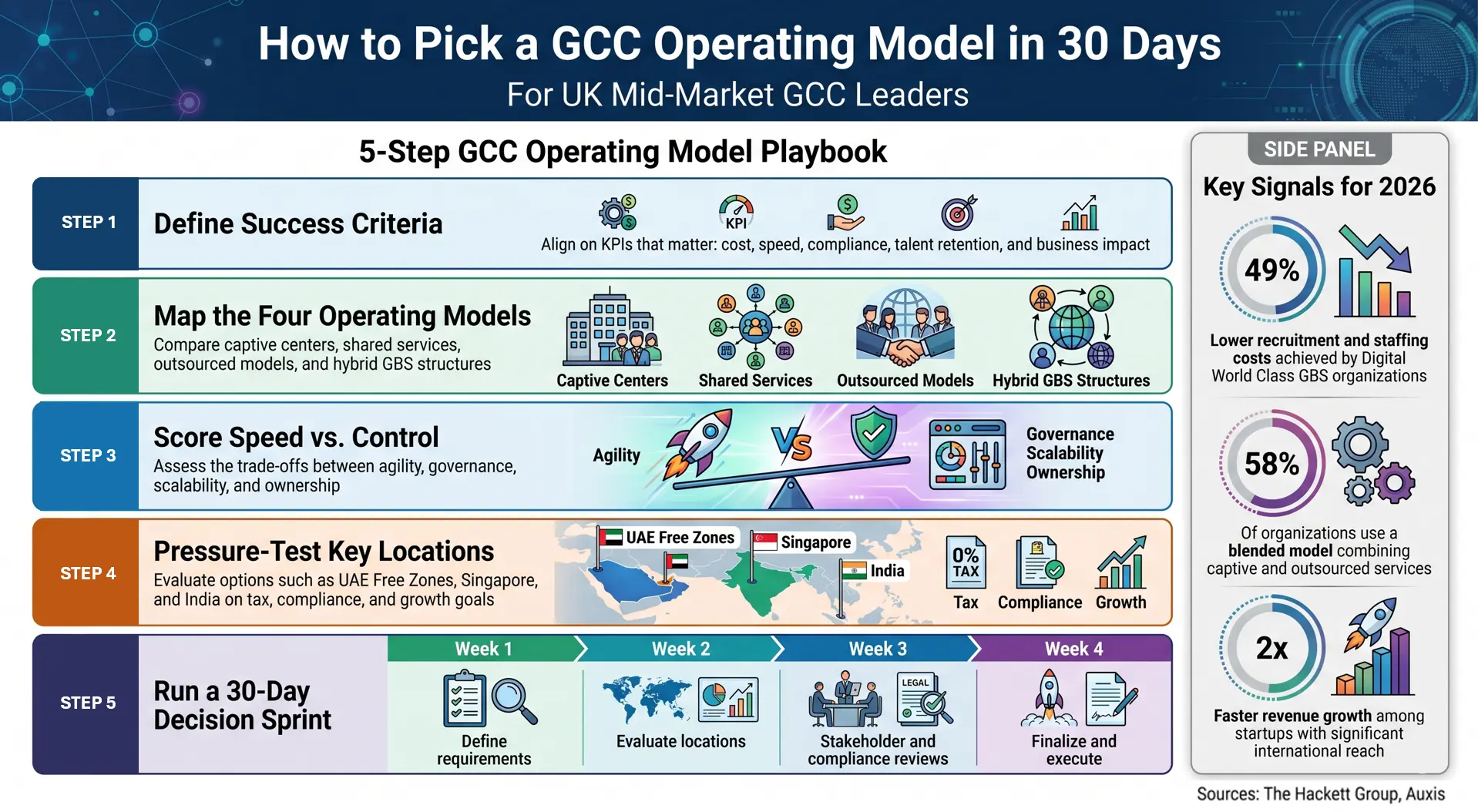
Define Strategic Success Metrics: Move past isolated cost metrics. Top-performing organizations target enterprise outcomes like a 20–40% reduction in cost per transaction, faster M&A integration, employee NPS, and strict compliance (HMRC/GDPR).
-
Select the Right Operating Model: 58% of companies now use a Hybrid approach, but your choice depends on your priorities:
1. Captive Center: Best for protecting sensitive IP and strategic functions.
2. Shared Services: Best for process consistency and efficiency.
3. Outsourced: Best for accessing specialized talent quickly.
4. Hybrid GBS: Best for balancing control, agility, and cost across multiple functions. -
Leverage Speed and Control: Modern GCCs allow you to retain ownership of your IP and governance. Setup in mature markets like India now takes just 4 to 6 months. Build-Operate-Transfer (BOT) frameworks can accelerate operational delivery even further.
-
Pressure-Test Offshore Locations:
-
UAE: Offers 0% corporate tax (on qualifying income), 100% foreign ownership, and fast 3–7 day incorporation.
-
Singapore: Highly credible, offers prime Asian market access, and rapid 1–2 day setup, though costs are higher.
-
India: The global leader for deep talent pools, engineering scale, and a mature GCC ecosystem for long-term growth.
-
-
Execute a 30-Day Decision Sprint: Don’t let evaluation paralysis delay growth.
-
Week 1: Define tax, banking, and infrastructure needs.
-
Week 2: Evaluate jurisdictions against your specific requirements.
-
Week 3: Align stakeholders and conduct compliance reviews.
-
Week 4: Complete incorporation and finalize strategic partnerships
-
Currency volatility, post-Brexit compliance requirements, and AI-driven competition for talent are all pushing leaders to rethink how they set up and run support functions. For UK businesses with revenues between £10 and £500 million, the issue is not just building a Global Capability Center.
It is about making sure the model can scale smoothly, stay compliant across markets, and keep delivering strategic value as the organization grows. That requires clear success metrics, a sensible operating model, effective global payroll services, resilient teams, and a disciplined approach to implementing change. This practical playbook to set up scalable, resilient GCC operations can help.
How Should You Define Your Success Criteria?
Top-performing organizations tie the success of Global Business Services (GBS) directly to measurable enterprise outcomes rather than isolated cost metrics. Industry insights show Digital World Class GBS organizations achieve 49% lower recruitment and staffing process costs by developing people and skills more efficiently.
Global organizations can start by aligning on three to five KPIs that reflect strategic priorities: cost per transaction (targeting 20% to 40% reduction), process cycle time, lower error rates, employee NPS for internal customers, and business impact metrics such as faster M&A integration or market entry speed.
For UK mid-market companies, it is crucial to integrate compliance adherence, like HMRC and GDPR. They must also plan for scalability early on for European expansion. Bringing in global payroll services early can act like a litmus test. Effective global payroll supports talent retention and improves cash flow visibility across jurisdictions.
An efficient way to measure success is through factors that provide a clear view of total rewards. Some examples include 99%+ on-time payments, fewer compliance penalties, and integrated HR systems. The next step is to benchmark against peers using maturity assessments from firms such as third-party firms. Test these criteria through a weighted scorecard before selecting an operating model or vendor. This helps prevent scope creep and increases the likelihood of achieving ROI within 18 to 24 months.
Why Is It Important to Map the Four Operating Models?
Hybrid models now dominate as the sharpest path to balancing control, cost, and speed for mid-market firms scaling global teams. According to recent industry research, 58% of organizations use a blended model that combines captive and outsourced services. Around 75% of organizations run multifunctional, multi-country shared services with GBS as the preferred framework.
For organizations navigating GCC operating model selection in 2026, the key is understanding each approach’s pros and cons:
|
Operating Model |
Best For |
Watch Out For |
|
Captive Center |
Handling sensitive data, IP, or strategic functions |
Higher costs and longer time to value |
|
Centralized Shared Services |
Consistency and process efficiency |
Potential lack of flexibility and innovation |
|
Outsourced or Managed Services |
Scaling quickly or accessing specialist expertise |
Vendor dependency and governance risks |
|
Hybrid Global Business Services Model |
Balancing cost, control, and agility across multiple functions |
Greater management and coordination complexity |
How Should You Score Speed vs. Control?
Global Capability Centers provide organizations with greater control over critical functions than traditional outsourcing models. Instead of relying on third-party vendors, companies retain ownership of their intellectual property, processes, and strategic capabilities. This creates stronger governance, faster decision-making, and closer alignment with business objectives. It also enables organizations to build dedicated talent teams and adapt more quickly to changing business needs.
This control is a big advantage. And it comes with impressive speed. For many companies, it takes 4 to 6 months to set up a GCC in India. That’s a lot faster than the 12 to 18 months it used to take. Some companies even start earlier with Build-Operate-Transfer models. They can usually expect delivery times that are two-to-three times faster and operational performance that is 30 to 50% better. Agile teams embedded in the company are often the reason for these gains.
GCCs offer a different option without needing vendor contracts. Instead, they offer control and the ability to scale. One executive at Hitachi Energy, for example, said they were able to scale to 1,000 projects with the talent pool in India, while providing close supervision. A GCC often requires a higher upfront investment than traditional outsourcing. However, it can deliver greater long-term value through stronger governance, deeper institutional knowledge, and enhanced innovation capabilities. By retaining control over critical functions and talent, organizations can reduce strategic risk and build a more scalable foundation for sustainable growth.
Why Is It Important to Pressure-Test GCC Locations Before Choosing One?
The UAE is often considered one of the best countries to set up an offshore company along with Singapore and India. A closer look can expose clear gains and trade-offs. First, UAE free zones offer 0% corporate tax on qualifying income. Additionally, it promises 100% foreign ownership and incorporation in 3 to 7 days. The UAE is, thus, outpacing many traditional havens while maintaining strong banking access.
Second, Singapore provides high credibility and a 17% corporate rate (often reduced via exemptions). It also offers fast setup (1 to 2 days) and excellent Asian market access. However, its higher costs and stricter requirements can be a drawback for businesses focused outside Asia.
Third, India remains one of the world’s leading GCC destinations, offering deep talent pools across technology, finance, engineering, and operations. While setup timelines may be longer than pure offshore jurisdictions, India provides scale, specialized skills, and a mature GCC ecosystem that supports long-term growth.
How Should You Run a 30-Day Decision Sprint?
Many leaders spend weeks evaluating jurisdictions before making a decision. However, prolonged delays can slow expansion efforts and postpone growth opportunities. Research indicates that startups with significant international reach achieve revenue growth rates approximately twice as high as those without it. The key is to balance thorough evaluation with timely execution.
Remote-first companies that make incorporation decisions quickly gain a significant advantage. In a typical 30-day sprint, the first week is spent defining tax, banking, and substance requirements. The second focuses on evaluating jurisdictions such as UAE Free Zones, Singapore, and India. The third is dedicated to stakeholder alignment and compliance reviews, while the final week is used to complete incorporation requirements.
This structured approach accelerates decision-making, reduces delays, and helps organizations establish a foundation for global growth.
Start by identifying the factors that matter most to your business. These may include talent availability, regulatory requirements, operating costs, customer proximity, or long-term scalability. Then evaluate how well each jurisdiction supports those priorities. A structured assessment can help organizations make faster, more informed location decisions and avoid costly course corrections later.
To get started, get in touch with experts at ANSR. We help enterprises evaluate jurisdictions, align location strategies with business goals, and build scalable GCC operations that support long-term growth.