
Build-Operate-Transfer vs Captive Setup: A 2026 Comparison
Summary
-
When establishing a Global Capability Center (GCC), organizations typically choose between a Build-Operate-Transfer (BOT) model or a fully Captive Setup.
-
Captive Setup: This model grants the enterprise immediate ownership and direct control over operations and intellectual property from the very beginning. While it is ideal for organizations with strict strategic requirements, it requires higher upfront investments and a longer setup time.
-
BOT Model: In this approach, a partner builds and runs the center for an initial period before transferring ownership back to the enterprise. This model requires a lower initial capital commitment, provides established local execution support, and allows for a faster launch.
-
Both models ultimately lead to long-term ownership.
-
The best choice depends on business priorities: a BOT model is better for organizations needing fast market entry or lacking GCC experience, whereas a Captive Setup is better suited for companies needing high IP sensitivity and direct ownership from day one.
Establishing a GCC in 2026 involves more than selecting a location with access to talent. Organizations must also determine how the center will be built, governed, and scaled over time. A UK fintech planning to add 300 engineers to its GCC in India, for example, may have already chosen its destination. The more immediate question is often whether to build capabilities independently from day one or work with a partner before assuming ownership later.
Recent global business services research, based on responses from leaders across more than 30 countries, found that over 45% of organizations are prioritizing next-generation capability development over the next three years. For mid-market organizations scaling technology, product, and business operations teams, the BOT vs captive setup in 2026 debate has become increasingly relevant.
The choice often comes down to two models: Build-Operate-Transfer (BOT) or a fully captive setup. Both can lead to long-term ownership, and both have been used successfully by global enterprises. The difference lies in the path taken to get there, the pace of execution, and the trade-offs made along the way.
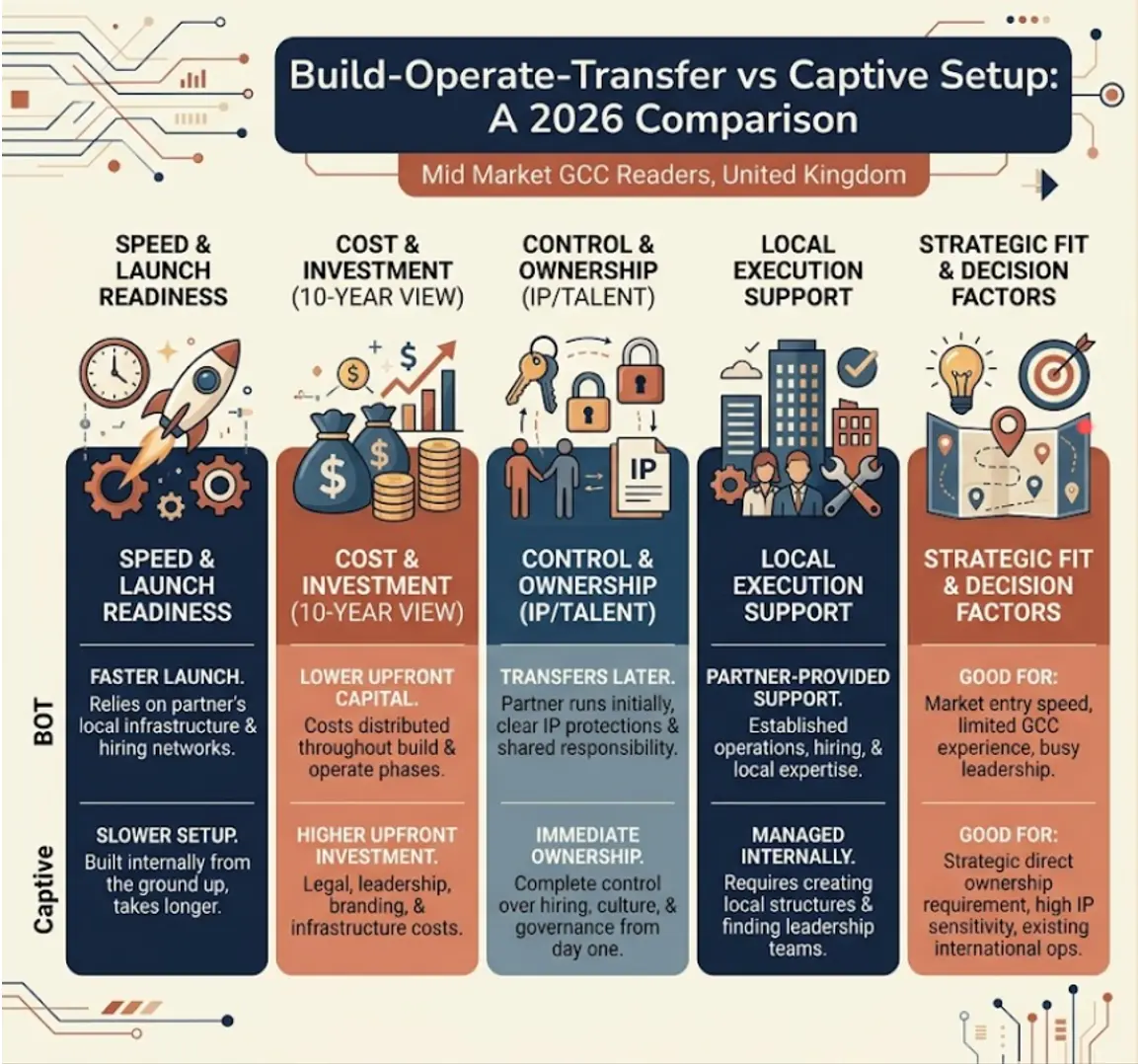
Build-Operate-Transfer vs Captive Setup Models
A captive setup gives enterprise ownership from the outset. The company establishes the entity, recruits’ talent, secures office space, and develops local operating processes. Over the years, this has been a preferred method of dealing with multinational corporations looking for direct control. In contrast, a BOT model allows organizations to rely on a partner during the initial stages before assuming ownership later.
In 1985, Texas Instruments set up one of the first multinational software design centers in India. This is a classic example of a wholly owned enterprise growing into a capability hub.
BOT change the journey and not the destination. A partner builds and runs the center for a set of period of time before transferring ownership to the enterprise.
This difference is important when comparing BOT vs captive setup in 2026, as organizations can begin scaling teams before building all the capabilities themselves.
|
Factor |
BOT Model |
Captive Setup |
|
Ownership |
Transfers to the enterprise after the operating phase |
Immediate enterprise ownership |
|
Speed to launch |
Generally faster |
Typically requires more setup time |
|
Upfront investment |
Lower initial capital commitment |
Higher upfront investment |
|
Local execution support |
Typically provided by the BOT partner |
Managed by the enterprise or its appointed teams |
|
Long-term ownership |
Yes, following the transfer |
Yes, from inception |
Speed Comparison: Time to Operational Impact
Speed is often the clearest point of difference between BOT and captive setups. Consider a UK software company establishing a GCC in India for the first time. Before the first employee joins, decisions around entity registration, tax compliance, payroll, office infrastructure, and recruitment processes must be addressed. These activities are essential, but they can extend timelines and require significant management attention.
A BOT model can shorten the path to operational readiness because the partner typically brings established local infrastructure, hiring networks, and administrative capabilities. This allows recruitment and team ramp-up to begin sooner.
A captive setup usually takes longer because the organization builds these capabilities internally. Leadership teams are responsible for creating local operating structures, hiring key personnel, and establishing governance frameworks from the ground up.
That additional time is not necessarily a drawback. Some organizations value the opportunity to develop local expertise early. The choice is often less about speed alone and more about how the organization prefers to build capability.
Cost Comparison: Looking at a 10-Year Horizon
The first-year budget rarely tells the full story. Captive setups typically require higher upfront expenditure. Legal formation, leadership hiring, employer branding, workplace infrastructure, and support functions create costs long before the operation reaches scale. For a growing company, that can place pressure on capital allocation decisions.
BOT models distribute costs differently. Instead of building every capability internally from day one, organizations pay for operational support during the build and operate phases. Initial spending may appear lower because some investments are spread across the engagement period.
A ten-year view often changes the conversation. Retention rates, productivity levels, leadership stability, and scaling efficiency can have a greater impact on financial outcomes than the original setup model. A captive center that struggles to attract talent may become expensive. Equally, a BOT arrangement with poorly defined transfer terms can create unexpected costs later.
This is why a meaningful GCC comparative assessment should move beyond launch budgets. Long-term value is shaped by execution quality as much as by structure.
Control Comparison: IP, Talent, and Exit
Control remains one of the strongest reasons organizations choose a captive setup.
From the beginning, the enterprise determines hiring standards, governance frameworks, reporting structures, and workplace culture. For companies developing proprietary technology or handling sensitive customer information, direct ownership can provide additional reassurance. Yet control is not always a binary concept.
Most BOT arrangements include clearly defined intellectual property protections and transfer provisions. Strategic decisions remain with the enterprise, even while operational activities are supported by the partner. The distinction often lies in how responsibility is shared during the initial years.
Talent adds another layer. Captive models allow organizations to build their employer brand immediately. BOT models may reduce early hiring challenges but introduce a transfer phase that requires careful planning.
Much of the BOT vs captive setup in 2026 discussion centers on when ownership and control become fully operational.
When to Pick Which model: BOT or Captive
The choice that’s right for the enterprise usually reflects business priorities rather than industry trends.
A BOT model deserves consideration when:
- Market entry speed is important
- Internal GCC experience is limited
- Leadership capacity is focused elsewhere
A captive setup is more suitable when:
- Direct ownership is a strategic requirement
- IP sensitivity is particularly high
- The organization already operates internationally
Many mid-market organizations find themselves somewhere between these positions. The decision often comes down to balancing speed, risk, investment, and operational readiness. With more than 210+ GCCs set up in India, ANSR’s expert teams can help you decide on the approach for your GCC keeping long-term business strategy in mind. Contact us today to evaluate operating models, assess expansion readiness, and set up your GCC.