
What Is Build-Own-Transfer and How Does It Differ From BOT?
Build-own-transfer is a delivery model in which a partner builds an asset or entity, owns it for a set term, then transfers ownership to the client. The ownership question is what separates it from build-operate-transfer, and it shapes risk, cost and control for any team setting up a global capability center (GCC).
What is Build-Own-Transfer?
Build-own-transfer describes an arrangement where a partner builds an asset or entity, legally owns it for an agreed term, and then hands ownership to the client. During the term the partner holds the asset, carries the setup risk and recovers its investment. At the end, the client takes over under pre-agreed transfer terms.
In practice, the phrase is often shorthand for build-own-operate-transfer (BOOT), where the partner also runs the asset while it owns it. The two are used interchangeably in many contracts and RFPs, so check the definitions clause before assuming which one is meant. The World Bank’s PPP Legal Resource Center is the standard reference for the formal infrastructure definitions of these models.
Where the term comes from
The model comes from infrastructure public-private partnerships (PPPs), such as toll roads and power plants. The private party finances, builds and owns the asset, runs it for a concession period to recover its cost, and then transfers it to the public authority. Technology companies have borrowed the structure, and the vocabulary, to describe how they set up entities and teams in new countries.
Build-Own-Transfer vs Build-Operate-Transfer: What’s the difference?
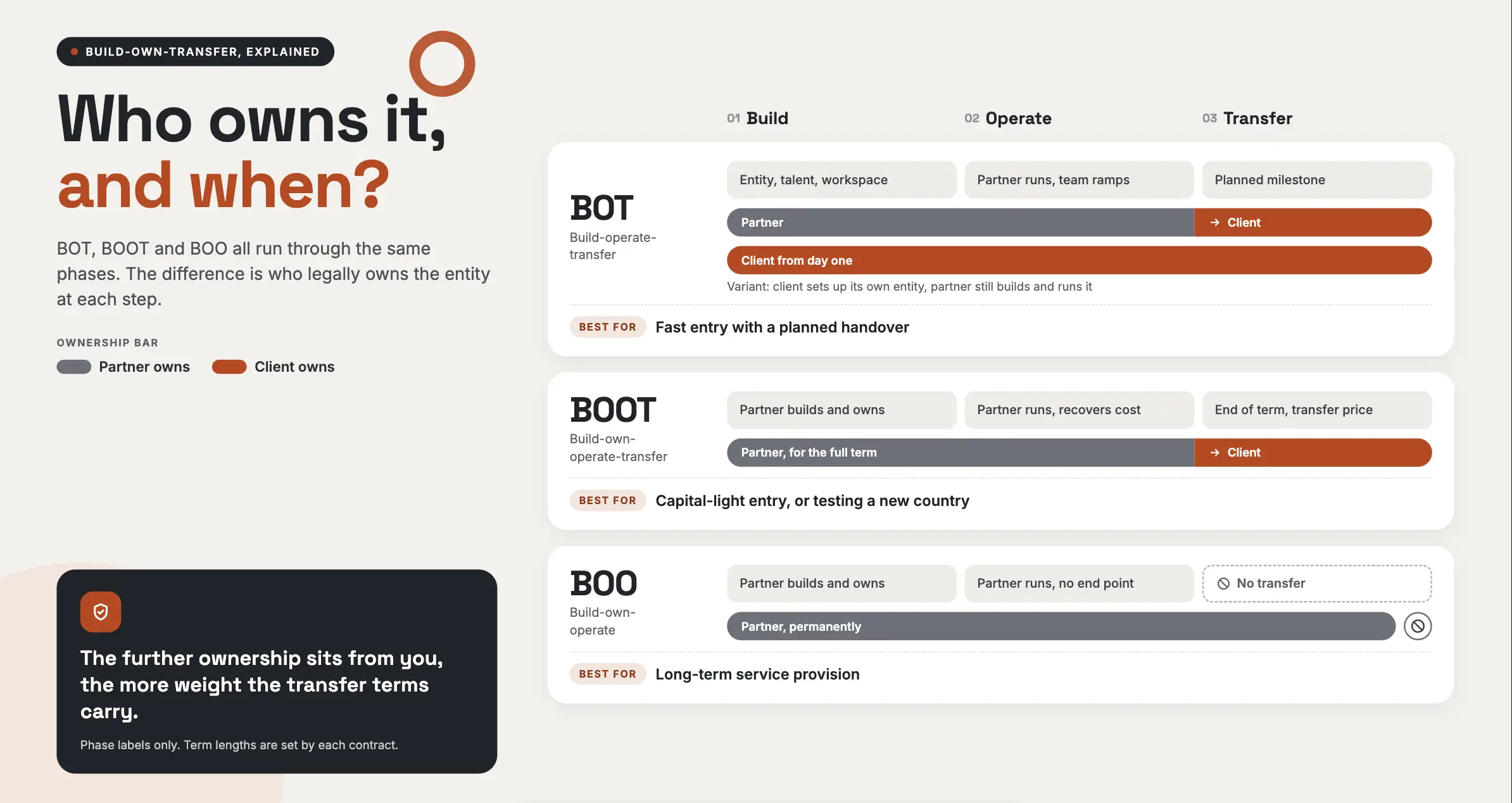
The difference is ownership timing. In build-operate-transfer (BOT), the partner builds and runs the operation, and the client takes over at a planned milestone. Ownership may sit with the client from day one, or with the partner only until that milestone. In BOOT, the partner legally owns the asset for the whole term. In build-own-operate (BOO), ownership never transfers.
|
BOT |
BOOT |
BOO |
Direct build |
|
|
Legal owner during the term |
Client from day one, or partner until a set milestone |
Partner for the full term |
Partner, permanently |
Client |
|
Who operates |
Partner |
Partner |
Partner |
Client |
|
Typical term |
Set by contract |
Set by contract, usually the longest |
No end point |
Not applicable |
|
Transfer trigger |
Planned milestone |
End of term, often with a transfer price |
None |
None needed |
|
Typical use |
Fast entry with a planned handover |
Capital-light entry or infrastructure PPPs |
Long-term service provision |
Large, IP-heavy or regulated operations |
|
Risk to the client |
Transfer readiness and continuity |
Transfer price, valuation and a longer dependency on the partner |
Permanent dependency |
Setup effort and time to first hire |
The practical point is simple: the further ownership sits from you, the more weight the transfer terms carry. A partner-owned model can lower your upfront commitment, but you are relying on the contract to bring the entity, people and IP back to you cleanly. Outsourcing and staff augmentation sit at the other end of the spectrum. They offer little control over the team and the work, and they need constant management effort from your side, which is why they are not true routes to owning a capability.
How do these Models apply to Tech Teams and GCCs?
Tech leaders rarely use the infrastructure labels literally, but the same questions come up in every GCC setup: who holds the legal entity, who employs the people, who owns the IP, and when does control pass to you? Mapping the acronyms onto those questions makes the options easier to compare.
Build-operate-transfer for a GCC
In a GCC context, the three phases work like this:
- Build: The partner sets up the entity, hires the talent and prepares the workspace.
- Operate: The partner runs day-to-day operations while the team ramps up against your goals.
- Transfer: The entity, team and operations move to you in a planned handover.
For a full walkthrough of each phase, see our guide to the build-operate-transfer model.
When does a Partner-Owned (BOOT-style) Setup make sense?
A partner-owned structure can suit you when:
- You are testing a new country before committing to a full presence.
- Your own entity setup is still pending.
- You want a capital-light entry.
The trade-off is that you pay for the partner’s ownership for longer, and the transfer terms matter far more. Price, timing and employee continuity all need to be settled up front.
When should you set up your own entity from day one?
Owning the entity from the start is usually the better fit when:
- Your target headcount is large.
- The work is IP-heavy.
- You handle regulated data.
In these cases, keeping legal ownership in-house removes a transfer risk. Our guides on how to register a legal entity in India and the legal entity overview cover what that involves.
How do you choose between BOT, BOOT and building it yourself?
Work through five questions:
- Time to first hire: How soon do you need people in seat? A partner with an existing entity is typically faster than a fresh registration.
- Capital appetite: How much do you want to commit before the model is proven? A partner-owned model lowers upfront commitment.
- IP sensitivity: How much proprietary work will the team handle? The more sensitive it is, the stronger the case for owning the entity, or for assigning IP to you from day one.
- Three-year headcount: Are you planning a small pilot or a large center? Larger plans favour early ownership.
- In-house expansion experience: Has your team set up a country operation before? If not, a partner-led route reduces the learning curve.
If most answers point to speed and low capital, a BOT or BOOT-style route fits. If they point to scale, IP protection and control, building your own entity from day one is usually the stronger choice.
What should a Build-Own-Transfer Contract Cover?
Because the partner holds something you will eventually own, the contract does the heavy lifting. Make sure it addresses:
- Transfer trigger & price: What event or date starts the transfer, and how the price is set.
- Employee transfer & continuity of service: How people, benefits and operations move without disruption.
- IP assignment from day one: Work product should belong to you from the start, not only at transfer.
- Step-in rights: Your ability to intervene if operations are at risk.
- Exit if the partner underperforms: A clear route out before the planned term ends.
- Asset valuation: An agreed method for valuing assets at transfer.
This is a general checklist, not legal advice. Take legal and tax advice in each jurisdiction before you sign.
How does ANSR help you Build, Own and Transfer a GCC?
ANSR’s build-operate-transfer engagement model covers the full path. ANSR sets up and runs the entity, talent, workspace and operations for your global capability center, then executes a planned transfer to you once the center is ready to run independently. If you are weighing these models for your own GCC, talk to ANSR about which route fits your plans.
FAQs
Is build-own-transfer the same as BOOT?
Often, yes. Build-own-transfer is commonly used as shorthand for build-own-operate-transfer, where the partner builds, owns and runs the asset before transferring it. Contracts differ, so check how the agreement defines who operates the asset and when ownership passes.
What is the difference between BOT and BOO?
In BOT, the partner builds and runs the operation and then hands it over to the client at a planned point. In BOO, the partner builds, owns and operates it with no transfer. BOT leads to client ownership; BOO keeps the partner in control permanently.
How long does a build-operate-transfer term usually last?
There is no single standard. The term is set by contract and depends on setup scope, how quickly the team ramps up and what conditions trigger the transfer. Agree the term, the transfer trigger and the exit options in writing before the engagement starts.
Who employs the team during a BOT engagement?
This depends on the contract. Commonly, the partner employs the team through its entity during the operate phase, and employment moves to the client at transfer. Confirm how benefits, notice periods and continuity of service are handled, and take local legal advice.